Share this post:
Quick summary: How Dubai was built
How Dubai was built is not simply a story of turning empty desert into skyscrapers. Dubai developed around a natural creek, trading communities and coastal settlements before large-scale roads, ports, airports, reclaimed islands and modern property districts transformed the emirate over several generations.
- Dubai’s modern settlement dates to 1833, when members of the Bani Yas tribe led by the Al Maktoum family settled around Dubai Creek.
- Trade came before oil. Fishing, pearling, shipping and commerce helped establish Dubai long before oil was discovered in 1966.
- Major infrastructure accelerated growth. Creek improvements, roads, bridges, Port Rashid, Jebel Ali, Dubai International Airport and later the Metro allowed the city to expand rapidly.
- Most of Dubai is not built on water. The main city occupies natural coastal and desert land, although famous developments such as Palm Jumeirah use reclaimed land.
- Property development became part of a wider economic strategy. Tourism, aviation, logistics, finance, freehold ownership and large master-planned communities all contributed to the modern city investors recognise today.
For property buyers, the important point is that Dubai did not appear overnight. Its present-day property market sits on decades of planned infrastructure, population growth, commercial expansion and the creation of entirely new residential districts.
Trying to understand the Dubai behind today’s property market?
Our team can help you look beyond the skyline and understand how infrastructure, locations and master-planned communities affect a property decision.
How Dubai was built: the story started around Dubai Creek
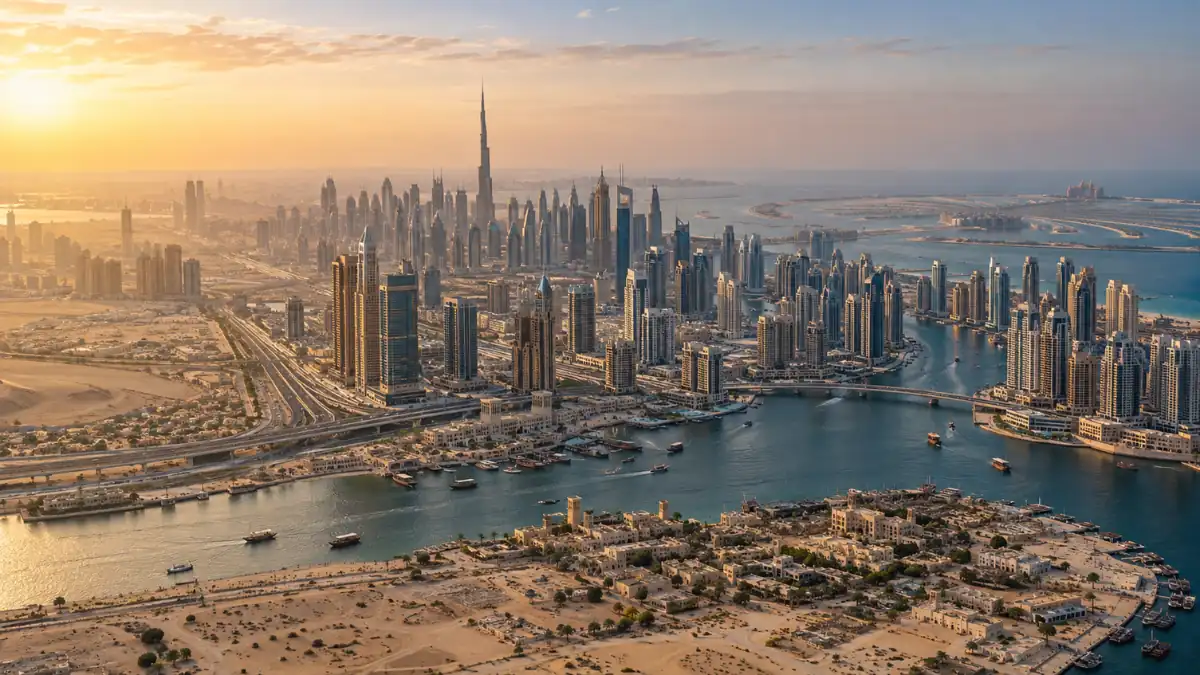
When people see Downtown Dubai, the Palm, Dubai Marina or the towers along Sheikh Zayed Road, it is easy to assume the city was simply constructed in the desert within a few decades. The reality is more interesting.
Dubai’s modern settlement is generally traced to 1833, when around 800 members of the Bani Yas tribe, led by the Al Maktoum family, settled around Dubai Creek. The creek provided a natural harbour, and the communities of Bur Dubai, Deira and Al Shindagha developed around fishing, pearling, boat building and regional trade.
Its location also mattered. Dubai sits on the Arabian Gulf between trading regions linking the Middle East, Africa and Asia. Therefore, commerce and shipping became part of the city’s identity very early.
If you want the broader historical timeline alongside the property perspective, our separate historical timeline looks at the key dates in more detail.
Was Dubai built on desert, water or reclaimed land?
This is one of the most common questions about how Dubai was built. The short answer is: mostly on natural land, with some very high-profile developments constructed on reclaimed coastal land.
Is Dubai built on sand?
Much of Dubai’s urban expansion moved inland across naturally sandy and desert terrain. Roads, villas, business districts, industrial zones and later master-planned communities were developed across this land.
Building on desert soil does not mean developers simply place towers directly onto loose sand. Major structures rely on engineered foundations, geotechnical surveys, piles or raft foundations where required, ground improvement and carefully designed drainage and utility systems.
Is Dubai built on water?
No. The idea that Dubai as a whole is built on water is incorrect. Historic Dubai grew alongside Dubai Creek, while much of the modern city occupies the mainland.
However, some of Dubai’s best-known projects involved land reclamation. Sand was dredged and placed to form new coastlines and artificial islands. Palm Jumeirah is the clearest example.
How Dubai was built through infrastructure first
One of the biggest reasons Dubai expanded successfully was that major infrastructure often preceded or supported property development. Roads, bridges, ports, airports and utilities allowed entirely new parts of the emirate to become accessible.
Dubai Creek became the early commercial engine
Sheikh Rashid bin Saeed Al Maktoum, who ruled Dubai from 1958 to 1990, played a major role in the development of modern Dubai. During this period, the city invested heavily in infrastructure rather than relying only on existing trade.
Al Maktoum Bridge opened in 1963, providing the first permanent road crossing over Dubai Creek. Other major works followed, including Port Rashid and improvements to Dubai’s transport network.
The pattern is important because it continues today: improve connectivity, establish infrastructure and then allow commercial and residential districts to grow around it.
Oil accelerated development, but it was not the whole story
Oil was discovered in Dubai in 1966, with exports beginning in 1969. The additional revenue allowed further investment in roads, services and public infrastructure.
Yet Dubai never had the same scale of oil reserves as some neighbouring Gulf economies. As a result, diversification became especially important. Trade, aviation, tourism, logistics, finance and property increasingly formed the economic base.
That broader economic story is covered in our guide explaining the main drivers behind Dubai’s wealth and growth.
Dubai development timeline at a glance
- 1833: Al Maktoum-led settlement established around Dubai Creek.
- 1958: Sheikh Rashid bin Saeed Al Maktoum becomes Ruler of Dubai.
- 1963: Al Maktoum Bridge opens across the Creek.
- 1966: Oil is discovered in Dubai.
- 1971: Dubai becomes one of the founding emirates of the United Arab Emirates.
- 1979: Dubai World Trade Centre opens and becomes an early symbol of the modern skyline.
- 1985: Emirates airline is launched.
- 2000s: Large-scale waterfront, freehold and master-planned property development accelerates.
- 2009: Dubai Metro Red Line begins operation.
Why was Dubai built so fast?
Dubai’s speed of development came from several factors working together rather than one single construction boom.
1. Centralised long-term planning
Major infrastructure and economic projects could be planned around long-term strategic goals. This helped coordinate roads, aviation, ports, business zones and residential expansion.
2. An economy designed to attract international activity
Dubai positioned itself as a place for trade, tourism, aviation, financial services and international business. As more companies and residents arrived, demand for offices, hotels, apartments, villas and supporting infrastructure increased.
3. Large master developers
Instead of developing only individual plots, Dubai increasingly used large master-planned communities. A single project might include thousands of homes as well as roads, landscaping, schools, retail, leisure space and transport connections.
This is why areas across the emirate can feel like distinct towns within the wider city. Our guide to Dubai’s communities and locations explains how these master-planned districts differ from one another.
4. Population growth and international migration
As Dubai became a regional business hub, a large expatriate population created sustained demand for accommodation and services. Property development therefore grew alongside employment, infrastructure and economic expansion.
5. Foreign ownership opened another phase of the market
The introduction and expansion of designated freehold ownership areas gave international buyers a route into Dubai real estate. This became a major catalyst for apartment, villa and off-plan development aimed at both residents and overseas investors.
Looking at a new or established Dubai community?
We can help you compare the infrastructure, maturity, ownership structure and development pipeline before you make a property decision.
How was Palm Jumeirah built on reclaimed land?
Palm Jumeirah is one reason so many people ask whether Dubai itself was built in the sea. The distinction matters: Palm Jumeirah is a purpose-built reclaimed island development, whereas most of Dubai is not.
Reclamation involves dredging marine sand and placing it in carefully engineered layers until new land rises above sea level. The shape must then be stabilised and protected against waves, settlement and erosion before roads, utilities and buildings can be developed.
Palm Jumeirah used this approach to create its trunk, fronds and crescent-shaped breakwater. The result substantially increased the amount of waterfront land available for hotels, apartments and villas.
Buyers considering this part of the city can read our dedicated Palm Jumeirah property guide for a more practical look at the area.
How was Dubai Marina built and why does it matter?
Dubai Marina shows another method of creating valuable waterfront property. Rather than constructing an island in the Gulf, the development was planned around a large man-made marina and canal system, surrounded by high-density residential towers, hotels, retail and public spaces.
That model demonstrates how Dubai often creates a destination first and then develops a complete property market around it. The attraction is not simply the tower itself; it is the combination of water, transport, retail, leisure, walkability and surrounding infrastructure.
For investors assessing the area today, our Dubai Marina investment breakdown looks at rental demand, returns and risks rather than construction history alone.
What How Dubai was built means for today’s property investor
The history becomes useful when you use it to understand why some Dubai locations are mature while others are still developing.
A completed community with established roads, schools, retail, landscaping and public transport presents a different investment profile from a district where much of that infrastructure is still being delivered.
Investor checklist: reading Dubai’s development story at property level
- Check whether the wider community is complete. A finished tower does not necessarily mean the surrounding district is mature.
- Look at existing transport links. Distinguish between infrastructure that is operational and infrastructure that is only planned.
- Understand the master developer. The quality and consistency of the wider community can matter as much as the individual building.
- Check future supply. Large numbers of additional apartments or villas can affect rental competition and resale conditions.
- Review service charges and maintenance. Waterfront and high-amenity projects can carry higher ongoing costs.
- Confirm ownership and registration. Overseas buyers should verify whether the property sits within an area where the intended ownership structure is permitted.
- Use official transaction data. Asking prices are useful, but completed transaction records provide a better view of what buyers have actually paid.
If you are new to the market, our complete buyer and investor Q&A covers many of the ownership, cost and purchasing questions that naturally follow from this guide.
You may also want to compare current districts with Dubai Creek Harbour, where a new generation of waterfront master planning is taking place close to the historic waterway that helped shape the original city.
Common myths about how Dubai was constructed
“Dubai was nothing but empty desert until oil was found”
This is too simplistic. Dubai had a functioning trading settlement, pearling activity, markets and maritime commerce well before the oil era.
“Dubai is built entirely on reclaimed land”
It is not. Reclaimed islands are visually famous, but they represent only part of Dubai’s urban footprint.
“Oil paid for everything you see today”
Oil revenue certainly accelerated early infrastructure spending. However, modern Dubai was deliberately diversified into aviation, logistics, tourism, finance, property and other sectors.
“The whole city was built in 20 years”
Dubai’s most dramatic skyline growth happened relatively recently, but the foundations of the modern city were laid over many decades. Roads, ports, government institutions, trade policy and international connectivity came first.
FAQs: How Dubai was built
How was Dubai built?
Dubai developed in stages. It grew from a creek-side trading settlement into a port and commercial centre, then used infrastructure investment, oil revenues, aviation, logistics, tourism and large-scale property development to expand into the modern city seen today.
Was Dubai built on water?
No. Most of Dubai stands on natural coastal and desert land. Some famous developments, particularly Palm Jumeirah, were created using reclaimed land, which is why the misconception is common.
Was Dubai built on sand?
Much of the emirate has naturally sandy desert geology, but modern buildings are supported by engineered foundations rather than simply sitting on loose surface sand. Ground conditions are assessed before the structural foundation system is designed.
When did Dubai start building rapidly?
Development accelerated particularly from the late 1950s onwards under Sheikh Rashid bin Saeed Al Maktoum, with major investment in transport and port infrastructure. Growth then increased further after oil was discovered in 1966 and again during the large property and tourism expansion of the late 1990s and 2000s.
How long did it take to build Dubai?
There is no single construction period because Dubai is still developing. Its modern settlement dates to 1833, major infrastructure expanded through the twentieth century, and many of the districts associated with the modern skyline were delivered from the 1990s onwards.
Why was Dubai built in the desert?
Dubai was not originally created as a random city in an empty desert. Its historic settlement grew around Dubai Creek, a natural harbour that supported fishing, pearling and trade. Urban expansion later extended inland across desert land.
How was Dubai built so quickly?
Rapid growth was supported by coordinated infrastructure investment, large master-planned developments, foreign capital, population growth and a policy of economic diversification. Transport, aviation and trade infrastructure also made large new districts commercially viable.
How was the Palm Dubai built?
Palm Jumeirah was created through land reclamation. Marine sand was dredged and placed to create the palm-shaped landform, while a protective crescent was engineered around the outer edge before roads, services and buildings were developed.
How was Dubai Marina built?
Dubai Marina was developed as a master-planned waterfront district around a man-made marina and canal environment. High-rise residential buildings, hotels, retail space, roads and public areas were then built around that waterfront framework.
Who built Dubai city?
No single developer or individual “built Dubai”. Its development spans generations of leadership, government investment, infrastructure authorities, private developers, international contractors, engineers, architects and a large multinational workforce.
Found a community but not sure how mature it really is?
We can help you look at surrounding infrastructure, future supply and the wider master plan before you commit.
Next steps & useful guides
If you are researching Dubai because you may eventually buy or invest here, these related guides provide the next layer of detail:
- Dubai Property Questions Answered: A Complete Guide for Buyers and Investors
- Where Dubai Is: Country, Continent and Location Explained
- Dubai Communities and Locations: The Ultimate Guide for Buyers & Investors
- Dubai Marina Investment Breakdown: ROI, Rental Demand & Risks
- Buying Property in Palm Jumeirah – What You Must Know
- Dubai Creek Harbour: Prices, Property Types & Investment Potential
- Why Dubai Is So Rich: The Real Story Behind Its Wealth
- Modern settlement Dubai’s modern settlement is generally dated to 1833, centred on Dubai Creek.
- Original economy Fishing, pearling, boat building, shipping and regional trade came before oil.
- Oil discovery Oil was discovered in Dubai in 1966, with exports beginning in 1969.
- Built on water? No. Most of Dubai is on natural land, although some waterfront projects use reclaimed land.
- Major growth drivers Ports, aviation, roads, tourism, international trade, property development and population growth.
- Investor relevance The age, infrastructure maturity and future master plan of a community can materially affect demand, liveability and investment risk.
Comparing locations? Ask Dubai Light Haven to help you assess the wider community before you buy.
Official resources worth checking
For historical context, infrastructure information and property-market data, these official resources are useful:
- UAE Government Portal — history of the United Arab Emirates
- Government of Dubai Protocol Department — Dubai history, geography and development
- Dubai Roads and Transport Authority — transport and infrastructure information
- Dubai Land Department — official real estate transaction and project data
How Dubai was built is really a story of infrastructure, trade and long-term expansion
The familiar “desert to skyscrapers” description captures the visual transformation, but it misses much of the substance. Dubai began as a trading settlement around a useful natural harbour. Over time, successive waves of roads, bridges, ports, aviation, utilities and master-planned development allowed that settlement to expand into a global city.
For investors, that history still matters. Dubai continues to create new districts, extend transport networks and develop new waterfronts. However, a new tower in an emerging area does not have the same risk profile as a property in a mature community with established infrastructure and long-term demand.
Therefore, rather than asking only whether a project looks impressive, we recommend looking at how the surrounding area has been built, what is already operating and what still depends on future delivery. That tends to produce a much more useful property decision.
Thinking about buying property in Dubai?
Dubai Light Haven can help you compare communities, understand the wider development plan and approach your property search with a clearer view of the risks and opportunities.

Performance Verified ✅
This page meets PME Optimisation Standards — achieving 95+ Desktop and 85+ Mobile PageSpeed benchmarks. Verified on
