
Share this post:
Quick summary: when Dubai was built
If you are searching for when Dubai was built, there is not one single construction date. The modern Emirate of Dubai is generally traced to 1833, when the Al Maktoum dynasty established itself in Dubai. However, the city you recognise today was created gradually through decades of trade, infrastructure investment, oil-funded development and large-scale urban expansion.
- 1833: the Al Maktoum dynasty established the Emirate of Dubai.
- 1950s–1960s: major investment began in Dubai Creek, roads, municipal services and aviation infrastructure.
- 1966: oil was discovered in Dubai, providing additional capital for infrastructure and economic development.
- 2 December 1971: Dubai became one of the founding emirates of the United Arab Emirates.
- 1970s–2000s: ports, free zones, airports, commercial districts and large residential communities transformed Dubai into an international city.
- Dubai was not simply “built on water”. Most of the emirate sits on natural land, although projects such as Palm Jumeirah were created using land reclamation.
For property buyers, this history matters because modern Dubai is not one uniform development. Different districts were created at very different stages of the city’s expansion, which helps explain why areas such as Dubai Creek, Downtown Dubai, Dubai Marina, Palm Jumeirah and Dubai South can feel completely different from one another.
Trying to understand how modern Dubai developed?
Understanding when different parts of Dubai were developed can give property buyers useful context when comparing established neighbourhoods with newer master-planned communities.
When Dubai was built: the short answer
There is no single year in which somebody simply “built Dubai”. The modern Emirate of Dubai is usually dated to 1833, when the Al Maktoum family established its rule. Even then, Dubai was a relatively small coastal settlement centred around Dubai Creek rather than the vast city of towers, villas, motorways and master-planned communities we see today.
Dubai's transformation happened in stages. Maritime trade and pearling came first. Later came major infrastructure projects, oil revenues, ports, aviation, free zones, tourism, finance, property development and international investment.
That distinction helps answer another common search question: “When was Dubai founded as a country?” Technically, it was not. Dubai became one of the founding emirates of the UAE in 1971.
What was Dubai before it became a modern city?
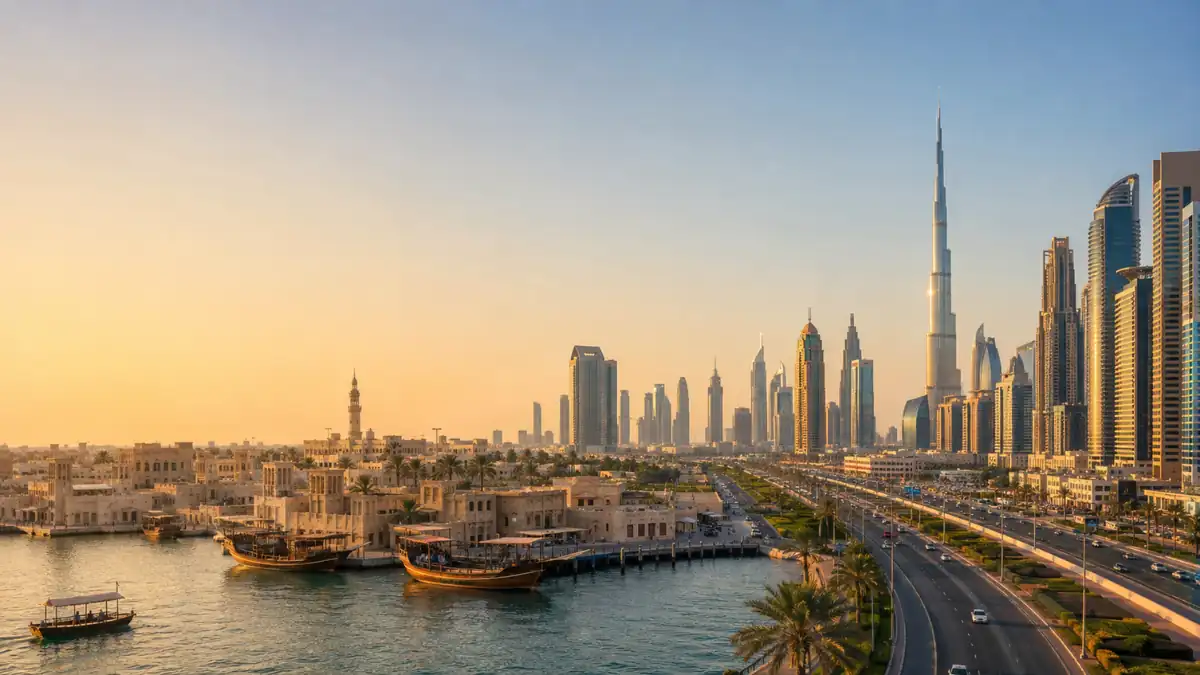
Long before the skyline appeared, communities along this part of the Arabian Gulf relied heavily on the sea, regional trading routes, fishing and pearling. Dubai Creek became particularly important because it offered a natural harbour around which commercial activity could develop.
The settlement that developed around the Creek eventually grew into two historic commercial areas: Deira on one side and Bur Dubai on the other. Traditional trading vessels, or dhows, connected Dubai with markets around the Gulf, India and further afield.
Therefore, the popular image of Dubai appearing suddenly in an empty desert misses much of the story. Dubai had an established commercial identity long before the modern construction boom.
If you would like to understand how that historic waterfront has evolved into a modern investment area, our guide to the Creek property market looks at what buyers should consider today.
How Dubai was built from a trading settlement into a global city
Dubai's physical development accelerated particularly strongly under the late Sheikh Rashid bin Saeed Al Maktoum, who became Ruler of Dubai in 1958. Rather than waiting for population growth to force infrastructure improvements, Dubai invested in projects designed to create future trade and economic activity.
Dubai Creek became an early infrastructure priority
One of the most important projects was the dredging and improvement of Dubai Creek. Making the waterway more accessible to larger vessels helped strengthen Dubai's trading role at a time when trade was central to the emirate's economy.
This is an important point because Dubai's development model was not based solely on building skyscrapers. The foundations were transport, trade and infrastructure.
Dubai International Airport opened in 1960
Aviation became another major component. Dubai International Airport officially opened in September 1960 and later expanded repeatedly as passenger and cargo traffic increased.
Today, it is easy to view Dubai's global connectivity as inevitable. However, building aviation capacity before demand reached modern levels was part of the longer-term infrastructure strategy that allowed the city to grow.
Oil accelerated development, but it did not start Dubai
Oil was discovered in Dubai in 1966. The resulting revenues provided additional resources for roads, utilities, public infrastructure and other development.
Nevertheless, it is misleading to say Dubai was created because of oil. Trade existed before oil, and the emirate later deliberately expanded non-oil industries including aviation, logistics, tourism, financial services and property.
Why was Dubai built so fast?
Searches such as “how was Dubai built so fast?” usually refer to the dramatic change visible from the 1970s onwards. Several factors worked together.
1. Infrastructure was built ahead of future demand
Dubai committed heavily to infrastructure that could support future commercial growth. Port Rashid opened in 1972, while Jebel Ali Port followed in 1979. Jebel Ali Free Zone was then established during the 1980s.
Together, these projects strengthened Dubai's role as a regional trading and logistics centre.
2. Economic diversification reduced reliance on oil
Oil provided valuable development capital, but Dubai continued building other economic sectors. Logistics, aviation, hospitality, retail, tourism, finance and real estate eventually became major parts of its international identity.
3. Large master-planned districts could be developed quickly
Dubai had substantial areas available for planned expansion. Instead of relying entirely on slow redevelopment of an old urban centre, new roads, communities and commercial districts could be created on relatively large sites.
That approach is still visible today. Communities such as Dubai Hills, Dubai South and Dubai Creek Harbour were planned on a very different scale from Dubai's older neighbourhoods.
4. Population growth and international investment reinforced development
As employment, tourism and international business expanded, housing demand grew alongside them. Developers responded with apartments, villa communities, mixed-use districts and new commercial centres.
Consequently, Dubai was not “finished” at a particular point. It has remained a continuously developing city.
Comparing an established area with a newer Dubai community?
We can help you look beyond the marketing and compare infrastructure, maturity, property type, rental demand and future development plans.
Is Dubai built on sand, water or reclaimed land?
This is another area where online explanations can become oversimplified. The majority of Dubai is built on natural land, including coastal plains and desert terrain. Dubai itself is therefore not a city floating on water, nor was the whole city reclaimed from the sea.
Is Dubai built on sand?
Much of Dubai's natural ground is sandy or desert terrain, so foundations must be engineered for local ground conditions. Large buildings use professionally designed foundation systems suitable for the site, rather than simply being placed on loose surface sand.
Is Dubai built on water?
No. Most of Dubai is located on natural land. However, some highly visible projects extend onto artificially created islands or reclaimed coastline.
Is Dubai built on reclaimed land?
Parts of it are. The best-known example is Palm Jumeirah, an artificial island created using large-scale land reclamation. Other waterfront developments also incorporate reclaimed land.
If Palm Jumeirah is part of your property research, our Palm Jumeirah buyer guide explains the area's property character and what buyers should look at before purchasing.
When was modern Dubai built? A simple timeline
Dubai development timeline at a glance
- 1833: the Al Maktoum dynasty establishes the Emirate of Dubai.
- Late 19th and early 20th centuries: maritime trade and pearling help strengthen Dubai's commercial role.
- 1958: Sheikh Rashid bin Saeed Al Maktoum becomes Ruler of Dubai.
- 1959–1960: major work on Dubai Creek supports larger vessels and expanding trade.
- 1960: Dubai International Airport officially opens.
- 1966: oil is discovered in Dubai.
- 1971: Dubai becomes one of the founding members of the United Arab Emirates.
- 1972: Port Rashid opens.
- 1979: Jebel Ali Port opens and Dubai World Trade Centre becomes an important symbol of the emerging modern city.
- 1980s onward: free zones, aviation, trade, tourism and real estate expansion accelerate.
- 1990s–2000s: large new districts, waterfront developments and high-rise centres transform the skyline.
- Today: Dubai continues to expand through new master-planned communities and infrastructure projects.
This is why a question such as “how long did it take to build Dubai?” does not have a meaningful single-number answer. The process has taken generations, and the city continues to be developed.
Why Dubai's development history matters to property investors
For an investor, the history is more than trivia. It helps explain why different districts have very different levels of maturity, infrastructure and property stock.
Older areas may have established infrastructure
Mature districts generally have existing roads, shops, transport links, schools and proven residential demand. However, older buildings can vary considerably in specification, maintenance history and service-charge profile.
Newer areas may offer modern master planning
Newer communities can offer contemporary layouts, amenities and planned infrastructure. At the same time, an investor should establish what has already been delivered and what remains dependent on future development.
Our area comparison guide provides a useful starting point if you are deciding which part of the emirate may suit your budget and investment objectives.
You can also return to our main property questions hub for straightforward answers to the wider questions international buyers regularly ask.
For buyers looking specifically at how the modern market has evolved, our market outlook guide provides additional context on current property conditions and future expectations.
FAQs: when Dubai was built
When was Dubai first built?
Modern Dubai is generally traced to 1833, when the Al Maktoum dynasty established the Emirate of Dubai. However, settlements and trading activity in the wider area existed before that date. The large modern city developed gradually, particularly from the mid-20th century onwards.
When did they start to build modern Dubai?
Dubai's major modern infrastructure programme accelerated during the late 1950s and 1960s. Projects involving Dubai Creek, municipal planning, aviation and roads laid important foundations for the much larger construction programmes that followed in the 1970s, 1980s and beyond.
When was Dubai founded?
The modern Emirate of Dubai is generally dated to 1833, when the Al Maktoum dynasty established its rule. Dubai later joined Abu Dhabi and the other founding emirates to establish the United Arab Emirates on 2 December 1971.
Was Dubai built because of oil?
No. Dubai was already an established trading settlement before oil was discovered in 1966. Oil revenue helped accelerate infrastructure development, but trade, ports, aviation, logistics, tourism, finance and property subsequently became major parts of the economy.
How long did it take to build Dubai?
There is no fixed construction period because Dubai was not one single project. Its transformation occurred over many decades and is still continuing. The city seen today combines historic neighbourhoods, 20th-century districts and very recent master-planned developments.
How was Dubai built so quickly?
Rapid development was supported by large infrastructure investment, trade, oil revenues, ports, aviation, foreign investment, master-planned development and the ability to create new districts on substantial areas of available land. Different parts of Dubai were therefore developed in parallel rather than one street at a time.
Is Dubai built on water?
No. Most of Dubai is built on natural land. Certain coastal developments, including Palm Jumeirah, use reclaimed land, but this represents only part of the wider emirate.
Is Dubai built on sand?
Large areas of the emirate have sandy and desert ground conditions. Modern buildings are therefore designed with engineered foundations suited to their particular site and structural loads.
Is Dubai built on reclaimed land?
Some waterfront projects are. Palm Jumeirah is the best-known example. Nevertheless, the majority of the city is on natural land rather than reclaimed sea.
Is Dubai built on an island?
No. Dubai itself is not an island. It occupies the Arabian Gulf coastline of the UAE. The emirate does contain artificial island developments, but these form only a small part of Dubai's overall geography.
When was Dubai Mall built?
Dubai Mall opened in 2008 as part of the Downtown Dubai development. It belongs to a much later stage of Dubai's growth than historic districts around Dubai Creek.
When was Palm Jumeirah built?
Construction and land reclamation began in the early 2000s, with the first residents moving onto Palm Jumeirah later in that decade. Development of individual hotels, apartments and villas continued in stages afterwards.
Have another Dubai property question?
We explain Dubai property in straightforward language so you can separate useful information from marketing noise.
Next steps & useful Dubai property guides
If the history of Dubai has helped you understand how different parts of the city evolved, these guides take the next step into buying and investment decisions:
- Straightforward answers to common questions from Dubai property buyers
- Compare established and emerging neighbourhoods across the emirate
- Understand the property market around Dubai's historic Creek
- Research property ownership on the best-known reclaimed island development
- See how a major newer master-planned district is developing
- Explore one of the city's modern residential master-planned communities
- Review wider market conditions before making an investment decision
- Modern foundation 1833, when the Al Maktoum dynasty established the Emirate of Dubai.
- Historic economic base Fishing, pearling, maritime trade and commerce centred around Dubai Creek.
- Major modernisation period Infrastructure investment accelerated strongly from the late 1950s onwards.
- Oil discovery 1966, helping to accelerate investment in the emirate.
- UAE founded 2 December 1971, with Dubai becoming one of the founding emirates.
- Built on water? No. Most of Dubai is on natural land, although some coastal projects use reclaimed land.
- Is Dubai finished? No. The emirate continues to build new communities, infrastructure and commercial districts.
- Property relevance Different districts were developed at different times, so infrastructure maturity, building age and future supply can vary substantially.
Comparing locations? Ask Dubai Light Haven to help you assess an area before you buy.
Official resources worth checking
For historical background and current information about Dubai and the UAE, these official resources are useful:
- UAE Government Portal — history and formation of the United Arab Emirates
- Dubai Municipality — milestones in Dubai's urban and municipal development
- Visit Dubai — official overview of Dubai's history and origins
- Dubai Land Department — official information for today's real estate market
So, when was Dubai really built?
The most useful answer is that when Dubai was built depends on which stage of its story you mean. Modern Dubai can trace its political foundation to 1833, while the infrastructure-led transformation into today's international city accelerated from the late 1950s and continued through the following decades.
Dubai Creek, aviation, ports, oil revenues, free zones, tourism and large-scale property development all played their part. Importantly, the process is still continuing.
For a property investor, that ongoing development is worth understanding. An established district and a recently launched master community can both offer opportunities, but they should not be assessed in exactly the same way. Infrastructure maturity, future construction, developer delivery, property supply and tenant demand all need to be considered together.
At Dubai Light Haven, our aim is to help you understand those differences clearly before you commit your money.
Considering property in Dubai?
Speak to Dubai Light Haven before you commit. We can help you compare areas, understand the property market and approach your purchase with clearer information.

Performance Verified ✅
This page meets PME Optimisation Standards — achieving 95+ Desktop and 85+ Mobile PageSpeed benchmarks. Verified on
