
Share this post:
Quick summary: When Dubai was established
If you are wondering when Dubai was established, the key date is 1833. That was when members of the Bani Yas tribal federation, led by the Al Maktoum family, settled beside Dubai Creek and established the emirate under the leadership of Sheikh Maktoum bin Butti Al Maktoum.
However, Dubai's history goes back further. Before 1833, the area was already associated with fishing, pearling and maritime trade. The modern city developed gradually, particularly during the twentieth century, before Dubai became one of the founding emirates of the United Arab Emirates on 2 December 1971.
Key facts: Dubai's establishment and development
- 1833: Dubai was established as an emirate under the Al Maktoum family.
- Before 1833: Fishing, pearling and trading communities existed around Dubai Creek.
- 1958: Sheikh Rashid bin Saeed Al Maktoum became Ruler of Dubai and accelerated modern development.
- 1960: Dubai International Airport officially opened.
- 1966: Oil was discovered in Dubai, helping to finance further expansion.
- 1971: Dubai became a founding member of the United Arab Emirates.
- 2000s onwards: Major residential districts, transport networks and international landmarks reshaped the city.
For property buyers and investors, this history helps explain why Dubai has several distinct property markets, from established neighbourhoods around the Creek to modern master-planned communities. Its development was not one construction project, but a long-term transformation driven by trade, infrastructure, investment and population growth.
Exploring Dubai's past before investing in its future?
Our Dubai Light Haven team can help you understand how established neighbourhoods and newer communities differ before you make a property decision.
When was Dubai first established?
Dubai was formally established as an emirate in 1833, when members of the Al Bu Falasah branch of the Bani Yas tribal federation settled beside Dubai Creek under the leadership of Sheikh Maktoum bin Butti Al Maktoum.
This event marked the beginning of Al Maktoum rule, which continues today. However, it does not mean Dubai suddenly appeared in 1833. Communities and trading activity existed in the area long before the emirate was established.
According to the official UAE Government history of Dubai, approximately 800 members of the Bani Yas tribe settled beside the Creek in 1833.
Was Dubai established in 1833 or 1971?
Both dates matter, but they describe different historical events.
- 1833: The establishment of Dubai under the Al Maktoum ruling family.
- 1971: Dubai joined five other emirates to establish the United Arab Emirates on 2 December.
- 1972: Ras Al Khaimah joined the federation, bringing the UAE to seven emirates.
Understanding that difference helps answer several common questions about when Dubai became a city, when it became part of a country and how its present-day government developed.
What was Dubai before it became a modern city?
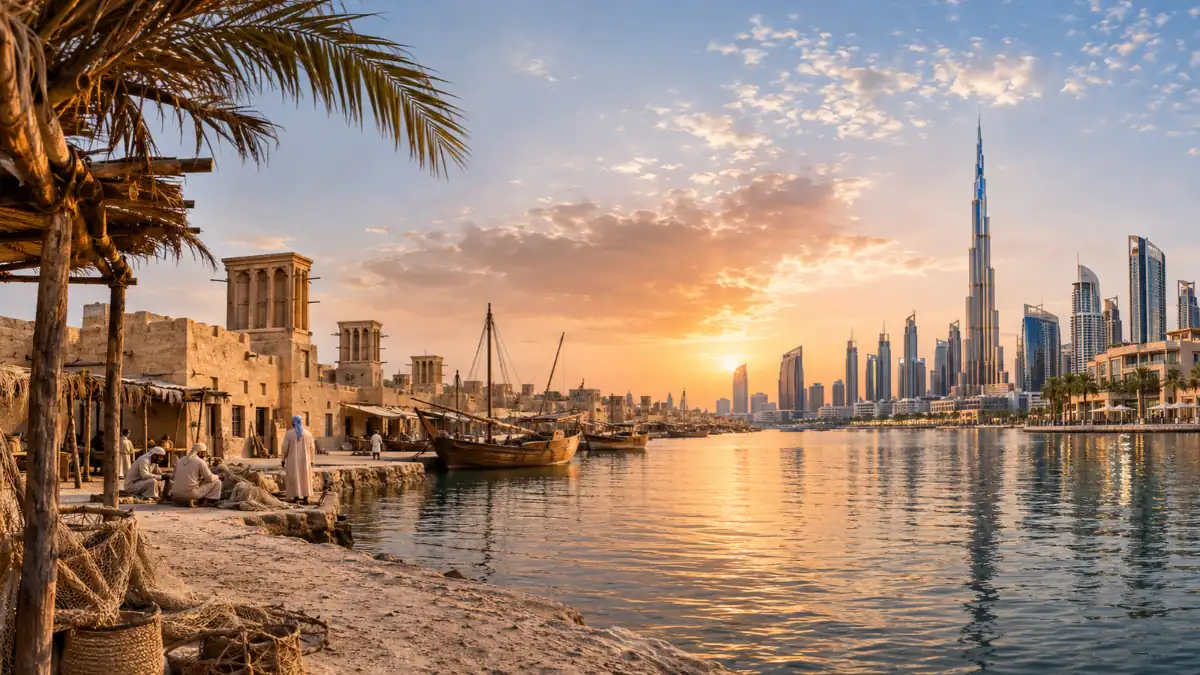
Long before skyscrapers, artificial islands and major motorways, Dubai was a relatively small coastal settlement. Its position beside the Arabian Gulf provided access to fishing grounds, pearling areas and maritime trading routes.
Dubai Creek was particularly important. This natural inlet provided shelter for boats and helped traders move goods between coastal settlements and markets further inland.
Dubai Creek and the original settlement
The Creek divided the historic settlement into two areas that remain familiar today:
- Deira: An important centre for merchants, trading activity and traditional markets.
- Bur Dubai: A historic residential, commercial and administrative area.
- Al Shindagha: One of Dubai's oldest neighbourhoods and an important centre associated with the ruling family and maritime life.
Traditional homes were often built using locally available materials. Many incorporated courtyards and architectural features designed to improve ventilation in the region's hot climate.
Today, these districts help visitors understand Dubai's earlier character. They also provide a useful contrast with the city's more recent property developments.
Why was Dubai originally formed?
Dubai's development was closely connected to its geographical position and access to maritime trade. Fishing, pearling and commercial exchange supported the settlement and helped attract merchants.
Therefore, the city's early growth was not driven by oil. It was driven by people, trade, transportation and the commercial opportunities created by its coastal location.
How was Dubai founded, and who established it?
Sheikh Maktoum bin Butti Al Maktoum is widely recognised as the founding ruler of the emirate in 1833. He belonged to the Al Bu Falasah branch of the Bani Yas tribal federation.
Under the Al Maktoum family, Dubai developed from a coastal trading settlement into an increasingly organised commercial centre.
Its development was gradual. The settlement relied on maritime trade, pearl diving and connections with merchants from surrounding regions, including Persia and the Indian subcontinent.
When did Dubai start to develop as a trading centre?
Dubai's commercial importance increased during the nineteenth century and into the early twentieth century. As trading activity expanded, merchants brought goods, skills and business connections into the settlement.
Over time, commercial policies and Dubai's port location helped support further economic activity. However, this early prosperity also faced challenges, including the decline of the natural pearl industry during the twentieth century.
Consequently, Dubai needed to develop additional sources of economic activity. Trade, port improvements and later investment in infrastructure became increasingly important.
Dubai establishment and development timeline: 1833 to today
Rather than being constructed in one particular year, Dubai evolved through several important stages. The following milestones explain how the settlement became a modern international city.
Key milestones in Dubai's history
| Year | What happened? |
|---|---|
| 1833 | Dubai was established under the Al Maktoum ruling family. |
| Late 1800s | Pearling and maritime trade supported the settlement's commercial development. |
| 1958 | Sheikh Rashid bin Saeed Al Maktoum became Ruler of Dubai. |
| 1960 | Dubai International Airport opened. |
| 1966 | Oil was discovered in Dubai. |
| 1969 | Dubai began exporting oil. |
| 1971 | Dubai became a founding emirate of the UAE. |
| 1979 | Dubai World Trade Centre opened, becoming an early landmark of the modern skyline. |
| 1985 | Emirates airline was launched. |
| 2001 | Palm Jumeirah was launched as a major waterfront development. |
| 2009 | Dubai Metro's Red Line opened. |
| 2010 | Burj Khalifa officially opened. |
| 2020s | Residential development, transport infrastructure and new communities continued expanding. |
Historical milestones are based on official Dubai Government, UAE Government, Dubai Airports and Roads and Transport Authority records.
When was modern Dubai built?
Modern Dubai began taking shape during the 1950s and 1960s, although much of the skyline familiar today developed considerably later.
When Sheikh Rashid bin Saeed Al Maktoum became Ruler in 1958, infrastructure investment became central to the emirate's development. Transport, public services and commercial facilities were progressively expanded.
When did Dubai start building major infrastructure?
One important development was the expansion of Dubai Creek to support commercial shipping. Meanwhile, the opening of Dubai International Airport in 1960 improved the emirate's international connections.
Roads, port facilities, utilities and public services subsequently developed alongside a growing population. These improvements supported commercial activity and created the foundations for further urban growth.
Did oil build Dubai?
Oil certainly helped, but it would be misleading to suggest that oil alone created modern Dubai.
Oil was discovered in 1966, with exports beginning in 1969. Revenue from the industry helped finance infrastructure and public services.
Nevertheless, Dubai increasingly developed businesses beyond oil, including shipping, trade, aviation, financial services, property and tourism.
This diversification remains central to understanding the city. Its economic development depended not only on natural resources but also on creating infrastructure and encouraging international business activity.
How was Dubai built so quickly?
People often ask how Dubai developed so rapidly. The answer lies in a combination of long-term planning, commercial expansion, international investment and major infrastructure projects.
Rapid development became particularly visible from the 1990s onwards, when tourism, international business and large-scale property construction began reshaping the urban landscape.
1. Investment in infrastructure
Airports, ports, highways and public transport improved connections across the emirate. These facilities also made Dubai more accessible to international businesses, visitors and residents.
2. International trade and business
Dubai's trading history encouraged a commercial approach to economic development. As business activity expanded, demand increased for offices, accommodation, warehouses and supporting services.
3. Large master-planned communities
Instead of expanding only through individual buildings, Dubai introduced major planned neighbourhoods containing homes, roads, parks, shopping facilities and other amenities.
This approach helped create residential destinations with different lifestyles and property types. Our guide to Dubai communities and locations explains how these areas differ.
4. International property ownership
The introduction and expansion of designated freehold ownership opportunities for foreign buyers played an important role in Dubai's real estate development during the 2000s.
As a result, international purchasers gained access to selected residential property markets. However, ownership rights still depend on the property's location, title and applicable rules.
For a clearer explanation, read our guide to freehold and leasehold ownership rules.
5. Tourism and international connectivity
Dubai developed major hotels, attractions, conference facilities and transport networks. These improvements attracted visitors and supported hospitality, retail and other service industries.
At the same time, greater international connectivity helped support demand for different forms of accommodation, from family homes to city-centre apartments.
Established neighbourhood or new development?
We can help you compare community maturity, surrounding infrastructure, ownership arrangements and development risks before you choose a Dubai property.
Old Dubai versus modern Dubai: What changed?
One of the most interesting aspects of Dubai's history is the contrast between its original trading districts and the large residential and commercial communities developed much later.
Old Dubai: Trading districts and traditional neighbourhoods
Historic Dubai developed around the Creek, particularly Deira, Bur Dubai and Al Shindagha. These areas remain closely associated with traditional markets, older commercial streets and the city's cultural heritage.
Their property stock and urban layouts can differ significantly from newer master-planned developments. Older buildings may also require different levels of maintenance and due diligence.
Modern Dubai: Planned residential and business districts
Newer areas include Downtown Dubai, Dubai Marina, Business Bay and other communities developed through major urban planning programmes.
These neighbourhoods offer a different physical environment, often incorporating modern apartment buildings, managed residential developments and dedicated community amenities.
For example, Downtown Dubai's residential market is closely connected to the modern central business and tourism district.
Meanwhile, our Dubai Marina investment guide explains the characteristics of an established waterfront apartment community.
Is older Dubai better than newer Dubai for property investment?
Neither is automatically better. The answer depends on the particular property, its location, building condition, ownership arrangements and your investment objectives.
- Established neighbourhoods: May offer mature infrastructure, existing services and a more observable rental or resale history.
- Newer communities: May offer contemporary homes, newer facilities and opportunities to enter developing neighbourhoods.
- Historic districts: Can have distinctive commercial and cultural advantages, but property availability and ownership arrangements require careful checking.
- Off-plan developments: May offer staged payment arrangements, although completion, delivery and future demand remain important considerations.
Why Dubai's history matters to today's property buyers
Understanding Dubai's development helps buyers assess how a neighbourhood became established and what may still be changing around a property.
Importantly, Dubai's real estate market is not one uniform market. Different communities have different infrastructure, ownership structures, building types and levels of maturity.
Established areas versus emerging locations
In an established neighbourhood, buyers may be able to inspect completed facilities, compare existing buildings and assess the surrounding environment before purchasing.
Conversely, an emerging location may depend more heavily on future infrastructure, population growth and the delivery of planned amenities.
Neither approach removes investment risk. Buyers should consider the actual property rather than relying solely on expectations about an area's future.
What should property investors check?
Before committing to a purchase, we recommend looking beyond the developer's presentation and assessing the fundamentals.
- Community history: When was the neighbourhood developed, and how established is it today?
- Infrastructure: Are roads, transport connections and essential facilities already available?
- Ownership: Is the property in an area where your intended form of ownership is permitted?
- Building condition: Are there maintenance concerns, major works or unusually high service charges?
- Rental demand: What evidence supports the expected occupancy and rental income?
- Future supply: Could additional residential development affect rents or resale competition?
- Total costs: Have you allowed for transfer fees, registration, service charges and other ownership expenses?
If you are considering a property purchase, our property due diligence checklist provides a practical starting point.
You can also review our guide to property prices and budgets to understand why purchase costs vary between different locations and property types.
Are newer Dubai communities always a better investment?
Not necessarily. New developments can offer modern specifications and attractive facilities, but those features need to be considered alongside price, construction quality, location and potential competing supply.
Equally, an older completed building may provide an established location, yet require greater maintenance expenditure.
Therefore, we would assess individual properties on their merits rather than assuming that either older or newer automatically means better value.
Conclusion: From a trading settlement to a modern international city
Dubai's official establishment dates back to 1833, when the Al Maktoum family began ruling the emirate. Its earlier history, however, was already shaped by coastal settlement, pearling and maritime trade.
The major transformation into today's city took place over generations. Infrastructure investment accelerated during the mid-twentieth century, oil revenue helped finance further development, and economic diversification supported the expansion of trade, tourism and property.
Dubai then became a founding member of the UAE in 1971, while later decades brought the master-planned neighbourhoods, transport networks and major landmarks familiar today.
For buyers and investors, the most useful lesson is that Dubai's communities have developed at different times and for different purposes. Understanding those differences can help you make more informed decisions about location, property type and long-term suitability.
FAQs: When Dubai was established and how the city developed
When was Dubai established?
Dubai was established as an emirate in 1833 under Sheikh Maktoum bin Butti Al Maktoum. The Al Maktoum family has ruled Dubai since that time. However, settlements and maritime activity existed in the area before 1833.
When did Dubai come into existence?
Dubai existed as a coastal settlement before its formal establishment as an emirate in 1833. Its historical origins are associated with fishing, pearling and trading communities around Dubai Creek.
Who founded Dubai and in what year?
Sheikh Maktoum bin Butti Al Maktoum is recognised as the founding ruler of Dubai in 1833. He led members of the Al Bu Falasah branch of the Bani Yas tribal federation.
When did Dubai become a city?
Dubai developed gradually from a coastal settlement into an urban trading centre. There is no single universally recognised date when it first became a city. Its modern urban expansion accelerated during the twentieth century.
When was Dubai built into a modern city?
Modernisation accelerated during the 1950s and 1960s, with major improvements to transport and infrastructure. Many of Dubai's best-known high-rise districts and landmark developments were built or substantially expanded from the 1990s onwards.
Was Dubai built from nothing?
No. Dubai was an established fishing, pearling and trading settlement long before modern skyscrapers appeared. Its transformation was a gradual process involving commercial activity, infrastructure, population growth and investment.
Why was Dubai developed so quickly?
Dubai's rapid development reflected infrastructure investment, commercial policies, international business growth, tourism and planned real estate development. Oil revenue contributed, particularly after exports began in 1969, but it was not the only factor.
When was Dubai established as a country?
Dubai was not established as a separate country. It became one of the founding emirates of the United Arab Emirates on 2 December 1971. The UAE is the sovereign country.
When did Dubai start building skyscrapers?
Dubai's modern high-rise development gained an important early landmark with the opening of the Dubai World Trade Centre in 1979. Much larger concentrations of skyscrapers appeared during subsequent decades, especially from the 1990s and 2000s.
When was Dubai Marina built?
Dubai Marina began developing in the early 2000s as a major planned waterfront community. Construction and handovers occurred across multiple phases, so the entire neighbourhood was not completed in a single year.
When was Palm Jumeirah built?
Palm Jumeirah was launched in 2001, with construction and land reclamation followed by phased residential and hospitality development. The island therefore developed over several years rather than opening as one completed project.
When was Dubai International Airport built?
Work on the original airport began in 1959, and Dubai International Airport officially opened on 30 September 1960. The airport has since undergone numerous expansion and modernisation projects.
When was Dubai Metro built and opened?
Construction of Dubai Metro began in 2006. The Red Line officially opened on 9 September 2009, followed by the Green Line on 9 September 2011.
How long did it take Dubai to develop?
Dubai developed across nearly two centuries following the establishment of the emirate in 1833. Its most visible modern transformation occurred during the second half of the twentieth century and the early twenty-first century. Development continues today.
Is an established Dubai neighbourhood safer for property investment?
An established neighbourhood can provide more information about existing infrastructure, building condition and rental activity. However, it does not guarantee returns or eliminate risk. Purchase price, ownership rights, service charges, demand and the condition of the individual property still need careful assessment.
Next steps & useful Dubai property guides
If Dubai's history has encouraged you to explore its property market, these related guides provide further information about different locations, ownership rules and investment considerations.
- Dubai Property Questions Answered: A Complete Guide for Buyers and Investors — our main reference guide.
- Dubai Creek Property Guide — understanding a location closely connected with Dubai's origins.
- Dubai Communities and Locations — comparing neighbourhoods across the emirate.
- Dubai Property Investment Guide — understanding the wider investment landscape.
- Buying Property in Dubai as a Foreigner — the important rules and practical considerations.
- Off-Plan Investment: Pros, Cons and Risks — understanding development-stage purchases.
Key Facts Snapshot: Dubai's establishment and history
- Establishment year 1833
- Founding ruler Sheikh Maktoum bin Butti Al Maktoum
- Ruling family Al Maktoum family
- Original economic activities Fishing, pearling and maritime trade
- Historic trading centre Dubai Creek
- Airport opening 30 September 1960
- Oil discovery 1966
- First oil exports 1969
- UAE formation 2 December 1971
- First major modern skyscraper Dubai World Trade Centre, opened 1979
- Dubai Metro opening 9 September 2009
- Property buyer takeaway Compare established districts and emerging communities using property-specific evidence rather than development age alone.
Official sources and historical references
For reliable background information on Dubai's origins, government formation, development and population, the following official resources are useful:
- UAE Government — Dubai's history and establishment provides background on the emirate, ruling family and economy.
- UAE Ministry of Foreign Affairs — History of the Federation explains the events leading to the establishment of the UAE in 1971.
- Dubai Government — Population and Vital Statistics provides official population information and links to historical demographic statistics.
- Visit Dubai — Historical Timeline and City Background provides an accessible overview of Dubai's major historical milestones.
Thinking about buying property in Dubai?
Dubai's history explains how the city developed, but choosing the right property requires careful research today. Contact Dubai Light Haven to discuss neighbourhoods, ownership options and the practical questions worth asking before you buy.

Performance Verified ✅
This page meets PME Optimisation Standards — achieving 95+ Desktop and 85+ Mobile PageSpeed benchmarks. Verified on
