
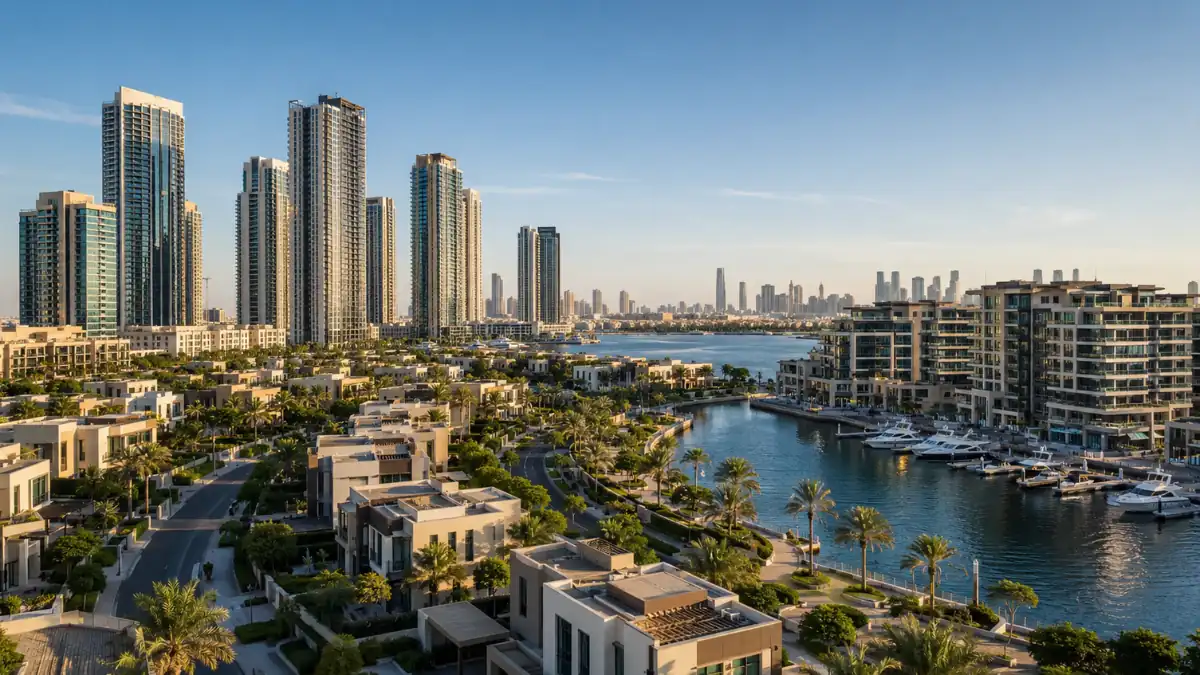
Share this post:
Quick summary: Dubai Property for buyers and investors
Dubai Property can offer international buyers a broad choice of apartments, villas, ready homes and off-plan developments, but the right purchase depends on far more than headline price or advertised rental yield. You need to understand ownership rules, location, total buying costs, service charges, developer quality, payment structure and your eventual exit strategy.
- Foreign buyers can own property in designated ownership areas, subject to the applicable Dubai rules and the individual property title.
- Budget beyond the advertised purchase price. Registration charges, trustee or administration costs, agency fees where applicable, mortgage costs, service charges and furnishing can materially change your total investment.
- Ready and off-plan property have different risk profiles. Ready homes offer greater visibility, while off-plan purchases can provide staged payment plans but require careful developer and project due diligence.
- Location should match your objective. A strong holiday-let area, family villa community and long-term rental district may each suit a different investor.
- Do not buy on projected ROI alone. Compare realistic rent, vacancy, annual service charges, finance costs and resale demand before committing.
Our view is simple: there is no single “best” purchase for every buyer. A sensible Dubai purchase starts with your budget, timescale and objective, followed by careful checks on the property, developer, legal status and true ongoing costs.
Trying to work out what kind of Dubai purchase actually suits you?
Tell our team your budget, preferred timeframe and investment goal, and we will help you narrow the market before you start comparing individual developments.
Dubai Property: understand the market before you buy
The first mistake many overseas buyers make is treating Dubai as one single property market. In reality, it is a collection of very different communities, building types and investment models.
A studio bought for long-term rental in Jumeirah Village Circle has a different tenant profile from a waterfront apartment in Dubai Marina. Equally, a family villa in Arabian Ranches should not be assessed in the same way as an off-plan apartment in a newly developing district.
Therefore, before looking at individual listings, decide what you actually want the property to achieve.
- A home for yourself — where lifestyle, schools, commuting and community matter most.
- A long-term rental investment — where tenant demand, annual costs and sustainable net yield become important.
- A short-term holiday rental — where location, tourism demand, licensing and management costs can affect performance.
- A capital-growth investment — where future infrastructure, supply and resale demand may matter more than immediate income.
- An off-plan purchase — where payment structure, developer track record and project delivery risk become central.
Buyers who are still at the beginning of their research should also read our complete foreign buyer overview. It explains the wider ownership and purchase framework that this guide supports.
Who can buy Dubai Property and what does ownership mean?
Foreign nationals can buy in areas where the relevant form of foreign ownership is permitted. However, you should never assume that every property in every district offers the same ownership rights.
The title, project status and permitted ownership structure should be checked before you pay a reservation fee or deposit. In practical terms, overseas buyers will often encounter freehold property in established investment locations, although the precise legal position should always be verified for the individual transaction.
Freehold and other ownership structures
Freehold ownership generally gives the registered owner title to the property, subject to the laws, community rules and obligations that apply to it. Other structures can include long-term rights of use or leasehold-style interests.
For that reason, the important question is not simply, “Can foreigners buy in Dubai?” It is: what exactly am I buying, for how long, and what rights will be recorded?
Our guide to checking the ownership structure before purchase explains this distinction in more detail.
Dubai Property types: apartments, villas, ready homes and off-plan
The type of property you choose can affect your purchase price, financing, running costs, tenant demand and eventual resale options.
Apartments
Apartments are common among first-time overseas investors because the entry price can be lower than for villas. They are available across a wide range of areas, from established central districts to newer communities.
However, building quality and annual service charges can vary considerably. Two apartments with a similar purchase price can produce very different net returns once recurring costs are taken into account.
Villas and townhouses
Villas and townhouses may suit families, longer-term tenants and buyers who value space. They can also provide access to established communities with schools, parks and local facilities.
Nevertheless, the total ticket price is often higher. Maintenance, landscaping and community costs should also be considered carefully.
Ready property
A completed property gives you the opportunity to inspect the actual unit or, where access is restricted, obtain a clearer understanding of the finished building and surroundings.
For investors, ready property may also provide a clearer picture of current rental demand and achievable rents.
Off-plan property
Off-plan means buying before a project is fully completed. Buyers are often attracted by staged payment plans, new specifications and the possibility of buying earlier in a development cycle.
On the other hand, you are buying something that may not yet physically exist in its finished form. Therefore, developer checks, project registration, payment arrangements, contract terms and the escrow structure deserve particular attention.
For a deeper explanation, see our beginner-friendly explanation of buying before completion and our guide to how regulated project accounts work.
Ready property vs off-plan: a simple comparison
- Ready property: greater visibility of the finished asset and potentially immediate use or rental income.
- Off-plan: staged payments may reduce the amount needed upfront, although completion and market risk remain.
- Ready property: current rents and building performance may be easier to assess.
- Off-plan: future value depends partly on delivery, future supply and market conditions at completion.
Dubai Property prices, budget and the true cost of buying
Asking “How much are properties in Dubai?” is understandable, but the answer varies enormously by area, property type, building quality, size, view and whether the home is completed or under construction.
A more useful approach is to divide your finances into three separate figures:
- Your maximum purchase price.
- Your total acquisition budget, including transaction costs.
- Your post-purchase reserve for furnishing, maintenance, vacancy and unexpected expenses.
Quick costs snapshot: what to budget beyond the purchase price
- Property registration charges and associated transaction costs.
- Trustee, administration or processing charges, depending on the transaction.
- Estate agency fees where applicable.
- Mortgage valuation, arrangement and registration costs if you borrow.
- Developer or community service charges.
- Conveyancing or independent professional advice where you choose to use it.
- Furnishing and fit-out costs, especially for rental property.
- Insurance, maintenance and property management.
Exact charges depend on the transaction, property and services used. Always request an itemised completion statement before you commit funds.
The Dubai Land Department currently publishes the official fees and procedures that apply to property registration services. Buyers should check the latest official schedule rather than relying on an old blog post, agent graphic or social media calculator.
For a more detailed breakdown, read our full guide to transaction and ownership costs and our explanation of official registration charges.
Is Dubai Property a good investment?
It can be, but “good investment” is not a characteristic of an entire city. It is the result of buying a particular property at a particular price, with realistic expectations about income, costs and resale.
A strong investment case usually rests on several factors working together.
- Purchase price: are you paying a sensible price relative to comparable transactions?
- Rental demand: is there a genuine tenant base for this unit type and location?
- Net income: what remains after service charges, management, maintenance and vacancy?
- Supply: are many similar units due to enter the market?
- Liquidity: is there likely to be a healthy resale market?
- Holding period: can you stay invested if the market slows?
Gross yield is not the same as net return
Marketing materials often focus on gross rental yield. That can be useful for an initial comparison, but it does not tell you what you actually keep.
A more realistic calculation should consider:
- annual service charges,
- property management,
- repairs and maintenance,
- periods without a tenant,
- letting or leasing costs,
- finance costs, where applicable, and
- furnishing or replacement costs.
For a more focused investment analysis, see our guides to weighing the advantages against the risks and building a realistic return calculation.
Found a property but not sure whether the numbers really work?
We can help you look beyond the brochure and consider the purchase price, ownership costs, rental assumptions, location and exit strategy together.
How to choose the right Dubai Property location
There is no universally best area. The right location depends on who will use the property and why.
For long-term rental demand
Consider access to employment areas, transport, schools, supermarkets and everyday services. Tenants who live in Dubai year-round often prioritise practical convenience as much as prestige.
For lifestyle buyers
Beach access, walkability, restaurants, views, community facilities and proximity to family or work may matter more than maximising rental yield.
For family villa buyers
Schools, journey times, parks, community maturity and the availability of larger homes often become central considerations.
For growth-focused investors
Future infrastructure and development can create opportunity, but forecasts should never be treated as guaranteed. A new area can take time to mature, and future supply may affect both rents and resale values.
Our community comparison hub can help you narrow the search, while our area-selection guide for investors focuses more closely on matching locations to investment objectives.
How to buy: a step-by-step Dubai Property checklist
The exact process varies between ready and off-plan transactions, cash and mortgage purchases, and individual developers. However, the following framework is a useful starting point.
Step-by-step buyer checklist
- Define your objective. Decide whether the purchase is for personal use, rental income, long-term growth or a combination of these.
- Set your total budget. Include purchase costs, registration, financing, furnishing and an emergency reserve.
- Choose a suitable ownership area and property type. Do not assume every area or project offers identical ownership rights.
- Compare real alternatives. Look at competing buildings, communities and recent market evidence rather than evaluating one listing in isolation.
- Check the seller, developer and property. Verify the parties involved and review the relevant official records and documentation.
- Understand the payment terms. Know exactly when money is due, what happens if you miss a payment and which charges are refundable or non-refundable.
- Review the contract before committing. Pay particular attention to the property description, payment obligations, completion provisions and any restrictions.
- Complete registration correctly. Follow the required Dubai Land Department process for the relevant transaction type.
- Plan the ownership phase. Arrange utilities, insurance, management, furnishing and leasing where relevant.
- Keep a complete document file. Retain contracts, receipts, registration documents and communications.
Our more detailed full purchase checklist and pre-purchase due-diligence checklist are useful companions when you move from research to an actual transaction.
Dubai Property risks and common buyer mistakes
Dubai has an established regulatory framework, but regulation does not remove the need for buyer judgement. A poor purchase can still be legal, registered and disappointing.
Buying because of guaranteed-looking returns
Forecasts are not the same as results. Ask how the rental figure was calculated, whether it is gross or net, and what assumptions have been made about occupancy.
Ignoring service charges
Annual building and community costs can materially affect net returns. They should be considered before you compare two investment options.
Assuming every new launch will rise before completion
Off-plan values can move in either direction. Resale may also be affected by developer restrictions, outstanding payment obligations and competition from later phases.
Choosing an area only because it is cheap
Lower entry price does not automatically mean better value. Demand, connectivity, building quality, future supply and resale liquidity all matter.
Using your entire budget for the purchase
Investors need liquidity after completion. Furnishing, repairs, mortgage payments and vacant periods can occur at inconvenient times.
Is the Dubai Property market going to crash?
No responsible adviser can guarantee that prices will always rise, and no one can accurately predict the exact timing of a future correction.
Dubai has experienced property cycles before. Therefore, buyers should be prepared for periods when price growth slows, values move sideways or some locations perform better than others.
The important point is that a city-wide headline can hide major differences between individual communities and projects. A market correction may affect highly supplied investor areas differently from established family communities or scarce prime locations.
Questions to ask before buying in a strong market
- Am I buying because the property suits my plan, or because I fear missing out?
- Can I hold the property if prices fall temporarily?
- Will the investment still work if rent is lower than forecast?
- How much competing supply is due nearby?
- Would I still be comfortable owning this property in a slower market?
For ongoing context, our market update hub and forward-looking market guide provide a better place for time-sensitive market commentary than a permanent beginner’s guide.
Dubai Property and residency: do not confuse ownership with automatic visa entitlement
Property ownership and UAE residency are related in some circumstances, but buying any home does not automatically mean every buyer receives the same visa.
Eligibility depends on the applicable residency category, the qualifying investment and the rules in force when you apply. Therefore, buyers interested in residency should check the current official requirements before structuring a purchase around a visa objective.
For a more detailed explanation, see our current eligibility overview for property investors and guide to the difference between buying and qualifying for residence.
FAQs: Dubai Property for buyers and investors
How do I buy property in Dubai?
Start by defining your budget and objective, then choose an appropriate area and property type. Before paying a deposit, check the property or project, understand the contract and payment terms, budget for all transaction costs and complete the required registration process through the appropriate official channels.
Is it worth buying property in Dubai?
It can be worthwhile when the purchase price, location, ownership costs and investment objective make sense together. However, not every development is a good investment. The decision should be based on the individual property rather than the assumption that the whole market will perform in the same way.
Is buying property in Dubai a good investment?
A well-selected property can provide rental income and potential long-term capital growth, but returns are not guaranteed. Calculate the likely net return after service charges, management, maintenance, vacancy and finance costs rather than relying only on an advertised gross yield.
Can foreigners buy a house in Dubai?
Foreign nationals can buy property in areas where the relevant form of foreign ownership is permitted. The precise ownership rights should be checked for the individual area and property before committing funds.
Can you buy property in Dubai without living there?
Overseas buyers can purchase eligible property without making Dubai their permanent home. However, buying, financing, signing documents and managing the property from abroad can involve additional practical steps, so the transaction structure should be planned carefully.
Can you buy property in Dubai without a visa?
Property ownership and residency are separate matters. A foreign buyer may be able to purchase eligible property without already holding UAE residence, although the exact documentation and transaction requirements should be confirmed for the individual purchase.
How much are properties in Dubai?
Prices vary widely by community, building, property type, size, condition and view. Rather than relying on a single city-wide average, compare recent evidence for the specific area and type of home you are considering.
Is property cheap in Dubai compared with London?
Some Dubai locations may offer more space or a lower price per square foot than comparable prime London areas, but the comparison depends heavily on location and property type. Currency movements, transaction costs and ongoing ownership expenses should also be considered.
Will Dubai property prices go down?
Prices can rise and fall, and different communities may perform differently at the same time. Buyers should avoid relying on a guaranteed-growth assumption and should be financially comfortable holding through a slower market.
Is the Dubai property market going to crash?
No one can predict a market crash with certainty. Dubai has experienced market cycles in the past, so sensible buyers should assess supply, affordability, rental demand and their own holding period rather than assuming prices can only move in one direction.
What is the difference between ready and off-plan property?
Ready property is completed, while off-plan property is bought before completion. Ready homes offer greater visibility of the finished asset, whereas off-plan purchases may offer staged payments but introduce construction, delivery and future-market considerations.
Does buying a property in Dubai give you residency?
Not automatically in every case. Property-based residency options have eligibility rules, investment thresholds and application requirements. Check the current official criteria before buying primarily for residency purposes.
Still comparing areas, developers or buying routes?
Dubai has plenty of choice. The useful part is narrowing that choice to properties that genuinely fit your budget, objectives and acceptable level of risk.
Next steps & useful guides
Once you have a clearer idea of what you are looking for, these guides can help you move into the next stage of your research:
- Start with the complete guide for overseas buyers
- Work through the complete purchase checklist
- Check what to investigate before paying a deposit
- Compare what different budgets may buy
- Narrow the search by community and investment objective
- Understand the costs beyond the advertised price
- Compare the main benefits and risks before investing
- Understand the off-plan buying model
- Who can buy? Foreign nationals can purchase in areas and projects where the relevant ownership rights are available to them.
- Main property choices Apartments, villas, townhouses, ready homes and off-plan developments.
- Budget rule Plan for the purchase price plus registration, transaction costs, financing where applicable, furnishing and ongoing ownership expenses.
- Investment test Assess realistic net income, tenant demand, future supply, holding period and resale liquidity.
- Ready vs off-plan Ready property offers greater visibility of the completed asset; off-plan may provide staged payments but requires additional project and developer checks.
- Biggest buyer mistake Choosing a property from the marketing headline before checking the total cost, actual demand and long-term strategy.
- Market risk Property values and rents can move in both directions. Different communities can perform differently within the same wider market.
- Residency Property ownership does not automatically give every buyer the same residency entitlement. Current eligibility rules should be checked separately.
Still deciding where to start? Talk to Dubai Light Haven about your budget, objective and preferred buying route before narrowing your shortlist.
Official resources worth checking
Property rules, fees, transaction procedures and residency requirements can change. For current official information, it is sensible to review:
- Dubai Land Department — official property registration, transaction and market information
- RERA — Dubai’s official real estate regulatory framework
- UAE Government — current Golden Visa information
- Dubai Land Department — official real estate data and transaction information
How Dubai Light Haven can help you make a clearer property decision
Buying in Dubai can look straightforward when you first browse listings. The difficult part is not finding property. It is working out which opportunities genuinely fit your budget, objectives and tolerance for risk.
A sensible buyer looks beyond the headline price. Ownership structure, location, ongoing costs, rental demand, payment terms, future supply and resale strategy all deserve attention before money changes hands.
At Dubai Light Haven, we aim to make that research easier to understand. We explain the market in plain English, highlight the questions worth asking and help buyers approach major decisions with a clearer view of both the opportunities and the risks.
There is no need to rush simply because a development is described as “selling fast”. A good purchase should still make sense after you have stepped away from the sales presentation and examined the numbers calmly.
Ready to explore your Dubai buying options?
Tell Dubai Light Haven what you are trying to achieve, and our team will help you approach the market with a clearer shortlist and a more informed buying strategy.
Performance Verified ✅
This page meets PME Optimisation Standards — achieving 95+ Desktop and 85+ Mobile PageSpeed benchmarks. Verified on
