
Share this post:
Quick summary: Dubai Off Plan Properties are homes you buy directly from a developer before (or during) construction. The appeal is simple: staged payments, early-bird pricing on launches, and the potential to benefit from capital growth before handover. However, timing, developer quality, contract terms, and true “all-in” costs matter more than the headline price.
Key facts snapshot: Dubai Off Plan Properties
- Best for: investors who can hold through construction and end-users who want a modern home with manageable staged payments.
- Main upside: structured payment plans, early launch pricing, and the ability to plan finances over time.
- Main risks: delays, market cycle shifts, poor build quality, and misunderstood fees/contract clauses.
- ROI drivers: location, unit type, developer track record, handover timeline, and rental demand in the chosen community.
- Practical rule: treat “ROI” as scenario-based (best/base/worst case) rather than a single guaranteed number.
Want a short-list that matches your budget and timeline? Our team can map payment plans, handover dates, and realistic exit options around your goals.
Speak to Dubai Light HavenNote: This is a Support Stone article for our beginner guide: Can you invest in Dubai real estate? (step-by-step). If you’re still deciding whether Dubai fits your plan at all, start there first.
Dubai Off Plan Properties: what they are (and why buyers choose them)
Dubai Off Plan Properties are purchased from a developer before the building is completed. In practice, you reserve a unit, pay a deposit, and then follow a staged schedule (often linked to construction milestones) until handover.
So why do buyers choose off-plan? Because it can feel more “manageable” than paying the full price upfront. You also tend to get newer layouts, modern amenities, and early access to prime units when a project launches.
That said, off-plan is not automatically “better value”. It is simply a different route, with different risks. The smartest off-plan buyers focus on the contract, developer, location, and timeline first, and only then compare prices.
Dubai Off Plan Properties payment plans: how they really work
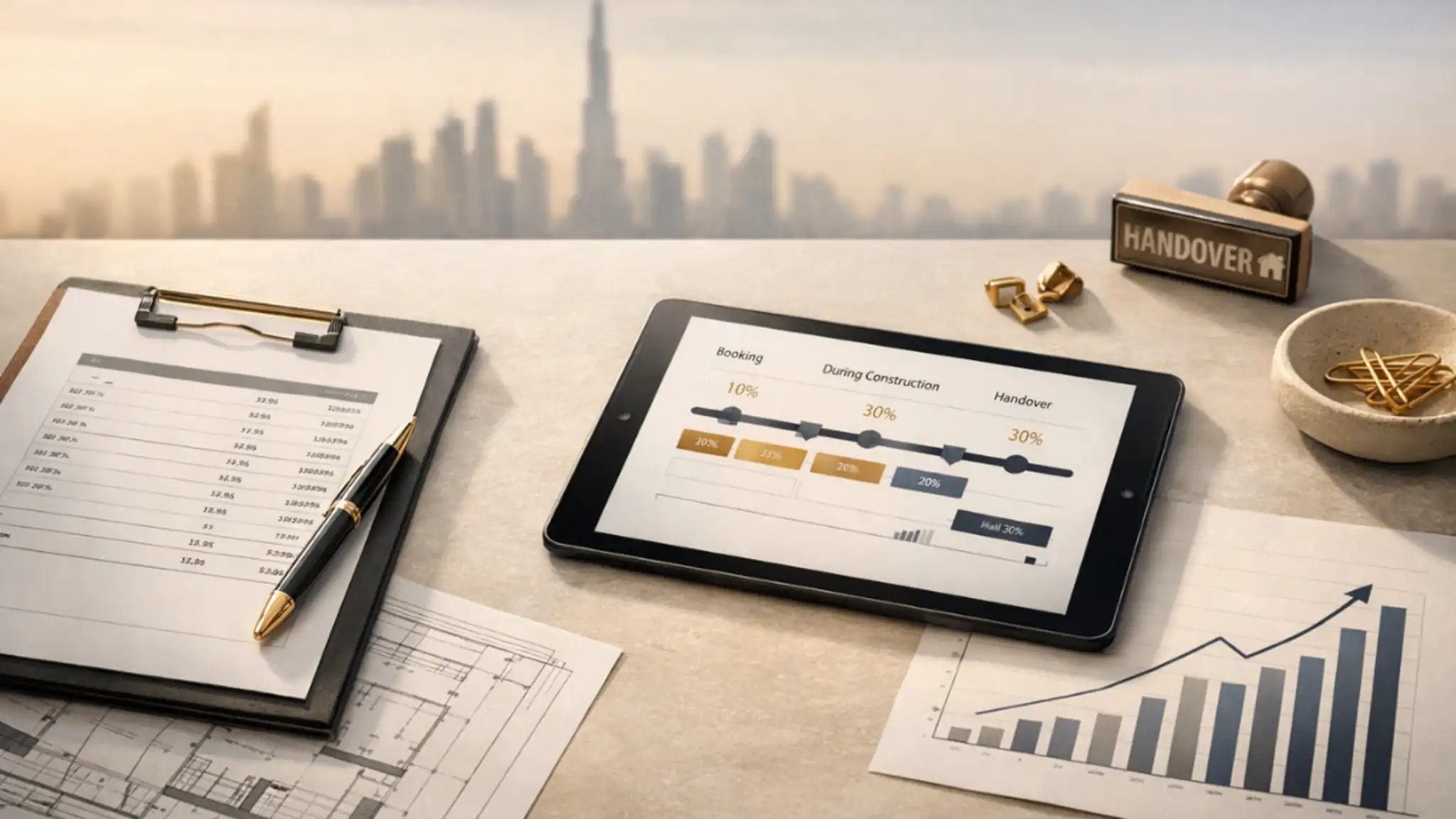
Payment plans are the headline reason many investors start looking at off-plan. Typically, you’ll see a deposit at reservation, followed by instalments during construction, and then a larger final payment at handover (or, in some cases, a post-handover schedule).
Common payment plan structures you’ll see
- Construction-linked plans: instalments triggered by build milestones (foundation, superstructure, façade, etc.).
- Time-based plans: fixed payments every month/quarter, regardless of progress.
- Handover-heavy plans: lower instalments during construction, with a larger balance due at completion.
- Post-handover plans: part of the price is paid after you receive the keys (useful, but only if the terms suit your cashflow).
Important: Always model your payment plan with “real life” costs included — not just the developer instalments. That means fees, furnishing, service charges, and a cash buffer for delays.
If you want a deeper look at the real cost structure, read this breakdown before you commit to any reservation.
Dubai off plan property price gap: why some launches look “too cheap”
You’ll often notice a “price gap” between newly launched off-plan units and comparable ready properties nearby. Sometimes that gap is genuine early-stage pricing. However, it can also reflect differences that matter to your return.
Reasons the off-plan price may be lower
- Time risk: you wait for completion, so you’re effectively “paying today” for use later.
- Market cycle risk: if prices soften during construction, your resale window may be less attractive.
- Location maturity: new districts can take time to build schools, retail, transport flow, and community feel.
- Specification differences: layouts, view premiums, and finishing quality can vary widely by developer.
In other words, the gap can be fair — or it can be a warning. A clean way to sanity-check it is to compare: (1) expected rent at handover, (2) service charges and furnishing costs, and (3) resale liquidity for similar stock.
Dubai Off Plan Properties risks: what to watch before you pay a deposit
Off-plan risks are manageable when you plan for them. Problems usually happen when buyers assume the brochure tells the whole story. Below are the main risk buckets we see, plus what to do about each one.
1) Handover delays
Delays can happen even with good developers. Because of that, your plan needs a buffer. If you’re relying on rental income from month one, for example, a delay can strain cashflow.
- Check the developer’s delivery history on past projects.
- Read the contract clauses around delays and compensation (if any).
- Keep a contingency fund so you’re not forced to exit at the wrong time.
2) Build quality and snagging
Quality varies. The best approach is to treat snagging as non-negotiable and budget for it. Then, if the home is excellent, you simply don’t need to spend it.
- Review previous handovers by the same developer.
- Plan a snagging inspection at handover.
- Consider furnishing and fit-out costs as part of the investment case.
3) Contract misunderstandings
Many “surprises” come from clauses buyers didn’t notice: unit size definitions, variation rights, payment triggers, penalties, and handover conditions.
- Slow down and read the SPA properly.
- Confirm what is included (appliances, parking, storage, balcony areas, etc.).
- Clarify resale and assignment rules early if you might exit before completion.
For a practical due diligence checklist, use this guide before paying any reservation fee.
Dubai Off Plan Properties ROI: how to estimate returns without guesswork
When people say “ROI”, they often mean different things. Some mean rental yield. Others mean capital growth. A sensible investor looks at both, and then stress-tests the numbers.
Rental yield basics for off-plan
- Expected rent at handover: base it on comparable homes already leasing in the same community.
- Service charges: these can materially affect net yield.
- Letting costs: include brokerage and ongoing maintenance.
- Furnishing: especially important if you plan to target premium tenants.
Capital growth: what actually moves the needle
- Micro-location: walkability, access roads, views, and proximity to transport.
- Unit type: layouts with strong tenant demand are easier to let and resell.
- Community trajectory: pipeline of retail, schools, and employment hubs nearby.
- Handover timing: completing into strong demand can support price resilience.
Tip: Build a simple “three-scenario” model: best case, base case, worst case. If the base case still works after fees and realistic rent assumptions, you’re thinking like an investor.
If you want an area-led approach to demand and resale strength, use this location guide alongside your shortlist.
Dubai off plan property mortgage: what’s realistic (and when)
Mortgages on off-plan can be possible, but they don’t work like a standard ready-property mortgage. In many cases, buyers use cash or staged payments during construction, and then arrange financing nearer handover (subject to bank criteria, valuation, and documentation).
Because lending policies vary, your plan should be flexible. If you might need financing at completion, you should stress-test affordability early, rather than assume it will be available on the day.
Golden visa Dubai off plan properties: when it can matter
Some buyers ask whether an off-plan purchase can support longer-term residency options, including the Golden Visa route. In practice, eligibility depends on the rules and how the property and value are assessed at the time you apply.
Instead of making assumptions, it’s safer to treat residency as a separate workstream: confirm the criteria you’ll need to meet, and then structure your property plan accordingly.
For a straightforward overview, see this explanation and then speak to a qualified adviser for your personal circumstances.
Dubai Off Plan Properties map: picking the right community, not just the right brochure
Buyers often start by comparing glossy renders. We prefer starting with your objective: capital growth, stable rent, lifestyle, or a blend. From there, we shortlist communities where the fundamentals support that objective.
Questions that shape the right community choice
- Are you targeting long-term tenants, short stays, or end-user resale?
- Do you need metro access, schools nearby, or a specific commute pattern?
- Is the area already mature, or still building its amenities and identity?
- How much new supply is completing around your handover date?
If your priority is “buying right” as a foreigner, it also helps to read this guide before you get too deep into unit comparisons.
Dubai off plan property status: how to track progress and reduce surprises
Once you reserve a unit, the goal is to stay informed without getting overwhelmed. Most developers provide construction updates, and you can also ask for clear milestone confirmations that align with your payment triggers.
- Keep a calendar of instalment dates and milestone expectations.
- Store receipts and correspondence in one place (it makes handover smoother).
- Plan snagging, DEWA setup, and any furnishing timeline well ahead of completion.
Dubai off plan property market cycles: how to think about timing
Timing matters, but it’s rarely as simple as “buy now, sell in two years”. Off-plan is a timeline-based investment. That means your entry point should be aligned to a realistic exit option: hold and rent, refinance, or resell after completion.
Instead of trying to predict the market perfectly, focus on controllable factors: good developers, strong micro-locations, and unit types with consistent tenant demand. Those choices tend to be more resilient across cycles.
For ongoing context, you can also follow our monthly market updates.
Dubai Off Plan Properties: a simple decision checklist (before you reserve)
- Your goal: rent, resale, lifestyle, or a mix? Be specific.
- Your timeline: can you comfortably wait to handover, even with delays?
- Your cashflow: do instalments fit your monthly/quarterly budget with a buffer?
- Your developer filter: track record, build quality, and delivery consistency.
- Your “all-in” cost: include fees, furnishing, service charges, and a contingency.
- Your exit options: hold, resell, or refinance — and when each becomes realistic.
Want us to pressure-test a shortlist for you?
Share your budget, preferred payment plan shape, and timeline. We’ll help you compare projects like an investor: total cost, realistic rent range, handover risk, and a sensible exit plan.
FAQs: Dubai Off Plan Properties
Are Dubai Off Plan Properties safe for foreign buyers?
They can be, provided you buy with a strong process: reputable developer, clear contract review, realistic budgeting, and a timeline that suits your cashflow. Safety comes from due diligence and planning, not from hype.
What deposit do you typically need to reserve an off-plan unit?
Deposits vary by developer and project stage. What matters more than the headline deposit is the full payment schedule and how it aligns with your budget, especially if there is a large handover payment.
Can you resell before handover?
It depends on the project’s rules and the contract terms. Some developers allow assignment under specific conditions, while others restrict it until certain payments or milestones are met. If you might exit early, confirm this before you reserve.
How do I estimate ROI on an off-plan purchase?
Start with realistic rent assumptions based on comparable completed homes, then subtract service charges and operating costs to estimate net yield. Next, treat capital growth as scenario-based and avoid relying on a single “guaranteed” appreciation figure.
What should I check in the SPA before I sign?
Focus on payment triggers, handover conditions, delay clauses, unit specifications, variation rights, fees, and resale/assignment restrictions. If any clause feels unclear, slow down and get it clarified in writing.
Next steps
If you’re comparing launches right now, it helps to pair this article with a practical process guide and a due diligence checklist. Here are the most useful next reads:
- Step-by-step purchase process
- How to buy safely on a tighter budget
- Choosing the right strategy for your goals
- Foreign buyer investment process
Speak to Plans Made Easy via Dubai Light Haven
Whether you’re aiming for rental income, long-term growth, or a future home, we’ll help you choose projects that fit your budget, timeline, and risk comfort — with clear numbers and no pressure.

Performance Verified ✅
This page meets PME Optimisation Standards — achieving 95+ Desktop and 85+ Mobile PageSpeed benchmarks. Verified on
