
Share this post:
Quick summary: Buying Real Estate in Dubai
If you’re Buying Real Estate in Dubai as a foreign buyer, the process is usually straightforward — provided you follow the correct order: confirm the property is in a freehold area, run due diligence, agree the sale terms, then complete the transfer at a licensed registration trustee.
- Foreigners can buy in designated freehold areas (most popular investor locations are freehold).
- Main government cost is typically the 4% DLD transfer fee (plus trustee/administration charges) — budget this upfront.
- Key documents are usually your passport (and Emirates ID if you’re resident), plus seller documents and developer NOC where required.
- Mortgage buyers should get pre-approval early; there’s also a mortgage registration fee (a percentage of the loan).
- Best practice: treat it like any serious investment — check service charges, rental demand, and resale liquidity before paying a deposit.
Below, we’ll walk you through the step-by-step process our team uses with overseas buyers so you know what happens, what to budget for, and what to double-check before you sign anything.
Want a clear, buyer-safe plan before you pay a deposit?
Message our Plans Made Easy team at Dubai Light Haven and we’ll map the exact steps, costs, and documents for your situation — especially if you’re buying from overseas.
Quick summary: Buying Real Estate in Dubai
Buying Real Estate in Dubai as a foreigner is typically a defined process: choose a freehold property, agree terms in writing, complete checks (including the developer NOC where needed), then transfer ownership through an authorised registration trustee — with government fees paid at transfer.
The buyers who feel most confident are the ones who budget accurately (including transfer and trustee fees), confirm what’s included in the sale, and verify the building’s running costs before paying a deposit.
Buying Real Estate in Dubai: the step-by-step overview
If you’re coming from the UK or Europe, the Dubai process can feel refreshingly structured — but the pace can be quicker, and the “admin” costs are sometimes misunderstood. So, here is the high-level flow we use with overseas buyers:
- Pick the right ownership zone (freehold for most foreign buyers) and confirm the property’s legal status.
- Budget properly for transfer fees, trustee fees, agent fee, and any mortgage charges.
- Agree terms in writing (price, deposit, timeline, included items, and conditions).
- Complete due diligence (title deed status, seller authority, NOC, service charges, and building quality).
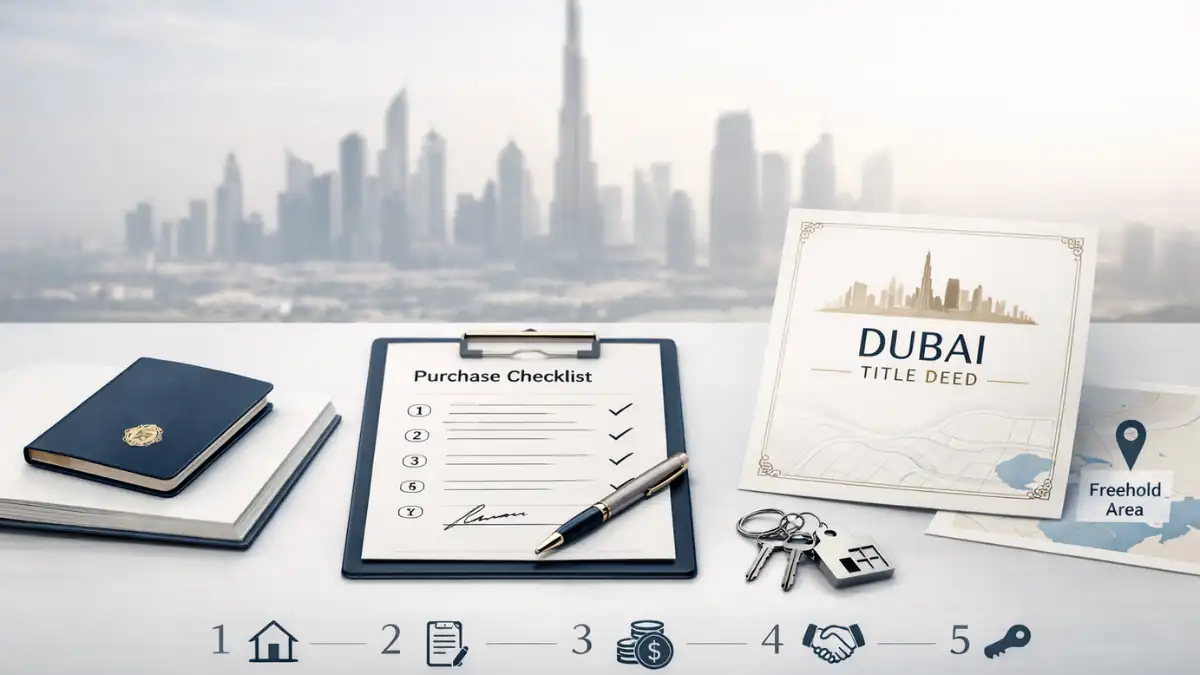
- Transfer ownership at a registration trustee and receive the title deed.
Before you buy: freehold areas, budget, and strategy
Before you view properties (or pay a reservation), decide what success looks like for you. Are you buying for lifestyle use, long-term capital growth, rental yield, or a mix? That answer affects the area, unit type, and even whether off-plan makes sense.
Freehold vs other ownership types
Most overseas buyers focus on freehold areas, where foreign ownership is permitted. A good agent should confirm the ownership status immediately — but we still like to double-check early, because it saves time later.
Set a “true budget” (not just the property price)
A realistic budget includes purchase price + transfer fees + trustee fees + agent fee, and then your ongoing costs (service charges, maintenance, insurance, and, if relevant, letting management). In practice, a buyer who plans properly feels in control — even when timelines move quickly.
Costs of Buying Real Estate in Dubai (fees you should expect)
Let’s talk about the costs that catch foreign buyers out — not because they’re “hidden”, but because they’re often not explained clearly at the start.
Government and trustee costs at transfer
- DLD transfer fee: commonly structured as 4% of the sale value (often shown as 2% buyer / 2% seller in the service schedule). This is part of the official sale registration process.
- Title deed issuance: a fixed admin charge applies at transfer.
- Service partner / trustee fees: a fixed fee band applies depending on the sale value (with VAT), paid during registration.
- Maps / admin items: small fixed charges can appear depending on property type.
Quick costs snapshot – what most foreign buyers budget for
- Transfer fee (percentage of the purchase price).
- Trustee / registration partner fee (fixed band + VAT).
- Agent fee (commonly agreed commercially, often a percentage).
- NOC fee (varies by developer/community).
- If using a mortgage: mortgage registration fee (percentage of the loan) + bank charges.
If you want, we can build you a line-by-line budget before you commit — it’s one of the easiest ways to reduce buying stress.
Documents required for Buying Real Estate in Dubai (foreigners)
Documentation can vary slightly depending on whether you’re resident, non-resident, buying with a mortgage, or buying via a company. However, the typical individual buyer should expect:
- Valid passport (especially important for non-resident foreigners).
- Emirates ID if you’re a UAE resident.
- Developer e-NOC where required (commonly handled via official channels/apps depending on the developer and area).
- Signed sale paperwork confirming terms (price, deposit, and timelines).
Step-by-step process: from offer to title deed
Here’s the step-by-step process we typically guide foreign buyers through. Your exact sequence can differ slightly depending on the property type (ready vs off-plan) and whether a mortgage is involved.
Step 1: Choose the property and confirm ownership basics
- Confirm the unit is in a freehold area (where foreign ownership is permitted).
- Check what is included (parking, kitchen appliances, furniture, payment timeline).
- Ask for service charge information and building rules if you plan to rent it out.
Step 2: Agree price and terms in writing
Once a price is agreed, the key is to document the terms properly: the deposit amount, timeline to transfer, conditions (if any), and what happens if something is delayed. In Dubai, clarity up front usually prevents disputes later.
Step 3: Due diligence checks
This is where experienced buyers slow down slightly — because it protects your money. Typical checks include:
- Seller verification and authority to sell.
- Property status (ready, mortgaged, tenanted, under notice, etc.).
- Developer NOC requirements and timeline (where applicable).
- Service charges and any known special levies or major works.
Step 4: NOC and trustee booking
Many resales require a No Objection Certificate from the developer before transfer. Once that’s in motion, you book the transfer at a licensed registration trustee and prepare the payment instruments required for the day.
Step 5: Transfer day and title deed issuance
At the trustee appointment, fees are paid, documents are verified, and the transfer is completed. You then receive the electronic title deed as proof of ownership.
Step-by-step checklist table – Buying Real Estate in Dubai (foreign buyer)
| Stage | What you do | What you confirm |
|---|---|---|
| Pre-search | Set strategy, target areas, and true budget | Freehold eligibility, realistic net yield assumptions |
| Offer | Negotiate price + terms in writing | Deposit, timelines, inclusions, any conditions |
| Checks | Run due diligence | Seller authority, unit status, service charges, NOC needs |
| NOC | Apply for developer NOC (if required) | NOC fee, expected time, any outstanding balances |
| Transfer | Attend trustee appointment (or POA) | Fee breakdown, payment instruments, title deed issued |
Buying with a mortgage: what changes for foreign buyers?
If you’re financing, the single biggest improvement you can make is getting mortgage pre-approval before you negotiate hard on a specific unit. It strengthens your position and prevents avoidable delays.
What’s different when a mortgage is involved?
- More documents: banks request income evidence, bank statements, and identity documents.
- Property valuation: lenders typically require a valuation before final approval.
- Mortgage registration fees: there is a mortgage fee calculated as a percentage of the mortgage value, plus related admin items.
Not sure if you should buy cash, mortgage, or a payment plan?
Tell us your budget and goals and we’ll outline the cleanest route — including the likely timeline, paperwork, and the fees buyers usually miss.
Buying off-plan vs ready property: key differences
Many foreigners consider off-plan because it can reduce your upfront cash requirement (via staged payments) and give you access to brand-new stock. However, the checks are different.
Ready property (resale or developer inventory)
- You can inspect the building, view the unit, and validate finishes.
- You can assess actual service charges and real rental performance in the tower/community.
- Transfer is typically quicker once NOC and paperwork are in place.
Off-plan property
- Focus shifts to the developer’s track record, contract terms, payment schedule, and handover standards.
- Snagging, handover timing, and post-handover defects management matter more.
- Exit rules (resale before completion) can vary by developer/project.
Buying Real Estate in Dubai vs UK: what feels different?
A lot of British buyers ask us this, because the buying “feel” is different even when the legal fundamentals are familiar. In simple terms:
- Timeline: Dubai transactions can move quickly once terms are agreed, especially for cash buyers.
- Process centre: the trustee transfer appointment is a clear milestone where ownership changes hands.
- Cost structure: you typically budget the transfer-related charges explicitly as part of the purchase plan.
- Investor mindset: service charges, building quality, and community demand are discussed very early (as they should be).
If you’d like a “UK buyer checklist” approach, we can provide a simple one-page plan you can follow from offer to title deed without guesswork.
Gotchas to avoid when Buying Real Estate in Dubai
These are the most common issues we see with foreign buyers — and the fixes are usually straightforward if you handle them early.
1) Underestimating the full upfront budget
Buyers sometimes focus on the headline price and only later realise they need extra cash for transfer and trustee charges, agent fees, and NOC costs. A clean budget prevents last-minute stress.
2) Ignoring service charges and building rules
Two apartments with identical prices can perform very differently if service charges are high or short-term letting rules are strict. Always treat running costs as part of the deal.
3) Treating “rental demand” as universal
Demand varies by building quality, view, layout, parking, and walkability — not just the area name. If your plan includes rent, check realistic comparable listings, not just marketing figures.
4) Skipping snagging on handover (off-plan)
Even good developers can hand over minor defects. Snagging is not “being difficult” — it is protecting your asset and future rental reputation.
FAQs: Buying Real Estate in Dubai
Can foreigners buy property in Dubai?
Yes — foreigners can buy in designated freehold areas. The practical key is confirming the unit is in a permitted ownership zone and ensuring the transfer is completed through the official registration process.
What documents are usually required to buy property in Dubai as a non-resident?
Typically you’ll need a valid passport (and Emirates ID if you’re resident). Depending on the transaction, you may also need supporting sale paperwork and a developer NOC where applicable. The Dubai Land Department’s sale registration service lists passport/ID and NOC requirements as part of the process.
Is it safe to buy property in Dubai?
Dubai has an established property registration system, and ownership is recorded via official processes with an electronic title deed issued on completion. “Safe” in practice comes down to doing your checks: verify seller authority, confirm fees, understand service charges, and avoid paying money outside documented, traceable steps.
Can you buy property in Dubai without living there?
Yes. Many buyers purchase as non-residents. The main practical considerations are: how you handle viewings and inspections, whether you travel for the transfer or use Power of Attorney, and how you manage the property afterwards if you intend to rent it.
Is Buying Real Estate in Dubai worth it?
It can be — if the unit is priced correctly, the running costs are sensible, and the building/community has proven demand. We encourage buyers to judge “worth it” using three lenses: (1) realistic rent after service charges, (2) resale liquidity for that building, and (3) your time horizon.
Is it a good time to buy real estate in Dubai?
The better question is whether it’s a good time for your goals. If you’re buying for yield, focus on net returns and occupancy; if you’re buying for lifestyle, focus on long-term affordability and suitability. A short review of comparable sales and current listings usually makes the decision clearer.
Can you buy real estate in Dubai with crypto?
Some transactions may involve crypto in parts of the payment chain, but the practical and compliance reality matters: property transfers and official registrations are typically settled in the required forms and currency for the trustee/DLD process. If you’re considering this route, get specialist guidance early so you don’t create delays at transfer.
Does buying property help with a UAE Golden Visa?
Potentially, yes. The Dubai Land Department’s investor service notes eligibility where the property purchase value is 2 million AED or more (with specific conditions, including for mortgaged properties). If visa planning is part of your strategy, we recommend confirming your exact case before you buy.
Want us to sanity-check the steps before you proceed?
Share the unit link (or the developer/project name) and your budget. We’ll flag the key fees, documents, and due diligence checks that matter most for overseas buyers.
Next steps & useful guides
If you want to go deeper than the step-by-step process alone, these DLH guides will help you build a safer, clearer buying plan:
- Start with our foreign-buyer overview (the main guide)
- Use our due diligence checklist before you pay any deposit
- Understand payment plans and the real costs behind them
- Compare neighbourhoods using our location guide
- Learn how off-plan handover and costs work in practice
- See the visa and legal overview for property buyers
- Foreign ownership Foreigners can buy in designated freehold areas (confirm eligibility per unit/location).
- Core transfer cost Budget for the official transfer fee (commonly structured as 4% total) plus trustee/service partner charges and fixed admin items.
- Typical documents Passport (non-residents) and Emirates ID (residents), plus sale paperwork and developer NOC where required.
- Mortgage note Mortgage buyers should secure pre-approval early and budget for a mortgage registration fee (percentage of loan value) and bank charges.
- Best buyer habit Treat service charges, building quality, and resale liquidity as part of the purchase decision — not an afterthought.
Official references (for fee schedules and processes)
- Dubai Land Department – Property Sale Registration
- Dubai Land Department – Registering the Sale of a Mortgaged Property
- Dubai Land Department – Golden Visa application (Investor)
Ready to move forward with confidence?
Contact our Plans Made Easy team at Dubai Light Haven. We’ll guide you through the full buying process — from shortlist to transfer — with clear costs, clean paperwork, and buyer-first due diligence.
Performance Verified ✅
This page meets PME Optimisation Standards — achieving 95+ Desktop and 85+ Mobile PageSpeed benchmarks. Verified on
