
Share this post:
Quick summary: Best Dubai Property Investment (hidden costs)
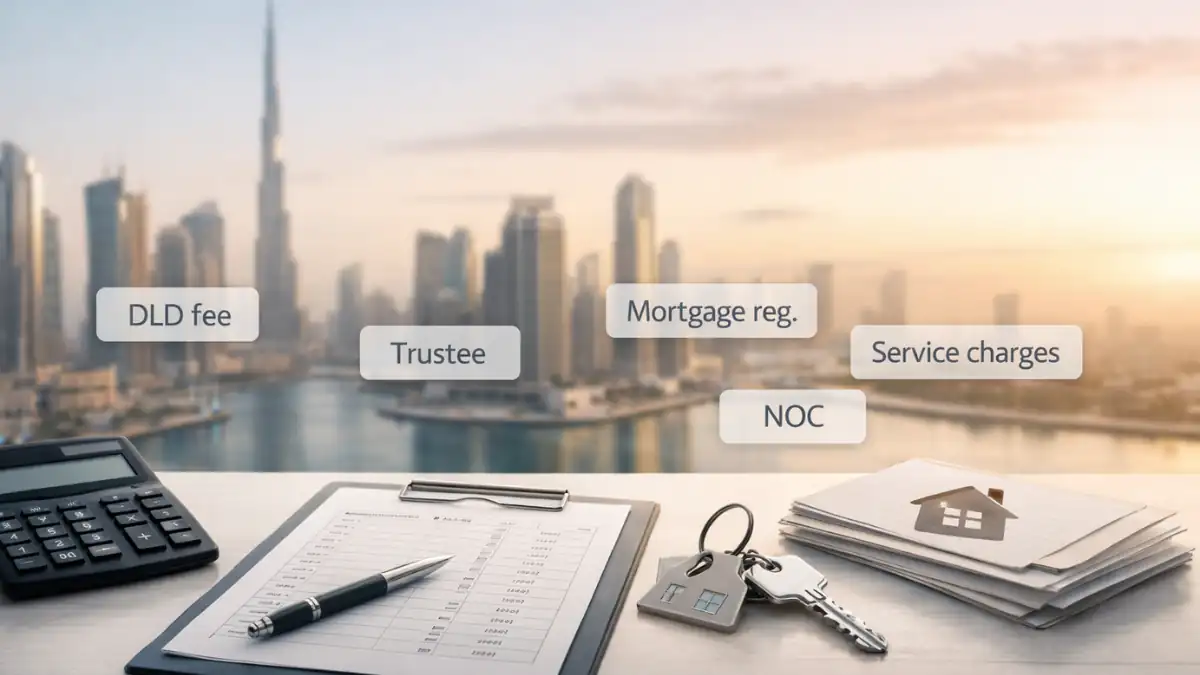
If you’re aiming for the Best Dubai Property Investment, the purchase price is only half the story. In Dubai, your “true” cost of buying and holding a property is shaped by transfer/registration fees, trustee/admin charges, mortgage and bank costs, plus ongoing service charges (and sometimes chiller/DEWA deposits). Budgeting these properly is what keeps your net yield and resale plan realistic.
- DLD transfer/registration: typically 4% of the purchase price (often shown as 2% buyer + 2% seller) plus admin items.
- Trustee / registration centre fee: commonly AED 2,000–4,000 + VAT depending on the transaction value.
- Mortgage registration (if you finance): typically 0.25% of the mortgage value plus admin fees.
- Agent commission: commonly around 2% + VAT (varies by deal structure and property type).
- NOC + admin costs: can apply on resale and may vary by developer/building.
- Ongoing service charges: annual costs (per sq ft) that can materially change your net yield.
Our practical rule: treat fees and setup costs as a separate “transaction budget”, then treat service charges as part of your annual operating costs (alongside insurance, maintenance, and any holiday-home licensing if you plan short lets).
Want the real “all-in” number before you commit?
Send us the property link (or brochure) and we’ll map the likely fees, service charges and setup costs so you can judge the deal properly.
Best Dubai Property Investment: the hidden costs that change your returns
The phrase Best Dubai Property Investment usually brings to mind location, rental demand, and future growth. However, experienced investors also obsess over something less exciting: the fee stack. Put simply, the same property can look “great” or “average” depending on the total cost of buying (one-off fees) and the cost of holding (annual charges).
That’s why our team at Dubai Light Haven treats fees and running costs as part of the strategy — not an afterthought. It’s also why this guide sits alongside our Pillar article on choosing the right property type and investment model. Your model (long-let vs short-let, off-plan vs ready, mortgage vs cash) determines which costs matter most.
What we mean by “hidden costs”
Most of these costs aren’t truly hidden — they’re just not front-and-centre in glossy listings. In practice, they fall into three buckets:
- Transaction fees (paid when you buy and/or sell): DLD registration, trustee fees, NOC fees, mortgage registration and agent commission.
- Building/community costs (paid annually): service charges, sinking fund contributions, and community management fees.
- Operating costs (depends on your plan): DEWA deposits, chiller charges, furnishing, minor maintenance, insurance, and licensing if you go short-let.
One-off buying fees: DLD registration, trustee and admin items
For many buyers, the biggest surprise is how “normal” it is to have a 4% registration cost on top of the purchase price. In Dubai, sale registration through Dubai Land Department processes commonly shows 2% seller + 2% buyer (often discussed as 4% total), plus a set of admin items like title deed issuance and map fees.
DLD registration/transfer fee: the non-negotiable line item
- Typical headline: around 4% of the sale value (often structured 2% buyer + 2% seller depending on the agreement).
- Other DLD/admin items: title deed issuance and map fees can apply depending on the transaction and property type.
- If you’re comparing deals: a lower purchase price in one building can be offset by higher service charges later — so look at the whole picture.
Trustee / registration centre fees (and why they matter)
In most ready-property transfers, the transaction is processed through authorised trustee/registration centres. These typically carry a service partner fee that changes depending on the sale value. In other words: even when the DLD percentage is familiar, you still need to budget the processing fee.
- Typical band: about AED 2,000–4,000 + VAT depending on whether the sale value is below or above the threshold.
- Why it matters: it’s a cash cost, due during the transfer process (so timing matters as much as the amount).
NOC and developer/building admin fees (resale scenario)
If you buy on the secondary market (resale), many developers require a No Objection Certificate (NOC) before the transfer can complete. The NOC process is usually straightforward, but the cost and timing can vary by developer and building.
- What it’s for: confirms there are no outstanding service charges or issues preventing transfer.
- Why investors care: it affects how quickly you can complete, and it’s one more payable item to include in your transaction budget.
If you want the broader buying journey mapped end-to-end, use our practical guide: the complete buying process in Dubai. If you’re buying as a non-resident, also read: what foreign buyers should expect.
Mortgage and bank fees (and why they surprise overseas buyers)
Financing can be an excellent tool for boosting your overall portfolio performance — but it also adds its own costs. Beyond standard bank arrangement/valuation items, Dubai’s system includes a formal mortgage registration fee.
Mortgage registration with DLD
- Typical fee: around 0.25% of the mortgage value (plus admin items).
- When it hits: as part of the purchase/registration flow, so it affects your completion funds.
For a clean due diligence approach before you pay a deposit, use: our investor due diligence checklist. It helps you check not only the property, but also the costs that can hit between reservation and transfer.
Not sure what the “all-in” fees look like on your exact unit?
We’ll build a simple budget sheet showing purchase fees, likely annual charges, and a realistic net-yield estimate.
Off-plan fees: Oqood, payment-plan admin and handover costs
Off-plan can be a strong route to growth, especially when payment plans are structured well. Yet off-plan also has its own fee language, and some costs land earlier than buyers expect. If your goal is the Best Dubai Property Investment through off-plan, you’ll want clarity on registration timing, developer admin items, and handover costs.
Oqood (provisional registration) and why it appears early
For many off-plan purchases, the initial sale is recorded through the Oqood portal (provisional sale registration). You’ll often see the same “2% seller + 2% purchaser” structure reflected in service fees, plus knowledge/innovation fees and a self-registration fee for developers.
- What it does: records the transaction during construction and helps protect buyer rights.
- Why it matters: it changes cashflow timing — you can pay registration-style costs well before handover.
Payment-plan admin fees and “small print” costs
Developers vary in how they package admin fees (reservation, SPA processing, amendments, and so on). Most are not huge individually, but they can stack up. That’s why we recommend reading our dedicated guide: how Dubai payment plans really work (and what to watch).
If you’re shortlisting new launches, this guide helps you connect the dots between fee timing, handover milestones and the real cost of ownership: Dubai off-plan projects — payment plans, handover and real costs.
Service charges: what they cover, how they’re set, and how to check them
Service charges are often the biggest long-term swing factor in your net yield. Two properties with the same rent can produce very different returns if one has premium facilities (multiple pools, concierge, high-end landscaping) and the other is more “lean”.
What service charges typically cover
- Building maintenance (lifts, lobbies, common areas, MEP systems)
- Security, cleaning, waste management
- Community landscaping and shared facilities (where applicable)
- Management and operational costs for jointly-owned property
How to check service charges properly
Dubai has an official Service Charge Index function that allows customers to inquire about approved service fees for jointly owned properties. We still recommend getting the building’s latest service charge statement where possible, because your real payment schedule and any special assessments matter too.
Holding costs: utilities, maintenance, and short-let licensing
After completion, your investment becomes an operating asset. That’s a good thing — but it means budgeting like a landlord, not just a buyer. Your exact costs depend on whether you do a long-let or short-let, and whether the unit is furnished.
Common operating costs investors forget to include
- Utility setup: deposits and connection items (varies by unit/building and usage).
- Minor maintenance: air-con servicing, snagging follow-ups, wear-and-tear fixes.
- Letting/management: tenant-find fees, renewals, and property management (if you’re overseas).
- Holiday home / short-let setup: licensing and operational compliance (if you choose this model).
If you’re a UK-based buyer, we also recommend reading: our UK investor cost checklist. It’s designed to help you budget in AED while still thinking clearly in GBP.
Step-by-step: your hidden-costs budget checklist
Here’s the process we use when we sanity-check a deal for investors. It keeps the numbers clean and makes it easier to compare options across areas and property types.
Checklist: calculate the “all-in” cost before you reserve
- Confirm the deal type. Ready vs off-plan, resale vs developer, cash vs mortgage.
- Write down the “headline” registration cost. Model the DLD registration/transfer cost as a percentage of purchase price, then add trustee/admin items.
- Add agent and admin fees. Include agent commission, and allow for NOC/admin costs on resale transactions.
- If financing, add mortgage extras. Include mortgage registration, valuation and bank arrangement items.
- Get the service charge figure. Ask for the latest service charge rate (per sq ft) and model it annually.
- Model conservative net yield. Use realistic rent, voids, and operating costs (especially if you’ll use a manager).
- Stress-test the exit. Add selling costs (agent fee, possible NOC, transfer process costs) so your resale target is realistic.
FAQs: Best Dubai Property Investment (fees, service charges & more)
Is buying property in Dubai a good investment once you include all the fees?
It can be, provided you budget properly. A deal that looks excellent on gross yield can soften once you include registration costs, ongoing service charges, and operating costs. The smart approach is to compare properties on net yield and a realistic resale plan — not headline rent alone.
What are the main “hidden costs” that affect net returns in Dubai?
Most investors should budget for the registration/transfer cost, trustee/admin items, agent commission, and (if applicable) mortgage registration. Then, on an annual basis, service charges are usually the biggest swing factor. If you plan short lets, licensing and management costs matter too.
How do service charges work in Dubai, and why do they vary so much?
Service charges are annual fees (often calculated per square foot) that cover maintenance and operation of the building/community. They vary because amenities and management costs vary. Buildings with concierge services, extensive leisure facilities, and premium common areas typically cost more to run.
Is off-plan cheaper once you include Oqood and payment-plan costs?
Off-plan can be attractive, especially for staged cashflow and potential upside. However, “cheaper” depends on the full model. You’ll often face provisional registration-related costs earlier, and you still need to model service charges and operating costs once the unit is handed over. If you want to compare properly, read our guide on off-plan costs and handover realities.
Is it worth investing in Dubai property from the UK, or do the extra steps add too much friction?
UK buyers invest successfully every day, but the friction is real if you don’t plan for it. The best way to reduce stress is to pre-budget fees, use a clear due diligence checklist, and have a management plan if you won’t be in Dubai often. Start with: our UK investor budget checklist.
Why do Dubai listings sometimes look “cheap” compared to other global cities?
Listings show purchase price, not the full cost picture. Buildings with higher service charges can appear better value on price per sq ft, while costing more to hold. That’s why we encourage you to evaluate the asset on an “all-in” basis: fees + annual charges + realistic rent assumptions.
Want us to sanity-check your numbers?
We’ll help you compare two or three options on a like-for-like basis, including fees, annual charges and net yield.
Next steps & useful guides
If you want to go deeper (and make sure your strategy fits your chosen property type), these guides will help:
- Choosing the right property type and investment model
- The full buying process in Dubai (from reservation to transfer)
- Due diligence checklist before you pay a deposit
- Understanding Dubai payment plans (real costs and admin items)
- Off-plan projects: costs, handover and what to check
- UK buyers: the true cost and budget checklist
- Legal, finance and Golden Visa basics for property buyers
- Core registration cost Commonly structured as 2% buyer + 2% seller (often discussed as 4% total), plus admin items.
- Trustee / registration centre Often around AED 2,000–4,000 + VAT depending on the sale value band.
- Mortgage registration (if financed) Typically 0.25% of the mortgage value plus admin fees.
- Service charges (annual) A major driver of net yield; always request the latest figure and confirm what it includes.
- Best investor habit Compare options on net yield (after service charges and operating costs), not gross rent.
Official references (for fees and service charges)
- Dubai Land Department: Property Sale Registration (service fees)
- Dubai Land Department: Registering the Sale of a Mortgaged Property
- Dubai Land Department: Service Charge Index overview
- Dubai Land Department: Provisional sale registration (Oqood portal)
Ready to invest with eyes open?
Tell us your budget and target area, and we’ll shortlist options with realistic fees, service charges and net-yield expectations.
Performance Verified ✅
This page meets PME Optimisation Standards — achieving 95+ Desktop and 85+ Mobile PageSpeed benchmarks. Verified on
