
Share this post:
Quick summary: Are Dubai Properties Freehold
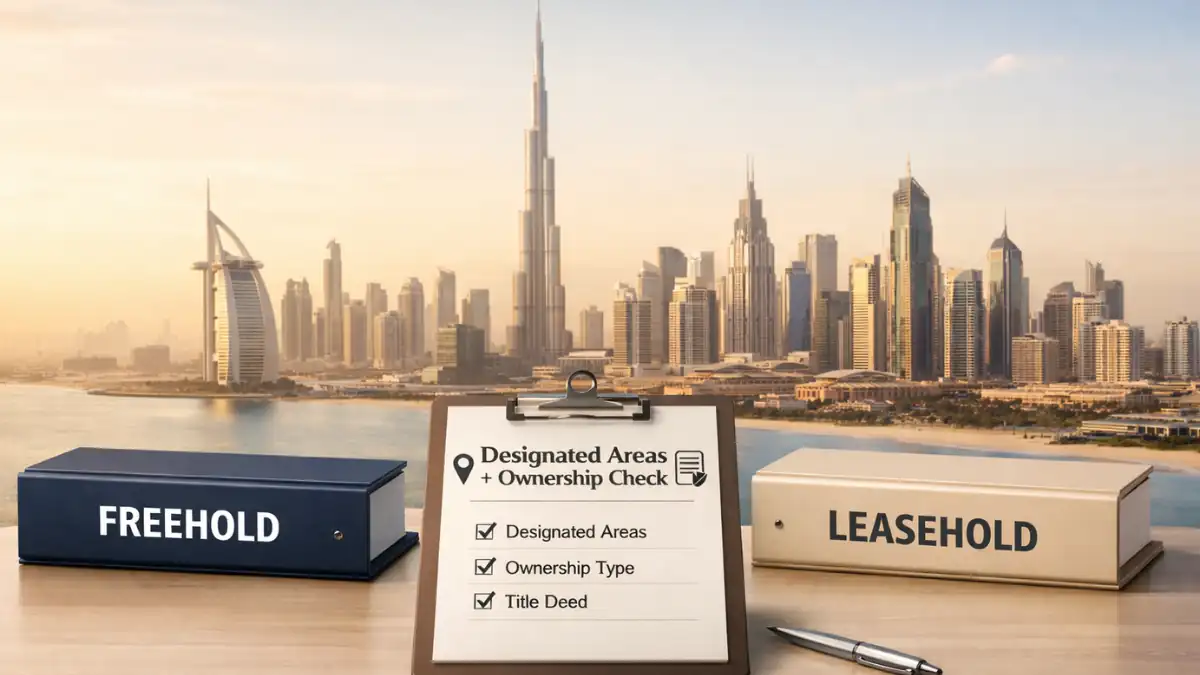
If you’re asking Are Dubai Properties Freehold, the honest answer is: some are — and some are not. In Dubai, overseas buyers can typically purchase with “freehold” rights in designated areas, while other neighbourhoods are structured as long leases or other property rights.
- Freehold usually means you own the unit (and often a share of the building’s common areas) with your ownership recorded by Dubai Land Department.
- Long lease / usufruct can look similar day-to-day, but it is time-limited (often up to 99 years) and the contract terms matter.
- Non-designated areas generally restrict what non-UAE nationals can buy — so location is the first filter.
- Off-plan purchases are typically registered on the DLD’s off-plan system during construction, then moved to a title deed at completion.
The key is not the marketing brochure — it’s what’s written in the SPA and what can be registered with DLD. Our team can sense-check a unit and explain what you actually get before you pay a deposit.
Want to confirm what you’ll actually own before you reserve?
Share the project name (and brochure if you have it) and we’ll explain the ownership structure, registration route, and the practical implications for resale and renting.
Are Dubai properties freehold or leasehold?
Most buyers arrive with the same question: Are Dubai Properties Freehold — and can a foreigner buy them? In practice, Dubai offers a mix of ownership structures. The important point is that your rights depend on the area, the specific property right being sold, and what can be registered with the Dubai Land Department (DLD).
In everyday conversation, people say “freehold” and “leasehold” as a neat two-choice comparison. However, Dubai also uses other long-term property rights (such as usufruct and musataha), which can feel similar to a long lease but have different legal mechanics.
So, what does “freehold” usually mean in Dubai?
In simple terms, “freehold” typically refers to a form of ownership that can be registered in the real property register, with a title deed issued for completed property. For most apartment buyers, that means you own your unit and you also have rights tied to the building’s common areas through the owners’ association structure.
And what does “leasehold” mean here?
“Leasehold” is commonly used as a catch-all phrase for time-limited rights. In Dubai, you may see structures such as long-term leases (often up to 99 years) and usufruct, which provides a right to use and benefit from a property for a defined term. In some development scenarios, musataha can apply, which relates to building and benefiting from a building for a set term.
Freehold vs leasehold in Dubai: the differences that matter
If you’re choosing between “freehold” and a long-term right, focus on the practical investor outcomes — not the label. Here are the differences we see affecting buyers most often.
1) Time horizon and resale mechanics
- Freehold is generally “open-ended” and tends to be easier to explain to future buyers and lenders.
- Long leases / usufruct are time-limited, so buyers will naturally price in the remaining term and the contract conditions.
2) What you can do with the property
In many cases, you can still rent, resell, and pass on long-term rights — but the contract wording matters. For example, approvals for alterations, subletting clauses, renewal terms, and transfer fees can differ between structures.
3) Registration and “proof” of ownership
- For completed property, buyers usually look for a DLD title deed as the cleanest proof of registered ownership.
- For off-plan purchases, buyers typically begin with an off-plan registration certificate during construction, which later converts to a title deed on handover.
Designated areas: why location determines what you can buy
For most non-UAE nationals, the concept of designated areas is the core rule. Put simply: Dubai permits foreign ownership and certain long-term rights in specific locations determined by the relevant authorities. This is why two neighbourhoods can feel similar on a map but have very different ownership options.
If you’re buying as a UK resident or other overseas buyer, start your search by filtering for areas where your intended structure is permitted, then shortlist projects and unit types within that framework.
How to check what you’re buying (step-by-step)
Whether you’re buying ready property or off-plan, your goal is the same: confirm the property right, confirm the registration path, and confirm the costs and restrictions that come with it.
Ownership check checklist (use this before you pay a reservation fee)
| What to check | What a “good answer” looks like |
|---|---|
| The exact right being sold | The SPA clearly states freehold / long lease / usufruct / musataha, and who the registered holder is. |
| Registration route | Ready unit: title deed transfer. Off-plan: off-plan registration during construction, then title deed at completion. |
| Area eligibility | The property is in a location where your buyer profile can register the right being sold. |
| Fees and ongoing costs | You have written clarity on DLD fees, developer/admin fees (if any), and service charges. |
| Restrictions | Rules on renting, alterations, and transfer are clear (and not buried in a separate schedule). |
If anything is unclear, that is your cue to slow down. A clean purchase is usually the one where the broker, developer (or seller), and conveyancer all describe the same structure in the same words — and it matches what can be registered.
Not sure if a unit is “the right kind” for your plan?
Tell us your goal (end-use, rental, or resale timeline) and we’ll help you filter projects that fit — including the ownership structure and the likely buyer pool later.
Off-plan purchases: registration during construction
If you’re buying off-plan, ownership is usually documented and registered differently before handover. Instead of a final title deed immediately, buyers typically start with an off-plan registration record during construction, then receive a title deed when the unit is completed and transferred.
Costs, timelines, and practical impacts for investors
Buyers often assume the ownership label changes the overall buying process. In reality, the steps are broadly similar — but the risk checks and the future buyer pool can differ.
When it matters most
- If you’re planning to hold long-term: “freehold” tends to be the simplest structure to explain and refinance against later.
- If you’re aiming for resale in 2–5 years: the easiest resales are usually those with uncomplicated registration, clear fees, and wide lender acceptance.
- If you’re buying for rental income: what matters is local demand, service charges, building quality, and management — more than the label itself.
A quick reality check on “cheap” listings
Some buyers see surprisingly low prices and ask whether something is “wrong”. Price can be low for plenty of normal reasons — layout, view, age of building, service charges, or simply a motivated seller — but it can also reflect a narrower buyer pool (for example, if the ownership structure is less familiar). The fix is not fear; it’s due diligence.
Related comparisons & common searches buyers make
When people research Are Dubai Properties Freehold, they often branch into adjacent questions. Here are the most common ones we hear — and how to think about them sensibly.
“Can I buy property in Dubai from the UK?”
In many cases, yes — but the key is buying in the right locations and using the correct legal and registration process. The practical steps (documents, banking, and timelines) are usually straightforward when you work with a proper conveyancing pathway and a clear payment plan.
“Is Dubai property a good investment?”
It can be, but only if the unit fits your strategy. We encourage buyers to judge: building quality, service charges, rental demand, exit liquidity, and the realism of any payment plan — rather than relying on a headline yield.
“How is the Dubai property market?”
Markets move in cycles. The safest approach is to focus on fundamentals you can control: budget discipline, conservative assumptions, and buying a unit you could still hold comfortably if the market takes longer to rise than expected.
Common pitfalls (and how to avoid them)
- Assuming “designated area” means every building is identical: the location may be eligible, yet the specific unit’s paperwork still matters.
- Not reading the schedules: key terms (fees, renewals, approvals) can sit in annexes, not the headline SPA pages.
- Ignoring ongoing costs: service charges and building management can make or break the net return.
- Overfocusing on the label: the lived reality is about registration, rules, and resale demand.
FAQs: Are Dubai Properties Freehold
Are Dubai properties freehold for foreigners?
In Dubai, non-UAE nationals can generally buy with freehold rights in designated areas. Outside those locations, the available options may be different, so the first step is always confirming the area and the right being sold.
Can you buy freehold property in Dubai without UAE residency?
Many buyers purchase without being UAE residents. What matters most is whether the property is in a location where your buyer profile can register the right, and whether your conveyancing and payment pathway are set up correctly.
What does “freehold” mean in Dubai in plain English?
In simple terms, it usually means registered ownership that can be recorded with Dubai Land Department, with the buyer receiving the relevant ownership documentation (such as a title deed for completed property).
What are “non-freehold areas” in Dubai?
“Non-freehold” is often used to describe areas where foreign buyers cannot register freehold ownership, and where other structures apply. If you have a target neighbourhood, we can tell you what is typically available there and what paperwork you should expect.
Is leasehold in Dubai always a bad idea?
Not necessarily. A long-term right can still be perfectly workable for renting and resale, provided the term is long, the contract is clear, and the registration is clean. The question is whether it fits your time horizon and resale plan.
How do I verify what I’m buying before I pay a deposit?
Ask for the SPA wording, confirm the registration route, and ensure the structure matches what can be registered. For off-plan, confirm what certificate you get during construction and what you receive at completion.
Why do some properties look “cheap” compared to others?
Price differences are often explained by view, layout, building age, service charges, or seller urgency. Sometimes, it can also be down to buyer demand and how easy it is to finance or resell. Due diligence turns “cheap” into either a bargain or a warning — you want to know which before committing.
Want a second opinion before you commit?
Send us the listing link and the project name. We’ll help you confirm the ownership structure, likely fees, and the checks you should do next.
Next steps & useful guides
If you want to go beyond “Are Dubai Properties Freehold” and understand the full buying process and strategy trade-offs, these guides will help:
- Our complete buyer guide for Dubai
- A step-by-step walkthrough for foreign buyers
- How to choose the right property strategy
- A practical due diligence checklist before you pay a deposit
- How to assess payment plans and the true costs
- A clear guide to visas and finance considerations
- Short answer Some are, and some are not — it depends on designated areas and the property right being sold.
- Best first check Confirm the community is eligible for your buyer profile, then verify what can be registered with DLD.
- Common alternatives Long-term rights (often up to 99 years) can exist and may still work well — but the contract terms matter.
- Off-plan reality During construction, buyers typically have an off-plan registration record, then receive a title deed on completion.
- Most important habit Treat marketing as marketing. Rely on the SPA wording, the registration path, and clear written fees.
Want help confirming a specific unit? Message our team and we’ll sense-check the ownership structure before you reserve.
Ready to buy with clarity (not guesswork)?
Dubai Light Haven will help you choose the right area, verify the ownership structure, and avoid the common paperwork traps that cost buyers time and money.
Performance Verified ✅
This page meets PME Optimisation Standards — achieving 95+ Desktop and 85+ Mobile PageSpeed benchmarks. Verified on
