
Share this post:
Quick summary: How to Buy Property in Dubai
If you’re searching How to Buy Property in Dubai, the good news is the process is structured, highly documented, and (in most cases) very workable for overseas buyers. The key is knowing which route you’re on — ready property (title deed transfer) or off-plan (developer purchase and staged payments) — because the steps, fees and timelines differ.
- Foreigners can buy in designated freehold areas — you don’t need to be a resident to own property.
- Budget beyond the price: think DLD registration/transfer costs, trustee/admin fees, agent fee (if applicable), developer NOC, and mortgage costs if financing.
- Expect 3 clear stages: (1) choose & reserve, (2) due diligence + paperwork, (3) register ownership (Title Deed or Oqood).
- Buying from abroad is common: much of the process can be handled remotely, but always keep identity/KYC and document legalisation in mind.
In the guide below, we’ll walk you through the exact step-by-step process our team uses with foreign buyers — plus the common pitfalls (and how to avoid them).
Want a calm, practical purchase plan — before you commit?
Tell us your budget, preferred area and whether you want off-plan or ready. Our Dubai Light Haven team will map the safest route and the real costs you should expect.
Quick summary: a step-by-step purchase you can follow
How to Buy Property in Dubai comes down to one core principle: make decisions in the right order. Choose the right area and asset type first, confirm the true “all-in” costs second, and only then sign and pay. When buyers rush this sequence, they usually overpay, buy in the wrong building, or get surprised by fees and timelines.
Our rule of thumb: if a deal feels “too fast”, slow the process down and verify the paperwork. Dubai is a transparent market when you follow the correct steps.
How the buying process works: ready property vs off-plan
Before you go into the checklist, you need to know which purchase route you’re on. Dubai property transactions are usually one of the following:
1) Ready property (secondary market)
- You buy from an existing owner (or an investor who already holds the unit).
- Ownership transfers at a registered trustee office, and you receive a Title Deed.
- Timelines can be fast if documents are clean and the seller is responsive.
2) Off-plan (direct from a developer)
- You buy from the developer, usually with a staged payment plan.
- Registration is different during construction (you won’t receive a final Title Deed until handover).
- Due diligence is developer-led — so you must be more careful about contract terms, delivery history, and payment schedules.
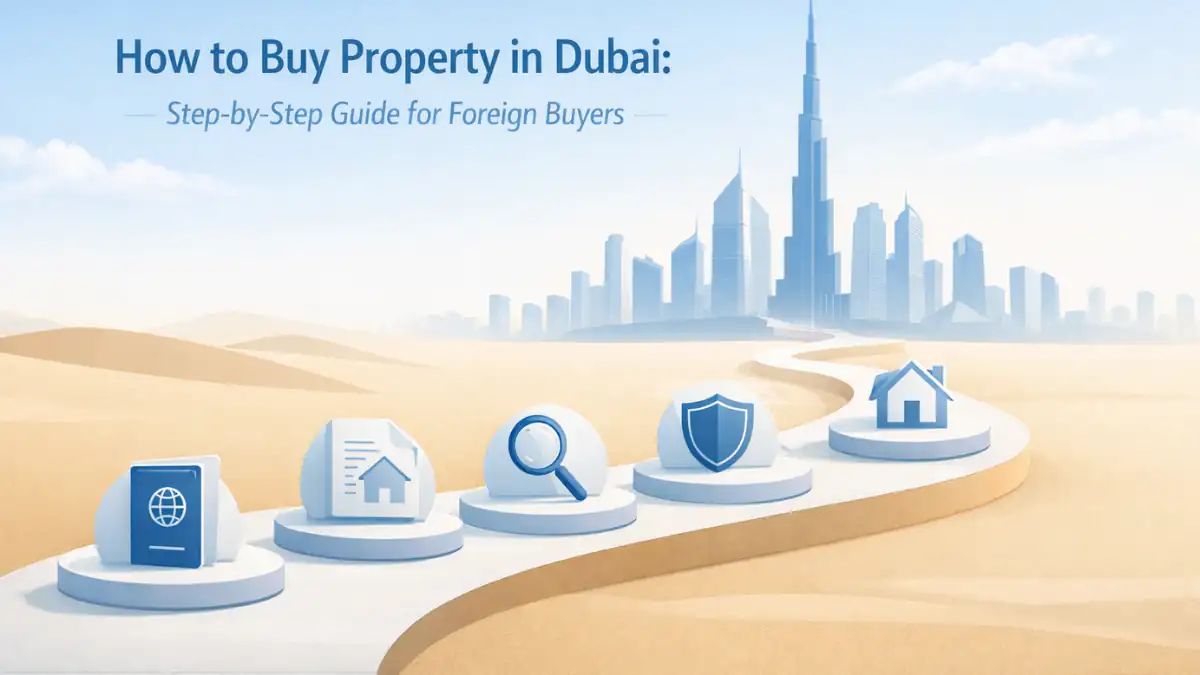
How to Buy Property in Dubai: step-by-step guide for foreign buyers
Here is the step-by-step process we use with international clients so nothing important gets missed. You can follow this whether you are buying from the UK, Europe, India, or elsewhere.
Step 1: Confirm your goal (and don’t skip this)
- Investment: yield, tenant demand, service charges, building quality, resale liquidity.
- Personal use: lifestyle, commute, schools, noise, parking, amenities, long-term suitability.
- Hybrid: live now, rent later — plan for furnishing, licensing rules, and exit flexibility.
This single step controls everything that follows — area choice, property type, budget, and the best payment method.
Step 2: Set a true “all-in” budget (price + fees + buffer)
In Dubai, most buyers budget the purchase price but underestimate the transaction costs. That’s where stress begins. Build a budget that includes:
- Government registration/transfer costs
- Trustee/admin fees
- Agent fee (where applicable)
- NOC / developer admin charges (common on ready-property transfers)
- Mortgage costs (valuation, bank arrangement, registration fees) if financing
- A sensible buffer for exchange rates, furnishing, and initial maintenance
Step 3: Choose the right freehold area and building quality tier
Foreign buyers can purchase in Dubai’s designated freehold zones. The practical point is this: the same area can contain both excellent and poor buildings. So we advise you to shortlist at two levels:
- Area shortlisting (tenant demand, infrastructure, future supply, transport, lifestyle)
- Building shortlisting (maintenance history, service charges, developer reputation, unit mix)
If your focus is purely investment-led, you may also want our deeper investor-specific walkthrough: follow the investment purchase checklist here.
Step 4: Do “real” due diligence (not just brochure research)
Whether you’re buying ready or off-plan, your due diligence should cover:
- Unit details: view, layout efficiency, balcony usability, noise sources, parking allocation.
- Building fundamentals: lifts, cooling, fire systems, common-area condition, management quality.
- Numbers: rent reality (not optimistic), service charge structure, vacancy risk, comparable sales.
- Contract terms: payment dates, penalties, handover conditions, snagging, defect liability.
Step 5: Reserve the unit and agree the deal terms (properly)
At this stage, most buyers will pay a reservation amount (off-plan) or a deposit (ready property) and sign the key documents. This is where clarity matters:
- Confirm what is included (parking, appliances, furnishing, upgrades).
- Confirm completion timelines and any conditions.
- Confirm who pays which fees (some costs are negotiable between buyer and seller).
Step 6: Complete the ownership registration (Title Deed or construction registration)
This is the point where your ownership becomes formal in the Dubai system. The exact steps depend on whether the unit is ready or off-plan:
- Ready property: transfer is completed through an approved registration channel and you receive a Title Deed.
- Off-plan: you register the purchase during construction and receive the final Title Deed at handover.
A simple checklist you can use before paying anything significant
- Define your goal (investment, lifestyle, hybrid) and your timeline.
- Confirm the route: ready property or off-plan — and why.
- List your “must-haves” (area, building quality, layout, parking, view, resale ability).
- Build the all-in budget (price + fees + buffer).
- Verify the paperwork and make sure fees and timelines are written down.
- Only then move to deposit/reservation and formal signing.
Not sure which route is safer for your situation?
Send us the listing link (or the developer + unit type). We’ll tell you what to check, what the usual costs are, and what to avoid — especially if you’re buying from overseas.
Costs, fees & the “real costs” buyers often miss
Dubai is not a “hidden fees” market when you understand the categories. However, first-time foreign buyers often miss one of these:
- Government registration/transfer costs (varies by scenario, but must be budgeted)
- Service partner / trustee office fees depending on transaction value and type
- Developer NOC / admin charges (commonly required for ready-property transfers in many buildings)
- Mortgage costs (valuation, arrangement, registration) if financing
- Service charges and move-in costs post-purchase
Quick costs snapshot: what to ask for in writing
- Itemised fee list (government + admin + agent + developer)
- Who pays what (buyer vs seller allocation)
- Payment schedule (especially off-plan milestones)
- Service charge estimate and what it covers
If you’re buying off-plan, payment schedules can look attractive on day one but become uncomfortable later. Our team strongly recommends reading: this guide to payment plans and hidden costs.
Buying property in Dubai from abroad (UK, India, Europe & more)
Many of our clients buy while still living overseas. The process is usually smooth, but you must plan around practicalities:
How to buy property in Dubai from the UK (or anywhere overseas)
- Time zones: align signing windows and transfer timelines early.
- Document handling: passports, signed forms, and (sometimes) legalised documents.
- Banking: understand how funds will be transferred and what the receiving party accepts.
- Remote viewings: video walkthroughs help, but still validate the building fundamentals.
How to buy property in Dubai as an Indian (and other common buyer groups)
The process is the same, but the logistics differ — especially around banking, remittance rules, and document turnaround time. If you’re buying from India, Pakistan, South Africa, Germany, Australia, Canada (or anywhere else), the safest approach is:
- confirm the funds route and expected transfer time,
- keep identity and KYC documentation ready, and
- avoid last-minute changes to buyer details once contracts are drafted.
Cash, mortgages, and “crypto purchases” — what’s actually realistic
Buying with cash
Cash purchases are common and can be the cleanest route, particularly for overseas buyers who want fewer moving parts. Still, “cash” doesn’t mean “no checks” — you should still expect proof-of-funds and identity verification.
Buying with a mortgage (as a foreigner)
Non-resident mortgages exist, but the approval timeline and documentation requirements tend to be stricter. If you are financing, build extra time for bank valuation, final offer issuance, and registration steps.
Buying using crypto
Buyers often ask about “buying property in Dubai using crypto”. Some developers and brokers market this heavily. In reality, the safe approach is to assume that property registration still needs clean, compliant documentation. If crypto is involved, it usually means crypto is converted through an approved channel before completion — and you should verify the compliance steps in writing before you rely on it.
Pitfalls & gotchas to avoid (so you don’t learn the hard way)
- Confusing area reputation with building quality — always assess the building itself.
- Underestimating service charges — these can materially change net yield.
- Rushing the paperwork — small name/passport errors can delay registration.
- Assuming “handover date” is guaranteed on off-plan — check track record and contract language.
- Comparing Dubai to the UK without adjusting assumptions — tenancy rules, service charges, and transaction structure are different.
Common comparisons buyers ask us about
- Dubai vs UK: faster transactions and different holding costs — but you must be sharper on building fundamentals.
- Dubai vs Sharjah: different ownership zones and lifestyle/commute considerations.
- Dubai vs Turkey: different currency dynamics, regulation environment, and liquidity — compare like-for-like before deciding.
If you want the broader context (including freehold basics and how ownership works), start here: read our main Dubai buying guide.
FAQs: How to Buy Property in Dubai
Can foreigners buy property in Dubai?
Yes — foreign buyers can purchase property in Dubai’s designated freehold areas. You do not need to be a UAE resident to own property. The key is ensuring the unit is in a freehold zone and that the transfer/registration steps are followed correctly.
Is buying property in Dubai a good investment?
It can be, but it depends on what you buy. The strongest results usually come from a good building in a proven rental area, with service charges that make sense and a realistic rent estimate. If you treat it like an operating asset (not a brochure), you make better decisions.
Is it safe to buy property in Dubai?
Dubai’s property system is structured, and purchases are recorded through formal registration channels. Most “safety issues” are not about the system — they come from rushed decisions, weak due diligence, or not understanding the contract terms. If you follow a disciplined process, risk reduces sharply.
Is it possible to buy property in Dubai as a non-resident?
Yes. Many non-residents buy while living overseas. The practical difference is logistics: document handling, timelines for signatures, and making sure funding routes and proof-of-funds requirements are prepared early.
Can foreigners buy property in Dubai with a mortgage?
In many cases, yes — non-resident mortgage options exist. However, the process tends to be more document-heavy, and timelines can be longer. If you plan to finance, build extra time for approvals, valuation, and bank requirements before you set a completion date.
How to buy property in Dubai step by step without getting caught out?
Don’t start with “the deal”. Start with the route (ready vs off-plan), build an all-in budget, shortlist buildings (not just areas), and only then sign and pay. Most expensive mistakes happen when buyers pay before the paperwork and fee allocation are clarified.
Is it expensive to buy property in Dubai once fees are included?
The headline price is only part of the picture. You should budget for government registration/transfer costs, admin/trustee fees, and often agent and developer charges. Once you see the full cost list, you can compare Dubai fairly with other markets.
How much property do you need to buy in Dubai for a Golden Visa?
Criteria can change and depends on the exact route, but the commonly referenced threshold for property-related eligibility is a minimum property value requirement. We always recommend checking the latest official requirements before you buy with residency as the main goal.
Want us to turn this into a personalised checklist for your situation?
Share your target area, budget, and whether you’re buying from overseas. We’ll reply with the exact steps, expected costs, and the key documents to prepare.
Next steps & useful guides
- Start with our broader Dubai buying guide (freehold, process, ownership basics)
- Understand payment plans: real costs, common traps, and what to negotiate
- Investment-only walkthrough: how to choose for yield and resale strength
- Contact Dubai Light Haven to plan your purchase route
- Two main routes Ready property (Title Deed transfer) vs off-plan (developer purchase + staged payments).
- Your safest order Goal → all-in budget → area + building shortlist → due diligence → paperwork → registration.
- Biggest buyer mistake Falling in love with a listing before confirming fees, building fundamentals, and contract terms.
- Buying from abroad Very common, but plan for KYC, document turnaround, and compliant funding routes early.
- Best risk reducer A written checklist, verified documents, and a calm timeline — not pressure decisions.
If you want our team to map your next steps, contact Dubai Light Haven here and we’ll guide you through the cleanest route for your buyer profile.
Official guidance worth checking
Rules and fee schedules can change, so it’s sensible to verify the latest requirements on official sites:
- Dubai Land Department (DLD) – Property sale registration (service details and fee components)
- DLD – Registering the sale of a mortgaged property
- UAE ICP – Golden Residency (official eligibility and documentation)
- UAE Government portal – Golden Visa overview
Ready to buy — and want it done properly?
If you’re buying from abroad (or buying for the first time), we’ll keep the process simple: clear steps, clear costs, and no rushed decisions. Tell us what you’re aiming for and we’ll guide you through the safest route.
To wrap up: How to Buy Property in Dubai is straightforward when you follow the correct sequence — and when every fee, document, and timeline is clarified before you commit funds. If you’d like, our Dubai Light Haven team can turn this guide into a personalised step-by-step plan based on your nationality, budget, and chosen area.
Performance Verified ✅
This page meets PME Optimisation Standards — achieving 95+ Desktop and 85+ Mobile PageSpeed benchmarks. Verified on
