
Share this post:
Quick summary: Dubai Off Plan Projects
If you’re looking at Dubai Off Plan Projects, the big question is rarely “is it off-plan?” — it’s what am I really paying, when do I pay it, and what happens if handover moves? Off-plan can work well for many investors and homebuyers, but only when the payment plan, project status, and total costs are understood upfront.
- Payment plans vary widely — the headline “1% monthly” isn’t the full picture once fees and milestones are added.
- Handover dates can shift; you want to plan for realistic buffers, not best-case marketing timelines.
- “Real costs” include more than the price — think DLD-related registration fees, admin charges, snagging, furnishing and running costs.
- Your legal position matters — the SPA, escrow arrangements, and your ability to resell/assign are where risk is actually controlled.
In this guide, our team breaks down how Dubai off-plan works in plain English — including typical payment plan structures, what happens at handover, and how to budget properly so there are no surprises.
Want a second opinion on a payment plan or project?
Send us the brochure or a screenshot of the plan and we’ll sanity-check the timeline, fees and resale rules — calmly and honestly.
Dubai Off Plan Projects: what they are (and why buyers use them)
Dubai Off Plan Projects are properties sold before they are fully completed (sometimes before construction starts). You reserve a unit, sign a Sales & Purchase Agreement (SPA), and pay in staged instalments linked to time or construction milestones. In return, buyers often get better launch pricing, new-build finishes, and structured payment terms that can be easier to manage than a single lump sum.
Off-plan is popular in Dubai because the market is built around new communities and planned growth. You’ll see everything from off-plan apartments in established districts to new master developments with phased releases, parks, retail and transport links. Some buyers focus on lifestyle, while others look for capital growth, rental demand, or a mix of both.
Why investors and buyers choose off-plan in Dubai
- Payment structure: staged plans can reduce upfront pressure versus paying 100% on day one.
- Modern product: new layouts, amenities, and contemporary building standards tend to appeal to tenants.
- Choice: early buyers can sometimes choose the best views, unit sizes, or floor levels.
- Potential upside: if the wider market rises during construction, completed value can be higher than the original purchase price.
Where buyers look (and how to think about location)
Searches often start with “best projects”, “new launches”, or “projects map” — and that’s understandable. However, we find it more useful to filter areas by what drives demand: work hubs, school access, transport, and long-term supply. Popular queries include district-focused searches (for example, Downtown area options) as well as broader “Dubai new plans” and “Dubai plan 2040” interest.
Payment plans for Dubai Off Plan Projects: what to expect
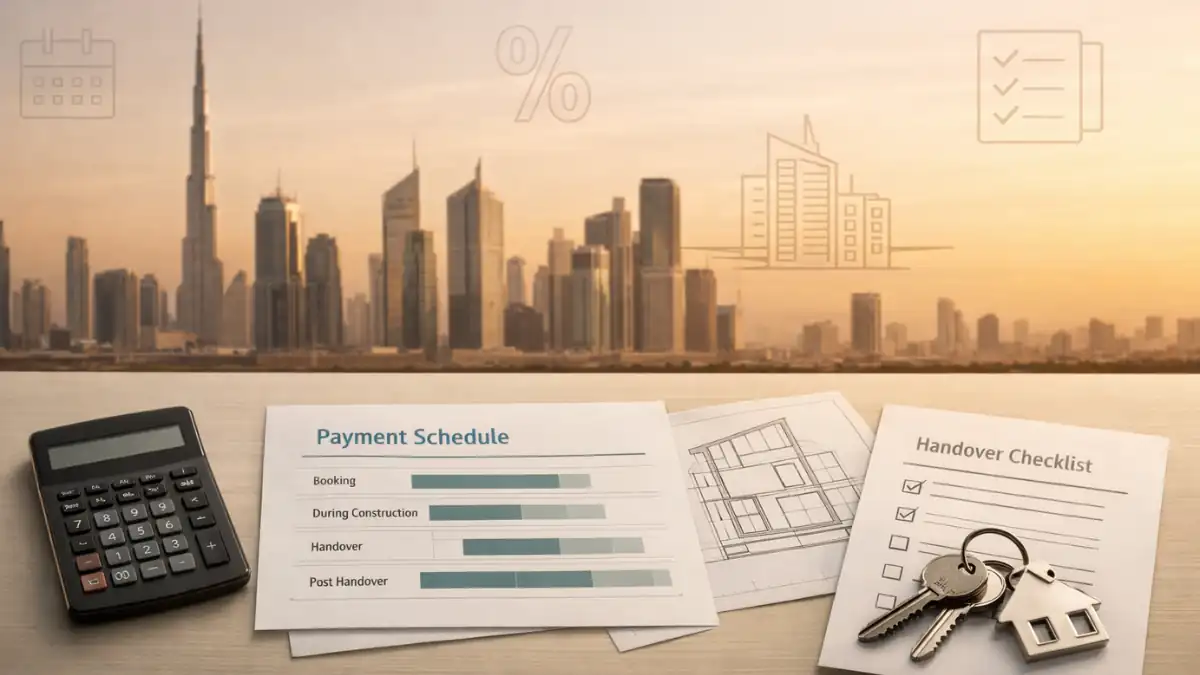
Payment plans are the heart of off-plan. The headline offer is usually simple (“60/40”, “70/30”, “1% monthly”), but the detail matters because it affects cash flow, resale flexibility, and total outlay by handover.
Common off-plan payment plan structures
- Construction-linked: instalments due at defined progress points (e.g., foundation, structure, façade, completion).
- Time-based: monthly or quarterly payments regardless of construction stage.
- Post-handover: a portion is paid after keys are issued (often over 1–3 years), subject to the developer’s rules.
- High-upfront / discounted: larger early payments can sometimes secure a stronger price, but reduce flexibility.
What “1% monthly” really means
“1% monthly” is usually a marketing shorthand, not a regulated format. Sometimes it means 1% of the purchase price each month after a booking amount, and sometimes it’s 1% for a period and then a larger balloon payment. In addition, you still need to allow for registration-related fees and admin charges.
Booking fees, deposit schedules and paperwork
Most launches start with a reservation/booking, then an SPA within a short window. The SPA sets out your instalment schedule, default rules, handover conditions, and any restrictions on resale/assignment. Because this document governs your rights, you want to understand it before you are emotionally committed to the unit.
Quick costs snapshot: budgeting beyond the brochure price
- Purchase price: the unit cost in the SPA.
- Registration-related fees: costs connected to official registration steps (timing varies by project and stage). :contentReference[oaicite:0]{index=0}
- Mortgage registration (if applicable): a government fee calculated as a percentage of the mortgage value (plus small admin fees). :contentReference[oaicite:1]{index=1}
- Move-in set-up: utilities deposits/connection, initial furnishing, snagging checks, and practical handover costs.
- Running costs: service charges, maintenance, insurance, and letting costs if you rent the unit.
The exact fee mix depends on whether you’re buying a completed property or registering an initial sale in an off-plan project, and on the specific process used for your transaction. :contentReference[oaicite:2]{index=2}
Handover in Dubai Off Plan Projects: timelines, snagging and keys
“Handover” is the point where the developer delivers the unit and you move from construction-stage payments to occupancy (or letting). It is also where buyers feel the difference between a well-managed project and a stressful one.
What usually happens at handover
- Completion notice: the developer confirms the project is ready for handover steps.
- Final payment(s): any remaining pre-handover instalments are paid according to the SPA.
- Snagging and inspection: you inspect finishes, systems and defects; issues are listed for rectification.
- Keys and access: you receive access once conditions are met (including payments and documentation).
- Operational set-up: utilities, building management processes, and practical move-in arrangements begin.
Handover delays: how to think about them calmly
Delays are frustrating, but they are not rare. The sensible approach is to plan for a range rather than a single date: set a conservative handover window, keep liquidity for a few extra months, and avoid hard commitments that assume keys on a specific week. If you’re relying on rental income, it is worth modelling a delayed start so you’re not forced into a rushed decision.
Snagging: why it matters (even in luxury projects)
Snagging is the process of identifying defects and incomplete items before you accept the unit as delivered. It protects you because small defects are easier to fix before you furnish or tenant the property. Even high-end developments can have finishing issues simply because large projects involve multiple contractors and tight timelines.
Real costs: fees, charges and budgeting properly
“Real costs” are where off-plan buyers either feel confident or feel caught out. The goal is simple: you should know your true all-in budget before you sign, not after the first invoice lands.
Registration and government-related fees (what to expect)
Dubai’s property system includes formal registration steps and defined service fees. In off-plan, the process is commonly tied to initial sale registration routes and project systems. The Dubai Land Department publishes service information on relevant eServices pages, including fees that can apply to registrations and mortgage-related charges. :contentReference[oaicite:3]{index=3}
- Initial sale / provisional registration: some processes show fees split between seller and purchaser, plus knowledge/innovation fees and other service items. :contentReference[oaicite:4]{index=4}
- Mortgage registration (if you use finance): listed as 0.25% of the mortgage value (plus additional fixed fees). :contentReference[oaicite:5]{index=5}
Service charges and operational costs
Service charges can make or break yields, especially in amenity-heavy towers. Pools, gyms, concierge services and large common areas can be attractive to tenants, but they also need maintaining. We encourage buyers to ask early for realistic service charge expectations and to model conservative rent assumptions.
Furnishing and letting costs (if you plan to rent)
If your strategy involves leasing, you’ll likely spend on furnishing, appliances, snagging rectification, and marketing/letting costs. That spend can be recovered over time through rent, but you want to avoid “panic furnishing” because the handover date arrived sooner than expected.
Not sure what the true all-in budget looks like?
We’ll map the payment plan against typical fees and handover costs so you can see the full picture before you commit.
Due diligence: how to check project status and reduce risk
Due diligence doesn’t have to be complicated. It just needs to be consistent. The purpose is to confirm the project is properly structured, funds are controlled appropriately, and the contract terms are workable for you.
Escrow accounts: what they are and why they matter
In Dubai, off-plan buyer payments are connected to the concept of an escrow account for real estate projects. The Dubai Land Department describes the escrow account as a project bank account where amounts collected from purchasers for units sold off-plan are deposited. :contentReference[oaicite:6]{index=6} This is one of the key buyer-protection mechanisms — it’s designed to separate project funds and support transparency around how payments are handled.
Project status: ask for evidence, not reassurance
Marketing can be slick. What you want is clarity: construction stage, realistic handover targets, what is already delivered by the developer, and how variations are handled. If a project has frequent “launches” and heavy discounts, it’s worth asking what is driving the urgency.
SPA terms to read carefully
- Payment triggers: what causes an instalment to become due?
- Default and grace periods: what happens if a payment is late?
- Handover definition: what counts as “complete” for key release?
- Resale/assignment rules: can you sell before handover, and under what conditions?
- Variation clauses: what changes can be made to layouts, views, or amenities?
Comparisons that matter: off-plan vs ready, apartments vs villas
Most buyers start by searching broad phrases like “best projects” or “projects map”. That’s fine for discovery, but decision-making comes down to comparisons that affect risk and returns.
Off-plan vs ready property: what changes for buyers
- Timeline: ready property can start producing rent sooner; off-plan requires patience and planning.
- Certainty: you can inspect a ready unit today; off-plan relies on specifications and delivery standards.
- Cash flow: off-plan spreads payments; ready property can be more finance-driven and upfront.
- Pricing dynamics: off-plan is sensitive to launch incentives; ready market is driven by immediate supply and demand.
Apartments vs villas: what usually matters most
Searches for off-plan apartments and off-plan villas often reflect lifestyle as much as investment. Apartments can be easier to let and manage in high-demand hubs, while villas may benefit from family-driven demand in school-led communities. Either can work, but the operational reality differs: villa maintenance and community fees can behave differently from tower service charges.
“Downtown” style searches and reality
Many people specifically look for central, landmark locations. When you’re comparing projects, focus on what drives long-term desirability: walkability, transport, supply pipeline, and the type of tenant or end-user that area attracts. A great tower in the wrong micro-location can still underperform.
Step-by-step: how to buy off-plan in Dubai (practical checklist)
If you’re buying for the first time, the process can feel fast. The easiest way to stay in control is to work in stages and make each stage “complete” before moving on.
Step-by-step: a practical buying process for Dubai Off Plan Projects
- Clarify your goal. Home, long-term hold, or resale before completion? Your goal changes the “right” payment plan.
- Shortlist areas. Choose locations based on demand drivers (work hubs, schools, transport), not just launch hype.
- Compare projects like-for-like. Unit type, view, floor, estimated service charges, and realistic handover window.
- Stress-test the payment plan. Model delays and include realistic “real costs” so you’re not surprised later.
- Review the SPA carefully. Pay special attention to handover definitions, default rules, and resale/assignment conditions.
- Confirm project protections. Understand escrow arrangements and official processes in plain terms. :contentReference[oaicite:7]{index=7}
- Plan for handover properly. Snagging, furnishing, utilities, and your letting plan if applicable.
How to think about “project status” and “market timing”
Buyers often ask, “How many off-plan projects are there?” or “Is the market surging?”. Instead of chasing headlines, focus on what you can control: buy in a location with proven demand, choose a product that tenants actually want, and keep your financing conservative. If the wider market lifts, you benefit — but your deal should still be workable without a perfect market.
Pitfalls & gotchas to watch for (before you sign)
Most off-plan problems are avoidable. They happen when buyers rush a decision, assume the brochure is the contract, or don’t model the full cost picture.
Common issues we see (and how to avoid them)
- Underestimating total costs: instalments are not the only outgoing — build a full budget model.
- Overweighting incentives: fee waivers and “guarantees” can distract from fundamentals like location and product.
- Ignoring service charges: net yield can disappoint if ongoing costs are higher than expected.
- Assuming handover is a single moment: it’s a process with inspections, snagging and operational set-up.
- Buying a unit you wouldn’t rent: the best “investment” unit is usually the one tenants compete for.
FAQs: Dubai Off Plan Projects
Are Dubai Off Plan Projects safe for overseas buyers?
They can be, provided you do proper due diligence. Focus on the developer’s delivery history, the SPA terms, and the project’s buyer-protection structure. Dubai’s framework includes the concept of project escrow accounts for off-plan funds, which is intended to support transparency and control around purchaser payments. :contentReference[oaicite:8]{index=8} The practical safety comes from verifying details rather than relying on reassurance.
What payment plan is “best” for an off-plan purchase?
The best plan is the one that matches your cash flow and your exit strategy. Monthly plans can feel comfortable, but check whether there are larger milestone payments later. If you may want to resell before completion, you also need to understand the developer’s assignment rules and any minimum paid percentage required before resale.
What does “handover” actually include?
Handover usually includes completion notice, final payment steps, inspection and snagging, and then keys/access once conditions are met. After that, you’ll still have practical set-up (utilities, furnishing, building management processes) before you move in or let the unit.
What are the main “real costs” beyond the property price?
Typical extra costs include registration-related service fees, admin charges, and (if using a mortgage) mortgage registration fees. Dubai Land Department eServices pages outline service fees for relevant processes and list mortgage registration fees as 0.25% of the mortgage value (plus fixed fees). :contentReference[oaicite:9]{index=9} You should also budget for snagging, furnishing, and ongoing service charges.
Can I get a mortgage on an off-plan property in Dubai?
Sometimes, yes — but it depends on the bank, the project, and the stage of completion. Many buyers fund earlier instalments in cash and consider finance closer to completion, when lenders can value the unit more conventionally. If you do use a mortgage, remember there is a mortgage registration fee payable when registering the mortgage. :contentReference[oaicite:10]{index=10}
What should I check about “project status” before reserving?
Ask for clear information on construction progress, planned completion, and what evidence supports that timeline. Confirm the SPA’s handover and delay clauses, and understand how your payments are structured if the programme shifts. You can also educate yourself on how escrow accounts are described for off-plan projects via Dubai Land Department guidance. :contentReference[oaicite:11]{index=11}
Is it better to buy an off-plan apartment or an off-plan villa?
It depends on your target tenant/end-user and your time horizon. Apartments often suit locations with strong rental liquidity and simpler management, while villas can be attractive to families in school-led communities but may come with different maintenance realities. The best choice is the one that aligns with demand drivers in that area.
How do I compare “new launches” without getting overwhelmed?
Use a repeatable checklist: location demand, developer delivery record, unit attributes (view, layout, floor), service charges, handover realism, and contract flexibility. Then score each project the same way. It turns a noisy marketplace into a clear decision.
Still unsure which project is “actually” the best fit?
We’ll help you compare two or three options side-by-side — payment plan, handover realism, and true costs — so you can move forward confidently.
Next steps & useful guides
If you want to go deeper than Dubai Off Plan Projects alone, these guides will usually help next. (Replace any placeholders below with the exact DLH URLs from your internal links list.)
- Buying property in Dubai: our complete guide
- How to choose the right Dubai area for your strategy
- Understanding service charges and running costs
- Mortgage basics for Dubai property buyers
- Ready property vs new-build: how to compare properly
- A simple due diligence checklist for buyers
- How to think about rental demand and yields
- What to expect at completion and move-in
- What “off-plan” means You buy before the unit is fully completed, paying in stages under an SPA.
- What matters most Payment plan realism, contract terms, project status evidence, and full all-in budgeting.
- Key buyer protection concept DLD describes a real estate escrow account as a project bank account where off-plan purchaser amounts are deposited. :contentReference[oaicite:12]{index=12}
- Mortgage-related cost (if used) Mortgage registration fee shown as 0.25% of mortgage value (plus fixed fees). :contentReference[oaicite:13]{index=13}
- Best practical habit Model conservative timelines and costs so delays and fees don’t force rushed decisions.
Useful external links
- Dubai Land Department FAQs (includes escrow account explanation) :contentReference[oaicite:14]{index=14}
- DLD eService: request to register the initial sale (service fees) :contentReference[oaicite:15]{index=15}
- DLD eService: mortgage registration (fees) :contentReference[oaicite:16]{index=16}
- DLD eService: registering the sale of a mortgaged property (fees list) :contentReference[oaicite:17]{index=17}
Ready to choose an off-plan project with confidence?
If you share your shortlist, we’ll help you compare the payment plans, handover realism and true costs — so you can move forward without guesswork.

Performance Verified ✅
This page meets PME Optimisation Standards — achieving 95+ Desktop and 85+ Mobile PageSpeed benchmarks. Verified on
