
Share this post:
Quick summary: Dubai Communities and Locations
If you’re trying to make sense of Dubai Communities and Locations, the simplest approach is to stop thinking “city-wide” and start thinking “community-first”. Dubai is built around master-planned neighbourhoods, each with its own lifestyle, price points, building quality, service charges, and rental demand.
- Best first step: choose a buyer profile (family, lifestyle, yield-focused, long-term growth) before you shortlist areas.
- Most important variable: commute + connectivity (Metro access vs car-dependent).
- For investors: compare net yield after service charges, not just headline rent.
- For end-users: focus on schools, parks, walkability, and everyday amenities within 10–15 minutes.
- Common mistake: buying “a tower” without understanding the community it sits in (and what’s being built next door).
Below, we break down Dubai’s key districts, the major community “types”, and a practical step-by-step method to pick the right location for your goals.
Want a short-list that actually fits your budget and lifestyle?
Tell us your budget, timeline, and “must-haves” (schools, Metro, beach, space, yield). Our team will suggest the most suitable areas and explain the trade-offs clearly.
This is our practical, investor-friendly guide to Dubai Communities and Locations — written to help you choose an area with confidence, whether you’re buying to live in or buying as an investor.
Dubai Communities and Locations: how Dubai is organised
Dubai doesn’t behave like many older UK cities where neighbourhoods evolved over centuries. Instead, it’s largely built through master-planned communities and districts — each with its own layout, amenities, building rules, and “feel”. That’s why “location” in Dubai is less about a postcode and more about the community ecosystem.
What does “community” mean in Dubai?
In Dubai, a community is usually a planned neighbourhood with a defined boundary and a recognised name (for example, a marina district, a villa community, or a mixed-use development with retail and parks). Communities often include:
- Core amenities (supermarkets, gyms, cafés, clinics)
- Transport links (Metro, tram, main road access)
- Property styles (towers, low-rise, townhouses, villas)
- Management structure (service charges, facilities upkeep, security)
A quick mental map of Dubai (useful if you’re new)
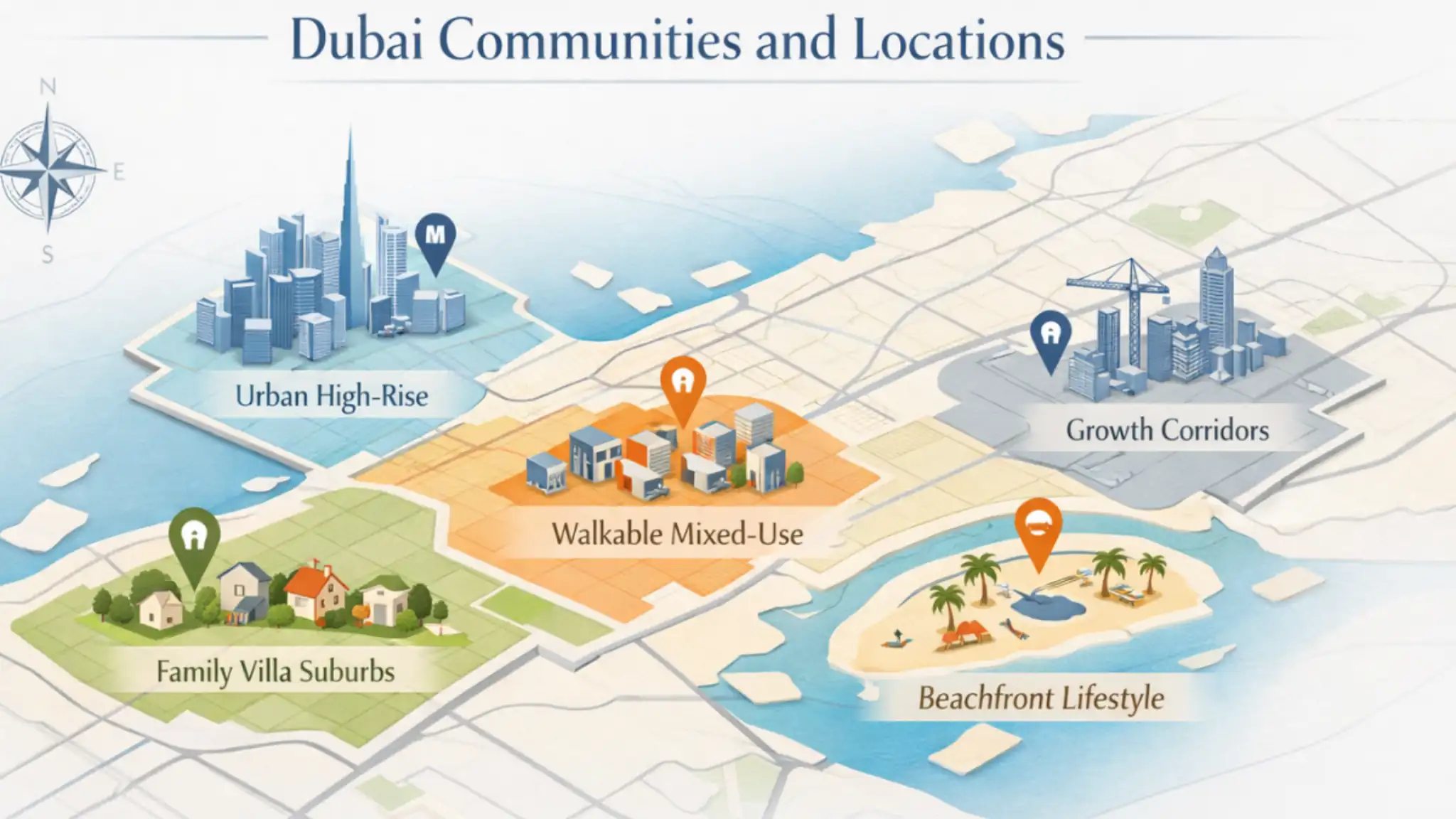
Most buyers end up choosing between a few “buckets”:
- Core city / business (high-rise living, faster commutes, more noise, strong rental demand)
- Coastal lifestyle (beach access, views, premium pricing, tourism/short-stay demand in some pockets)
- Suburban family (more space, schools, parks, car-first living, community facilities)
- Growth corridors (newer masterplans, off-plan pipelines, long-term upside with delivery risk)
Types of Dubai communities (and what they mean for price and demand)
Not all locations in Dubai are priced the same way, because they don’t serve the same buyer and tenant profiles. Once you understand the community “type”, your shortlisting becomes much easier.
1) High-rise urban districts
Typically apartment-led, with strong weekday demand and a broader tenant base (professionals, couples, corporate lets). These districts often offer:
- Better commute convenience
- More rental liquidity (easier to rent or resell, depending on the building)
- Higher service charge sensitivity (lifts, pools, shared facilities)
2) Mixed-use “walkable” communities
These aim to blend residential, retail, cafés, and parks so day-to-day life is easier without constant driving. For end-users, the lifestyle benefit is real. For investors, tenant retention can be stronger.
3) Family villa and townhouse communities
These are often chosen for space, schooling options, and a calmer pace. You’ll usually get:
- More internal space for the price (vs premium beachfront zones)
- Parks and community facilities (playgrounds, pools, walking routes)
- Car-dependent living (with some exceptions)
4) Resort-style and beachfront locations
These areas can be lifestyle-led and premium-priced. They can suit certain investors, but the numbers need to be checked carefully (especially if you’re comparing long-term rentals vs short-term stays).
5) Emerging / growth corridor masterplans
These are the “future Dubai” areas — newer infrastructure, large-scale community plans, and often attractive payment structures on off-plan. The trade-off is timeline and delivery risk (and the reality of living near construction).
How to choose the right Dubai community (step-by-step)
If you follow a simple selection method, you avoid the most common mistake we see: choosing an area based on photos, then discovering the day-to-day realities (traffic, access, noise, service charges, or a construction site outside your balcony).
Step-by-step: choosing Dubai Communities and Locations that fit your goals
- Define your “buying purpose”. Is this for living in, long-term renting, short-stay strategy, or a hybrid?
- Set your non-negotiables. For example: Metro access, beach access, schools, space, pet-friendly, parking, or a quiet building.
- Pick a commute radius. Choose realistic travel times to work hubs and daily routines (school runs and gym included).
- Choose your property style. Tower living, low-rise, townhouse, or villa — each behaves differently for upkeep and demand.
- Compare net costs. Check expected service charges, maintenance, and furnishing requirements (where relevant).
- Check the construction pipeline. What is planned next door? What views might be blocked? What noise should you expect?
- Shortlist buildings, not just areas. In Dubai, two buildings in the same district can have different management and quality.
- Validate with real comparables. Look at current listings, achieved rents (where possible), and realistic resale comparables.
Dubai communities by buyer type: families, lifestyle buyers, and investors
Below is a practical way to think about locations without getting overwhelmed by hundreds of community names. We’ll keep it grounded in what usually matters to buyers and investors.
For families: space, schools, and calm day-to-day living
If you’re asking “where to live in Dubai with a family”, you’re usually balancing three things: space, schooling, and commute friction. Family buyers often prioritise:
- Townhouses and villas with practical layouts
- Parks, pools, and walk routes inside the community
- Quick road exits (because the school run becomes your daily reality)
- Everyday amenities within 10–15 minutes
For lifestyle buyers: “weekend life” and proximity to what you actually use
Lifestyle buyers should define their routine first: beach mornings, dining, marina walks, gyms, or a quieter suburban rhythm. Once you do that, your shortlist becomes clearer — and you avoid paying a premium for features you won’t use.
For investors: demand, liquidity, and the true net yield
Investors tend to do best when they combine tenant demand with resale liquidity. In practice, that means checking:
- Tenant profile stability (professional hubs, family hubs, tourism-driven pockets)
- Service charges and the impact on net returns
- Building reputation (handover quality, maintenance, management)
- Supply pipeline (too much nearby delivery can suppress rent growth)
Want us to sanity-check an area before you commit?
Share the community and your target budget. We’ll flag the usual risks (service charges, oversupply, construction zones) and explain what similar buyers typically choose instead.
Living in Dubai without a car: Metro-friendly vs car-first locations
“Living in Dubai without a car” is possible — but it’s very location-dependent. Dubai is designed around driving, so the easiest “car-free” life tends to be in areas with strong Metro access and walkable amenities.
Where a car-free lifestyle is most realistic
- Along the Metro corridors (where you can walk to stations safely and comfortably)
- Mixed-use districts with supermarkets, cafés, gyms, and clinics nearby
- Established urban hubs where taxis and ride-hailing are readily available
Where a car is usually essential
- Most villa and townhouse communities (especially if you have school runs)
- Outer masterplans while they are still completing retail and transport links
- Low-density areas where amenities are spread out
Location due diligence: service charges, noise, views, and future construction
This is the part many buyers skip — and it’s where problems usually appear after purchase. A community can be “excellent” but still have specific streets, plots, or building clusters that underperform.
Service charges: the quiet driver of long-term value
In apartment towers (and in some townhouse communities), service charges can materially affect net yield and resale appeal. When comparing options, ask for:
- Current service charge figures (and what they include)
- Whether there have been recent increases
- The quality of maintenance and facilities management
Noise and “micro-location” checks
- Road noise (especially near major interchanges)
- Nightlife (great for some tenants, a deal-breaker for others)
- Construction pipeline (nearby plots being developed)
- Facing direction and sun (daytime heat and balcony use)
Dubai communities map: how to use it without getting misled
Many buyers search for a “Dubai communities map” and assume it’s a straightforward answer. In reality, maps are helpful, but you should also verify:
- Which plots are still under development
- Where the retail and schools actually sit (not just where they’re “planned”)
- How you enter and exit the community during peak times
Will Dubai sink or be underwater? A sensible way to assess long-term risk
Questions like “will Dubai be underwater” or “will Dubai sink” come up often — especially when buyers are considering coastal locations. It’s sensible to think long-term, but it helps to frame it practically.
What you can do as a buyer (without guessing the future)
- Choose resilient buildings: quality construction, well-managed maintenance, and strong developer track record.
- Check drainage and access: some micro-locations cope better than others after heavy rainfall.
- Consider elevation and exposure: beachfront lifestyle can be brilliant, but understand the trade-offs.
- Focus on liquidity: in uncertain scenarios, the easiest properties to resell are usually those with broad demand.
FAQs: Dubai Communities and Locations
Which area of Dubai is best to stay in?
It depends on your priority. If you want a central base with lots of dining and quick access to business areas, a core urban district can suit. If you want a holiday feel, coastal zones may be better. The key is to match the area to your daily routine: how you’ll commute, what you’ll do on weekends, and whether you prefer walkability or space.
Where to live in Dubai with a family?
Most families prioritise space, parks, school access, and easier driving routes. In practice, that often means townhouse or villa communities with strong amenities nearby. We suggest choosing based on the school run, road exits, and day-to-day convenience — not just the marketing brochure.
Where to live in Dubai as an expat?
Expats choose very different areas depending on work location, lifestyle, and budget. If you’re commuting to business hubs and want a city lifestyle, central districts tend to suit. If you want more space and quieter living, suburban communities can be better — but you’ll likely rely on a car.
Can you live together in Dubai without being married?
UAE rules and enforcement can change, and personal circumstances vary (visa type, employer, building policies). If this matters to you, it’s best to check the latest official guidance and, where relevant, your employer or relocation adviser. From a property perspective, focus on finding a home that suits your routine and tenancy requirements.
How many communities are there in Dubai?
Dubai has a large number of named communities and sub-communities, and the list changes as new masterplans and phases launch. Rather than trying to count them, it’s more useful to shortlist by community “type” (urban, family suburb, beachfront, growth corridor) and then narrow to specific districts and buildings.
Are Dubai and Abu Dhabi different countries?
No. Dubai and Abu Dhabi are separate emirates within the United Arab Emirates (UAE). For buyers, the important part is that each emirate can have different property regulations and market dynamics, so always compare like-for-like when researching.
When did Dubai start being built up as a modern city?
Dubai’s rapid modern growth accelerated in the late 20th century and continued strongly through the 2000s, with many master-planned communities delivered in phases. When assessing an area, check whether it is established (mature amenities) or still developing (more upside, more construction).
Will Dubai become uninhabitable or “too hot” in the future?
Dubai’s climate is already hot in summer, so smart building design, shading, insulation, and community layout matter. The practical buyer approach is to choose well-built properties, consider sun exposure, and prioritise areas with strong infrastructure and broad demand.
Not sure which communities match your budget?
Send us your numbers and preferred lifestyle. We’ll explain which areas typically fit — and which ones look good online but disappoint in real life.
Next steps & useful guides
If you want to keep learning (and avoid expensive mistakes), these guides are a strong next step:
- Buying property in Dubai: our step-by-step overview for buyers
- What overseas buyers should know before purchasing
- Understanding payment structures and the true costs to budget for
- A practical guide to buying an investment property as a foreigner
- Best way to choose an area Start with your buyer profile (family, lifestyle, yield, growth), then shortlist communities.
- Biggest day-to-day factor Commute and connectivity: Metro-friendly vs car-first living changes everything.
- Investor reality check Compare net returns after service charges and vacancy, not just headline rent.
- Common buyer mistake Buying a unit without checking building management, micro-location noise, and nearby construction.
- Simple rule of thumb Shortlist communities first, then choose the best buildings within them.
Ready to choose a location with confidence?
If you tell us your budget, timeline, and priorities, Dubai Light Haven will help you compare areas properly — including the trade-offs most listings don’t mention.

Performance Verified ✅
This page meets PME Optimisation Standards — achieving 95+ Desktop and 85+ Mobile PageSpeed benchmarks. Verified on
