
Share this post:
Quick summary: Dubai Property Buying Costs
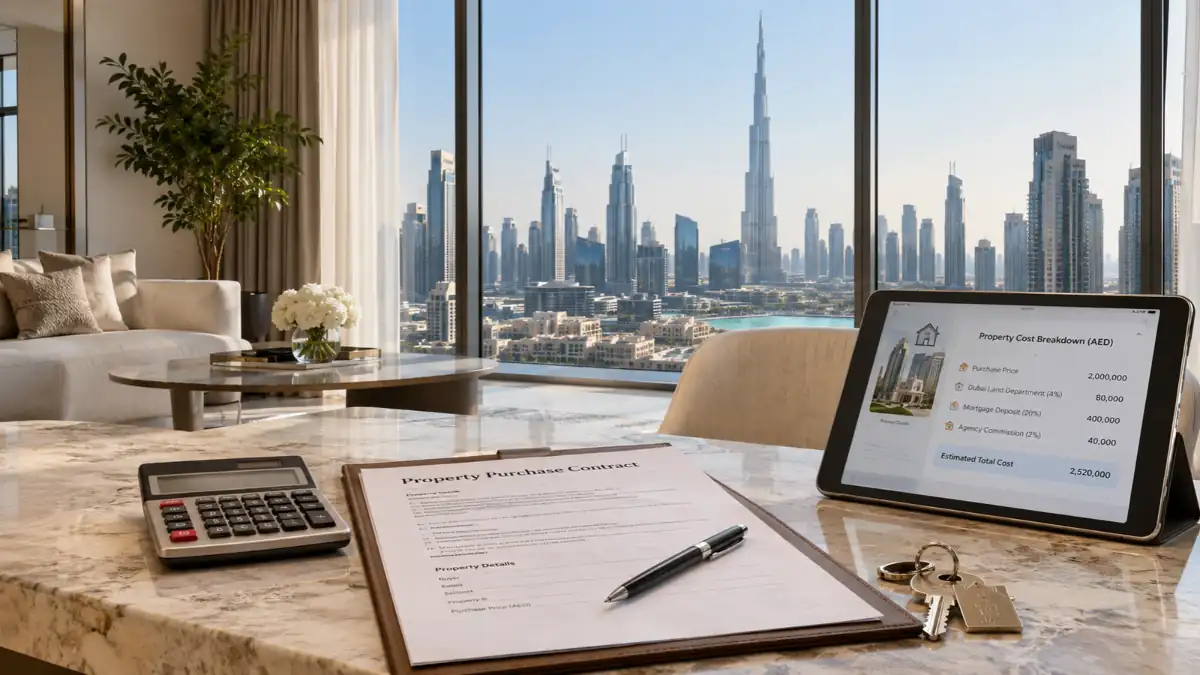
Dubai Property Buying Costs go beyond the advertised price of a house or apartment. Alongside the purchase price, buyers should budget for Dubai Land Department (DLD) registration charges, possible estate agency commission, trustee and title deed fees, and mortgage expenses where applicable. For a typical resale transaction, allowing approximately 6%–8% above the property price can be a useful initial planning estimate, although your actual costs will depend on the contract and transaction.
- DLD sale registration: 4% of the property value in total. The official standard allocation is 2% to the buyer and 2% to the seller, although buyers are commonly asked to cover the full 4% under the agreed transaction terms.
- Estate agency commission: Often 2% of the purchase price plus 5% VAT on the commission for a typical resale transaction, where agreed.
- Trustee and title deed fees: Additional administrative charges apply. For qualifying transfers through a registration trustee, the service partner fee is AED 4,000 plus VAT for properties valued at AED 500,000 or more.
- Mortgage expenses: Buyers using finance may face valuation charges, bank arrangement fees, mortgage registration and insurance costs.
- Off-plan purchases: Developer payment plans can spread the property price over time, but registration, administration and handover costs still require careful checking.
- Ongoing ownership costs: Service charges, maintenance, insurance, utilities and property management should form part of your long-term budget.
Example: A Dubai property advertised at AED 1,000,000 could require approximately AED 65,700 in selected purchasing fees, assuming the buyer pays the full 4% DLD charge, 2% agency commission plus VAT, AED 4,000 trustee fee plus VAT, and AED 500 for title deed and apartment map issuance. Other administration costs, mortgage expenses and applicable transaction charges are excluded.
The important point is to calculate your complete purchase budget before paying a deposit. A property that appears affordable at the advertised price can become considerably more expensive once transaction charges and future ownership costs are included.
Not sure how much you really need to buy in Dubai?
Dubai Light Haven can help you understand the purchase price, additional fees and practical budget considerations before you commit.
What Does Buying Property in Dubai Really Cost?
When you start looking at houses or apartments in Dubai, the advertised price is naturally the first figure you notice. However, that price is only one part of your total financial commitment.
In addition to the property itself, you may need to pay government registration charges, professional fees and finance-related expenses. Furthermore, once you become the owner, ongoing service charges and maintenance costs can affect how affordable the property is over time.
At Dubai Light Haven, we encourage buyers to distinguish between three separate figures:
- Purchase price: The agreed amount paid for the property.
- Acquisition costs: The additional expenses required to complete the transaction.
- Ownership costs: The expenses involved in holding, maintaining and potentially renting out the property.
This distinction is particularly important for overseas buyers comparing Dubai with the UK, Europe or the United States. The tax and registration systems differ, so simply comparing advertised property prices rarely gives you the complete picture.
For the wider investment process, our complete beginner's guide to investing in Dubai property explains how acquisition costs fit into the broader investment decision.
Dubai Property Buying Fees: What Will You Actually Pay?
Several charges can arise during a typical purchase. Some are government fees, while others depend on the agent, lender, developer and registration process involved.
1. Dubai Land Department registration fees
The Dubai Land Department is responsible for registering property ownership transactions in Dubai. Its standard sale registration charge is 4% of the sale value.
Officially, this is normally allocated as 2% payable by the buyer and 2% by the seller. However, the parties can agree a different allocation, and many market transactions are structured so that the buyer covers the full 4%.
Consequently, you should not assume who pays until the contract clearly confirms the arrangement.
- AED 750,000 property: total 4% registration charge of AED 30,000.
- AED 1,000,000 property: total charge of AED 40,000.
- AED 1,500,000 property: total charge of AED 60,000.
- AED 2,000,000 property: total charge of AED 80,000.
You can check the applicable registration process through the Dubai Land Department's official property sale registration service.
2. Estate agency commission
For a conventional resale purchase, a commonly quoted agency commission is 2% of the property price plus 5% VAT on the commission.
For example, on a property costing AED 1,000,000, a 2% commission would be AED 20,000. VAT on that commission would add AED 1,000, bringing the total to AED 21,000.
Nevertheless, commission is a commercial charge rather than a universal fixed government tariff. The exact amount and responsible party should be agreed in writing.
3. Registration trustee and title deed expenses
Completed-property transfers may involve a Real Estate Registration Trustee Centre. For DLD's property sale registration service, the published service partner fee is AED 4,000 plus VAT where the property value is AED 500,000 or above, or AED 2,000 plus VAT below that threshold.
Additional charges can include title deed issuance, property maps, knowledge and innovation fees. The exact combination depends on the transaction and registration channel.
4. Developer NOC and clearance costs
For a resale property, the developer may need to issue a No Objection Certificate, commonly called an NOC, confirming the required conditions for transfer have been met.
The seller commonly arranges the NOC, but responsibility for any fee should be confirmed in the agreement. Outstanding service charges, mortgage discharge requirements or other restrictions may also need resolving before transfer.
Quick Costs Snapshot: Typical Dubai Purchase Expenses
| Expense | Indicative amount |
|---|---|
| DLD sale registration | 4% total; allocation determined by law and agreed terms |
| Resale agency commission | Often 2% plus VAT on commission |
| Registration trustee service | AED 4,000 + VAT for qualifying sales of AED 500,000+ |
| Title deed issuance | AED 250 for standard sale registration |
| Villa or apartment map | AED 250 where applicable |
| Mortgage expenses | Bank-dependent, plus applicable registration fees |
| Annual service charges | Building and community dependent |
These are planning figures, not a complete fee quotation. Other government, developer, lender and administrative charges may apply. Different DLD transaction channels can have different service partner fee schedules.
How Much Does It Cost to Buy a House or Apartment in Dubai?
The most useful way to understand property acquisition costs is to look at complete examples rather than isolated percentages.
Example 1: Buying an AED 1 Million Dubai Apartment
Assume you are purchasing a completed apartment for AED 1,000,000 without a mortgage. The following example assumes the buyer has contractually agreed to pay the full 4% DLD charge.
| Purchase expense | Amount (AED) |
|---|---|
| Apartment purchase price | 1,000,000 |
| DLD registration, 4% | 40,000 |
| Agency commission, 2% + VAT | 21,000 |
| Trustee service, AED 4,000 + VAT | 4,200 |
| Title deed and apartment map | 500 |
| Illustrative total | 1,065,700 |
In this example, the selected additional purchase expenses total AED 65,700, or approximately 6.57% above the advertised property price.
This excludes knowledge and innovation fees, any further administrative charges, legal or due diligence services, mortgage costs, initial service charge adjustments and other property-specific expenses.
Example 2: Buying a Property for AED 2 Million
If you buy a completed property for AED 2,000,000 under similar assumptions, the selected costs could be:
- Purchase price: AED 2,000,000.
- Full 4% DLD charge: AED 80,000.
- Agency commission plus VAT: AED 42,000.
- Trustee charge plus VAT: AED 4,200.
- Title deed and property map: AED 500.
That produces an illustrative total of AED 2,126,700, before other applicable expenses.
Naturally, the financial commitment can be significantly different if you are using a mortgage, buying directly from a developer or negotiating different fee arrangements.
Our guide to Dubai property prices at different budgets can help you compare what various purchase amounts may offer before adding transaction costs.
Dubai Property Buying Costs With a Mortgage
Using a mortgage reduces the amount of the property price you need to fund immediately, but it introduces additional expenses and ongoing repayments.
How much deposit do you need?
For eligible expatriate first-home owner-occupiers, UAE Central Bank rules permit mortgage financing of up to 80% for a property valued at AED 5 million or less. Above AED 5 million, the maximum is 70%.
These are regulatory maximums, not guaranteed lending offers. Banks assess residency, income, credit history, property valuation and other eligibility factors.
Different limits apply to subsequent properties and off-plan purchases. Furthermore, non-resident buyers may face stricter lender requirements.
On an eligible AED 1,000,000 property, an 80% mortgage would mean:
- Property price: AED 1,000,000.
- Mortgage amount: AED 800,000.
- Buyer deposit: AED 200,000.
- Additional purchase fees: payable separately unless an approved financing arrangement expressly provides otherwise.
Therefore, the deposit is not the same as your complete upfront cash requirement.
Additional mortgage charges
Depending on your lender and transaction, further expenses may include:
- Mortgage arrangement or processing fees.
- Independent property valuation charges.
- DLD mortgage registration, generally 0.25% of the registered mortgage amount, plus applicable charges.
- Life or property insurance required by the lender.
- Mortgage broker fees, where agreed.
- Early settlement or refinancing costs under the applicable loan terms.
For an AED 800,000 registered mortgage, the 0.25% registration component would be AED 2,000 before other applicable fees.
For a more detailed explanation of deposit requirements, see our Dubai property deposit and down-payment guide.
Buying with cash or arranging a mortgage?
Share your intended purchase budget with Dubai Light Haven. We can help you identify the cost categories to check before choosing a property.
Off-Plan vs Ready Property: Which Has Lower Buying Costs?
Dubai offers two broad purchasing routes: buying a completed property or purchasing an off-plan home that is still under development.
Each route has its advantages. However, the timing and structure of payments can be very different.
Buying a completed property
A ready property can generally be inspected before purchase, and buyers can assess the actual building, facilities and existing service-charge history.
Nevertheless, the purchase price and transaction expenses usually become payable within a relatively short completion period. Mortgage buyers also need to coordinate bank approval and transfer arrangements.
Buying an off-plan property
An off-plan developer may offer staged instalments, allowing buyers to spread the purchase price across construction milestones or agreed dates.
Common structures include construction-linked schedules and post-handover payment plans. However, the percentage paid upfront and the balance due at completion vary significantly.
Additional points to examine include:
- Initial reservation and deposit requirements.
- Applicable DLD or provisional registration charges.
- Developer administration expenses.
- Payment deadlines and late-payment provisions.
- Handover charges and service-charge commencement.
- Potential mortgage availability and valuation differences at completion.
Our Dubai property payment plan guide explains how instalment structures work. You can also explore the advantages and risks of off-plan investment before selecting a development.
Dubai Property Ownership Costs After Completion
Buying the property is only the beginning of your financial responsibility. Whether you intend to live in the home or rent it out, recurring expenses should be included in your calculations.
Annual building and community service charges
Service charges help fund the operation and maintenance of shared facilities. These can include security, cleaning, lifts, landscaping, common-area utilities, building systems and reserve funds.
Rates differ considerably between developments. A building with extensive amenities may have a higher recurring cost than one offering fewer shared services.
Before purchasing, check the approved charges for the specific building through the official DLD Service Charge Index.
For illustration only, a property with a chargeable area of 1,000 square feet and an assumed service charge of AED 15 per square foot would cost AED 15,000 annually. This is a mathematical example, not a published rate for any particular building.
Maintenance, insurance and utilities
In addition to community expenses, you may need to budget for:
- Internal repairs and replacement appliances.
- Air-conditioning maintenance and servicing.
- Buildings or contents insurance, where relevant.
- Electricity, water, cooling and internet services.
- Furniture and refurbishment if the property is rented furnished.
- Possible vacancy periods and letting-related expenditure.
Investors should also consider the expenses of finding tenants, tenancy administration and property management.
Gross yield versus net rental return
An apartment generating AED 80,000 in annual rent may initially look attractive. However, that amount is gross income, not necessarily your profit.
Suppose service charges, management, maintenance and other operating expenses total AED 20,000 annually. Your illustrative net operating income would fall to AED 60,000 before mortgage interest, relevant taxes and other personal costs.
This is why we recommend comparing properties using realistic net figures rather than relying exclusively on advertised rental yields.
Buying Property in Dubai as a Foreigner: Are the Costs Different?
Foreign nationals can purchase property in designated ownership areas in Dubai, subject to the relevant rules and property title arrangements.
A British, American or other overseas buyer generally encounters the same core DLD sale registration framework as other purchasers. Nevertheless, financing eligibility and international transaction expenses can differ.
Extra considerations for overseas buyers
- Currency conversion: Exchange-rate movements can affect the amount transferred from pounds, dollars or euros.
- International transfers: Banks or payment providers may apply transfer charges and currency spreads.
- Mortgage eligibility: Non-resident products can require larger deposits or additional documentation.
- Legal checks: Independent legal advice may be useful, particularly when buying remotely.
- Tax residency: Your home country's tax rules may affect rental income, gains or reporting obligations.
- Residency: Buying property does not automatically grant a visa. Eligibility depends on the relevant immigration programme.
For buyers purchasing remotely, we recommend reading our step-by-step foreign buyer guide.
If you are investing from Britain, our UK investor cost and budget checklist covers additional considerations for cross-border purchases.
How to Calculate Your Complete Dubai Property Budget
A structured budget can help prevent cash-flow problems and make different properties easier to compare.
Before you sign a reservation form or purchase agreement, work through the following steps.
Step-by-Step Dubai Property Buying Cost Checklist
- Set your maximum property budget. Decide how much you can comfortably spend without using money reserved for emergencies or other commitments.
- Confirm the property price and payment schedule. Establish the agreed purchase amount, initial deposit and all payment deadlines.
- Identify the exact registration charges. Ask how the DLD fee will be allocated and which title deed, trustee or developer fees apply.
- Confirm agency and professional fees. Obtain written details of commission, VAT, legal assistance and any additional transaction services.
- Add mortgage costs if borrowing. Include your deposit, bank charges, valuation, registration and insurance.
- Check annual ownership expenses. Request recent service-charge information and estimate maintenance and management costs.
- Calculate your total cash requirement. Combine the deposit or full cash purchase price with fees due before and at completion.
- Keep a contingency. Allow extra cash for unexpected administrative expenses, repairs, currency movements or completion adjustments.
When assessing whether the asking price is reasonable, compare it with relevant completed transactions rather than relying entirely on online listing prices.
The Dubai Land Department's property transaction data provides an official starting point for researching registered sales and comparable market activity.
Common Mistakes That Make Buying Property in Dubai More Expensive
Even buyers with a healthy budget can underestimate the final cost when they focus too heavily on the advertised purchase price.
Ignoring annual service charges
Two apartments at the same purchase price may have very different annual running costs. Over several years, these differences can materially affect investment returns.
Confusing the booking deposit with additional fees
A deposit is generally a payment towards the purchase price, subject to the contractual terms. It should not automatically be treated as an extra charge on top of the agreed price.
Equally, buyers should check whether a reservation payment is refundable, when it becomes binding and what happens if financing is declined.
Assuming every advertised promotion represents a saving
An offer such as "registration fee included" may be worthwhile. However, it should be measured against the property's overall asking price and comparable alternatives.
Overlooking future selling costs
If you eventually sell your Dubai property, you may incur agent commission, developer clearance charges, mortgage release expenses and other transaction-related costs.
In addition, the final distribution of registration charges will depend on the agreed sale terms at that time.
Using unrealistic rental assumptions
A projected rental return should allow for possible vacant periods, maintenance, property management and market changes.
Consequently, the highest advertised rental yield is not necessarily the best investment. A well-managed property with reasonable recurring costs may provide a more dependable financial outcome.
Conclusion: Budget for the Full Purchase, Not Just the Property Price
Understanding the complete costs of buying property in Dubai puts you in a stronger position to compare homes, evaluate financing options and assess potential investment returns.
For a conventional resale purchase, registration, agency and administrative fees can add a meaningful amount to the advertised price. Mortgage buyers may need additional cash for financing arrangements, while off-plan buyers must consider instalment obligations and later handover expenses.
The most sensible approach is to request a complete written cost breakdown before committing to a property. You should then compare that initial outlay with ongoing service charges, maintenance and your intended holding period.
At Dubai Light Haven, our aim is to help you approach the market with clear expectations and make decisions based on realistic figures rather than headline prices alone.
FAQs: Dubai Property Buying Costs
How much does it cost to buy property in Dubai?
The total depends on the property's price, the agreed DLD fee allocation, agency commission, administrative charges and whether you need a mortgage. For a conventional resale purchase where the buyer pays the full 4% registration charge and typical agency commission, around 6%–8% above the property price can be a useful preliminary budget estimate. Your actual quotation may be higher or lower.
What is the benefit of buying property in Dubai?
Potential benefits include access to an international property market, a range of residential communities, opportunities for rental income and designated freehold ownership for foreign buyers. However, investment returns are not guaranteed, and buyers should consider transaction expenses, service charges, market fluctuations and their individual tax position.
How much is buying a house in Dubai?
The amount depends on location, property size, condition and whether you are buying a townhouse, villa or apartment. Alongside the advertised price, allow for registration and transaction expenses. Using an additional-cost allowance of around 6%–8% can help with preliminary budgeting for some resale purchases, subject to the actual terms.
Are Dubai houses cheap compared with other countries?
Some Dubai neighbourhoods can offer competitive prices or larger properties relative to certain international cities. However, prime waterfront, luxury and central locations can be expensive. A meaningful comparison should consider location, floor area, property quality, service charges and transaction costs rather than price alone.
Can I buy property in Dubai from the USA?
Yes. American citizens can generally purchase eligible property in Dubai's designated foreign ownership areas, subject to the relevant requirements. You should also consider international transfer costs, mortgage eligibility, due diligence and any US tax reporting obligations.
Can you buy property in Dubai and rent it out?
Yes, property owners can generally rent out eligible properties in accordance with applicable tenancy, building and licensing rules. Short-term holiday letting involves additional requirements. Investors should calculate net income after service charges, management fees, maintenance and possible vacancies.
Why is some Dubai real estate relatively cheap?
Prices vary according to location, accessibility, development age, facilities, supply, demand and completion status. A lower asking price does not automatically mean better value. Buyers should investigate building condition, service charges, comparable sales and the wider community before purchasing.
Why is Dubai real estate so expensive in some areas?
Prime locations can command higher prices because of waterfront access, limited desirable land, luxury amenities, international demand and proximity to commercial or lifestyle destinations. High prices do not automatically mean stronger investment returns, so compare acquisition costs with achievable rental income and future risks.
Will Dubai property prices come down?
Property prices can rise or fall as market conditions change. Future supply, borrowing costs, economic activity, demand and individual community performance all influence values. Nobody can reliably guarantee when prices will decline. Therefore, it is sensible to buy based on affordability and realistic long-term objectives rather than trying to predict the market's exact turning point.
Is buying property in Dubai a good investment?
It can be suitable for some investors, particularly when the property matches their budget, income objectives and risk tolerance. However, a good investment depends on the total acquisition cost, financing, achievable rental income, ongoing expenses and future resale value. An attractive advertised yield alone is not enough.
Do foreigners pay higher property registration fees in Dubai?
Foreign buyers generally fall under the same core DLD sale registration framework. However, financing arrangements, international transfers and professional advice may make their individual transaction more expensive. Always confirm the relevant ownership area and any property-specific requirements.
What is the difference between a Dubai property deposit and buying fees?
A purchase deposit normally contributes towards the agreed property price, subject to the contract. Buying fees are separate costs incurred to complete the transaction, such as registration, commission and administrative expenses. Buyers should obtain a payment schedule that distinguishes the two.
Still have questions about the total cost?
Tell us the property type, approximate budget and whether you intend to buy with cash or finance. We can help you identify the fees and ownership costs worth checking.
Next Steps & Useful Dubai Property Guides
Once you understand your likely buying expenses, the next step is to compare suitable properties and establish which ownership strategy fits your goals.
- Dubai Property Investment: Complete Investor Guide — the main pillar guide to investment fundamentals.
- The Complete Dubai Buying Property Checklist — documents and practical steps before completion.
- Best Areas to Buy Property in Dubai — how to compare communities and neighbourhoods.
- Buying Property in Dubai as a Foreigner — ownership rules and considerations for overseas buyers.
- Dubai Off-Plan Projects — payment schedules, completion and development considerations.
- Main buying cost The agreed property purchase price plus applicable transaction expenses.
- DLD registration 4% total sale registration fee, normally allocated 2% buyer and 2% seller unless agreed otherwise.
- Agency commission Often 2% plus VAT on commission for a conventional resale transaction, subject to agreement.
- Trustee expenses AED 4,000 plus VAT for qualifying property sale registrations valued at AED 500,000 or more.
- Mortgage deposit Eligible expatriate first-home owner-occupiers may obtain up to 80% financing on properties valued at AED 5 million or less, subject to lender approval.
- Indicative additional budget Approximately 6%–8% above purchase price for some typical resale transactions where the buyer pays the full registration fee and agency commission; not a guaranteed total.
- Recurring expenses Service charges, maintenance, insurance, utilities, management and mortgage repayments where applicable.
- Best next step Request a written, itemised cost breakdown before paying a deposit or signing a binding agreement.
Official Resources for Checking Dubai Property Costs
Property fees and finance rules should be checked against official sources before completing a transaction. These resources are useful starting points:
- Dubai Land Department — Property Sale Registration: government registration requirements and published fees.
- Dubai Land Department — Service Charge Index: approved service-charge information for eligible jointly owned developments.
- Dubai Land Department — Real Estate Data: official transaction and market information.
- Central Bank of the UAE — Mortgage Loan Regulations: regulatory loan-to-value limits and related mortgage requirements.
Information is provided for general guidance and should not be treated as individual financial, tax or legal advice. Fees, policies and property-specific requirements should be confirmed with the appropriate authorities and professional advisers.
Ready to Plan Your Dubai Property Purchase?
Dubai Light Haven can help you approach your property search with a clearer understanding of purchase expenses, ownership commitments and the questions to ask before investing.
Performance Verified ✅
This page meets PME Optimisation Standards — achieving 95+ Desktop and 85+ Mobile PageSpeed benchmarks. Verified on
