
Share this post:
Quick summary: properties in Dubai for investment
Choosing the right properties in Dubai for investment starts with understanding your budget, rental income expectations and long-term plans. Areas such as Jumeirah Village Circle (JVC), Business Bay, Dubai Marina, Dubai Hills Estate and Dubai South offer different opportunities. However, the best choice is not necessarily the most expensive property or the one advertising the highest rental return.
At Dubai Light Haven, we encourage investors to compare net rental income, purchase costs, tenant demand, service charges and resale potential before making a decision.
Key considerations for Dubai property investors
- Rental income: Established apartment communities such as JVC, Jumeirah Lake Towers and Dubai Marina can be worth examining for long-term tenant demand.
- Capital growth: Dubai Hills Estate, Dubai Creek Harbour and selected emerging communities may appeal to investors focused on longer-term value, although appreciation is not guaranteed.
- Premium properties: Downtown Dubai, Palm Jumeirah and waterfront locations offer distinctive assets, but higher purchase prices can affect percentage rental returns.
- Buying costs: Budget for Dubai Land Department registration fees, transaction costs, possible agency fees and ongoing ownership expenses.
- Foreign ownership: Overseas investors can buy freehold property in designated Dubai areas, subject to the applicable ownership rules.
- Investment returns: Gross rental yield is only a starting point. Net returns depend on service charges, maintenance, vacancy, management costs and financing where applicable.
Our view: The strongest investment is usually the property that balances realistic rental demand, manageable ownership costs and a sensible purchase price. Compare individual buildings and completed transactions rather than relying on general area averages or promotional yield claims.
Not sure which Dubai property area suits your investment plans?
Dubai Light Haven can help you compare locations, property types, buying costs and realistic rental potential before you commit.
Are Properties in Dubai for Investment Worth Considering?
Dubai continues to attract international property buyers because of its established rental market, expanding communities, infrastructure investment and opportunities for foreign ownership.
However, buying a property in Dubai is not automatically a profitable investment. Your results depend on what you purchase, how much you pay and whether the property can attract suitable tenants or future buyers.
According to official figures published in January 2026, Dubai recorded more than AED 917 billion in real estate transactions during 2025, across over 270,000 transactions. These figures cover broader real estate activity and should not be confused with residential sales alone.
This demonstrates the scale of Dubai's property market, but transaction growth does not mean every building or neighbourhood will increase in value.
Why do international investors consider Dubai?
- Rental opportunities: Residential demand comes from professionals, families and international residents.
- Foreign ownership: Eligible overseas buyers can acquire freehold property in designated areas.
- Different investment budgets: The market includes studios, family apartments, townhouses and luxury villas.
- Established infrastructure: Transport connections, schools, employment districts and lifestyle facilities influence tenant preferences.
- Tax environment: Dubai generally does not impose an annual personal property tax or UAE personal income tax on ordinary residential rent, although other tax obligations may apply.
For a broader explanation of the market, ownership structures and buying strategy, read our complete Dubai investor guide.
Best Areas in Dubai to Buy Property for Investment
One of the most important decisions is choosing the right location. Some areas are particularly interesting for apartment rental income, while others appeal to buyers seeking family accommodation, premium assets or potential long-term capital growth.
The following communities are worth comparing. They are not a ranking of guaranteed performance, and individual buildings can produce very different results.
1. Jumeirah Village Circle (JVC) – Apartments and Rental Income
Jumeirah Village Circle is a popular starting point for investors comparing relatively accessible apartments with established locations. The community offers studios, one-bedroom apartments and larger homes across developments of different ages and standards.
JVC may appeal to professionals, couples and smaller households seeking accommodation outside Dubai's most expensive central districts.
- Suitable for: Investors prioritising long-term rental income.
- Property options: Studios, one-bedroom and two-bedroom apartments.
- Potential advantage: A broad tenant market and varied purchase budgets.
- Main considerations: Building quality, competing supply, traffic, parking and service charges.
Two similar apartments can produce different returns depending on the building's maintenance, facilities and purchase price. Therefore, compare completed transactions and realistic rental evidence before choosing a unit.
Our JVC neighbourhood guide provides further local context.
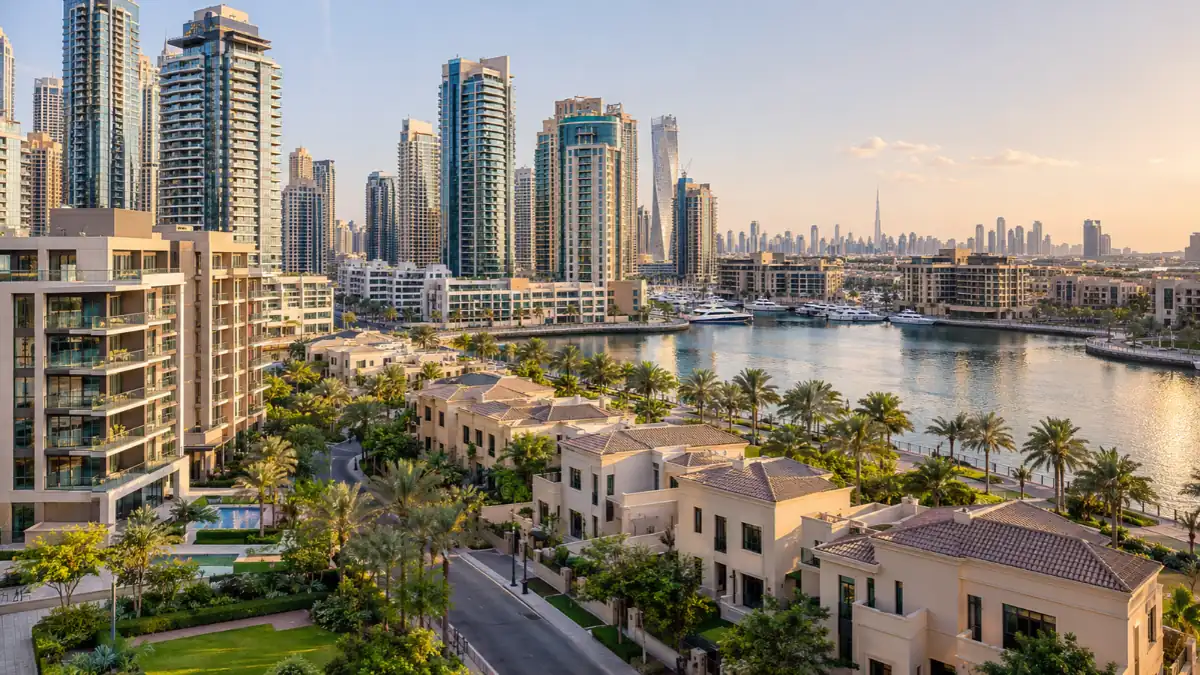
2. Dubai Marina – Established Waterfront Apartments
Dubai Marina combines high-rise residential living with waterfront surroundings, restaurants, leisure facilities and transport connections. Its established international profile makes it an area many overseas buyers consider first.
The community includes both older towers and more recently completed developments. As a result, purchase prices, apartment layouts and annual service charges vary considerably.
- Suitable for: Investors seeking an established apartment location.
- Property options: Studios, family apartments and premium waterfront units.
- Potential advantage: Recognisable location and demand from different tenant groups.
- Main considerations: Tower condition, congestion, service charges and premium pricing.
Some owners also investigate holiday letting. However, short-term rentals require appropriate permits, management and realistic occupancy assumptions. A long-term tenancy may be simpler for investors who do not want intensive management.
3. Business Bay – Central Location and Professional Tenants
Business Bay is positioned close to Downtown Dubai and contains residential towers, commercial buildings, hotels and mixed-use developments.
Its central location can be attractive to professionals who want convenient access to employment districts and city amenities.
- Suitable for: Investors considering centrally located apartments.
- Property options: Studios, one-bedroom apartments and larger residences.
- Potential advantage: Proximity to business and commercial activity.
- Main considerations: Road access, construction nearby, tower management and service charges.
Before buying, compare properties within the same tower or immediate neighbourhood. Business Bay contains considerable variation between buildings, so relying on a district-wide average can be misleading.
4. Dubai Hills Estate – Family Demand and Long-Term Ownership
Dubai Hills Estate appeals to buyers who value planned surroundings, parks, retail facilities, schools and a wider selection of residential property.
Although some investors focus on apartments, the area's townhouses and villas may suit families seeking longer-term accommodation.
- Suitable for: Investors balancing rental income with long-term resale appeal.
- Property options: Apartments, townhouses and villas.
- Potential advantage: Lifestyle facilities and family-oriented accommodation.
- Main considerations: Higher entry costs for some property types and differences between individual sub-communities.
Our Dubai Hills Estate assessment explains the area's investment and lifestyle considerations.
5. Dubai South – Emerging Communities and Future Development
Dubai South attracts attention because of its residential developments, logistics activity and proximity to Al Maktoum International Airport.
For investors considering longer-term opportunities, the area's development plans may be interesting. Nevertheless, expected infrastructure improvements should not be treated as guaranteed capital appreciation.
- Suitable for: Investors comfortable with an emerging location and a longer investment horizon.
- Property options: Apartments, townhouses and off-plan developments.
- Potential advantage: Opportunities to compare newer stock and different entry budgets.
- Main considerations: Delivery timelines, future supply, tenant demand and resale liquidity.
Our Dubai South area analysis explores what buyers should consider before committing.
6. Downtown Dubai and Palm Jumeirah – Premium Investment Locations
Downtown Dubai and Palm Jumeirah are distinctive markets with established international recognition and premium residential properties.
These locations can appeal to investors who prioritise property quality, limited or distinctive positioning, lifestyle value and potential resale demand.
However, higher acquisition prices do not automatically produce higher rental yields. Premium properties can also have substantial maintenance, management and service-charge expenses.
Comparing Dubai Investment Areas: Which Strategy Fits?
Rather than asking which single area is best, we recommend matching each location to your financial objectives.
Dubai investment area comparison
| Area | Typical focus | Property type | Key consideration |
|---|---|---|---|
| JVC | Long-term rental income | Studios and apartments | Building quality and competing supply |
| Dubai Marina | Established rental market | Waterfront apartments | Purchase premium and service charges |
| Business Bay | Central professional tenants | High-rise apartments | Building-by-building variation |
| Dubai Hills Estate | Family demand and resale appeal | Apartments and villas | Entry price and holding period |
| Dubai South | Longer-term development potential | New-build homes | Future supply and delivery risk |
| Downtown Dubai | Premium central property | Luxury apartments | High acquisition costs |
| Palm Jumeirah | Premium and waterfront assets | Apartments and villas | Ownership and maintenance costs |
These are qualitative comparisons, not live listings, yield forecasts or guarantees. Property-specific pricing and rental evidence should be checked before making a purchase.
For a wider location comparison, explore our area-by-area buyer research.
Which Property Types Offer the Best Investment Opportunities?
The type of property you buy can be just as important as its location. Studios, larger apartments, villas and off-plan homes serve different markets and involve different costs.
Apartments in Dubai for Investment
Apartments are a practical starting point for many investors because they are available across a wide range of budgets and locations.
Studios and one-bedroom apartments may attract individual professionals and couples. Meanwhile, two-bedroom units can appeal to smaller families and tenants who need extra space.
Smaller apartments sometimes produce a higher gross rental yield relative to their purchase price. However, tenant turnover, furnishing costs and service charges can reduce the difference.
Villas and Townhouses for Family Tenants
Villas and townhouses often involve higher initial costs but provide larger living spaces, outdoor areas and family-oriented accommodation.
Some tenants may prefer longer occupation periods because moving a family can be disruptive. Nevertheless, larger properties may require more expensive maintenance, and vacant periods can have a greater financial impact.
Off-Plan Versus Ready Properties
Off-plan properties are purchased before construction is completed. Developers may offer staged payment plans, giving buyers a way to spread payments during construction.
Ready properties, by contrast, can generally be inspected before purchase and may generate rental income sooner, subject to any existing tenancy or preparation work.
- Off-plan advantage: Staged payments and access to new developments.
- Off-plan risk: Construction delays, changing market conditions and no rental income before completion.
- Ready-property advantage: Physical inspection and more immediate rental potential.
- Ready-property risk: Existing maintenance problems, older facilities and possible refurbishment costs.
For more detail, see our off-plan risk comparison.
Dubai Property Investment Returns: Gross Yield Versus Net ROI
Rental returns are frequently used to compare investment properties. However, advertisements often highlight gross yield without explaining the expenses associated with ownership.
How do you calculate gross rental yield?
Gross rental yield measures annual rent against the property's purchase price.
Example: calculating rental income
Illustrative apartment purchase price: AED 1,000,000
Illustrative annual rent: AED 70,000
Gross rental yield:
70,000 ÷ 1,000,000 × 100 = 7%
This is a hypothetical calculation, not an estimate for a particular Dubai building or a promised return.
What happens when ownership costs are included?
Suppose the same property generates AED 70,000 in annual rent but has the following illustrative annual expenses:
- Service charges: AED 12,000
- Maintenance allowance: AED 3,000
- Property management: AED 3,500
- Vacancy allowance: AED 3,500
The total annual allowance for expenses is AED 22,000, leaving AED 48,000 before financing and any other applicable costs.
That produces a 4.8% net operating yield on the AED 1 million purchase price.
If acquisition costs are also included in the invested capital, the percentage reduces further. Mortgage interest, taxation applicable to the investor, capital expenditure and eventual selling costs may affect the actual investment return.
What is a good ROI for Dubai property?
There is no single percentage that makes every investment attractive. A property with a lower yield may offer greater flexibility, stronger tenant appeal or characteristics that support long-term resale demand.
Conversely, a high advertised yield may reflect a low purchase price for a reason, such as older building facilities, weak resale demand or unusually optimistic rental assumptions.
We recommend comparing net annual cash flow, total acquisition cost, financing exposure and possible exit value rather than selecting properties using one yield figure.
Found a Dubai property with an attractive advertised ROI?
Before deciding, compare the expected rent with service charges, acquisition costs and realistic vacancy allowances. Our team can help you identify the questions worth asking.
How Much Does It Cost to Buy an Investment Property in Dubai?
The property price is only one part of your budget. Buyers should also allow for registration costs, possible agency fees, mortgage expenses and ongoing ownership charges.
Dubai property purchase costs to consider
- Dubai Land Department registration: The standard sale-registration charge totals 4% of the property value. Official rules identify 2% for the buyer and 2% for the seller, although contractual arrangements can determine who bears the cost in practice.
- Registration trustee and administrative fees: These vary according to the transaction and applicable fee schedule.
- Agency commission: Often agreed as part of the purchase transaction. Confirm the amount and VAT treatment in writing.
- Mortgage-related costs: Financing can introduce valuation fees, lender charges, mortgage registration costs and interest.
- Annual service charges: Apartment owners commonly contribute towards building maintenance and shared facilities.
- Additional costs: Furnishing, repairs, management, utilities during vacancy periods and insurance where appropriate.
Quick costs snapshot: AED 1 million purchase
- Property price: AED 1,000,000.
- Illustrative 4% DLD charge: AED 40,000.
- Other transaction costs: Additional and dependent on the agreement.
- Annual ownership costs: Building-specific and dependent on the rental arrangement.
- Mortgage expenses: Additional where financing is used.
Example only. Obtain a written, transaction-specific completion statement and confirm the current charges before paying a deposit.
The Dubai Land Department's official property-sale registration guidance explains the registration process and published fees.
Can Foreigners Buy Investment Properties in Dubai?
Yes. Foreign nationals, including non-residents, can purchase freehold property in designated areas of Dubai. However, foreign ownership rights are not identical across every neighbourhood or plot.
Freehold ownership generally means owning the property outright, while leasehold and certain other recognised rights provide an interest for a defined period.
Before buying, verify the exact property's ownership designation and registration arrangements. Do not assume that every property advertised in a well-known community has the same title conditions.
Do overseas investors need a Dubai residence visa?
A UAE residence visa is not generally required simply to purchase eligible freehold property. Overseas buyers can use a valid passport for the relevant registration procedures.
Property ownership may support certain residency applications where the applicable requirements are met. Nevertheless, buying a home does not automatically grant residency or guarantee approval for a Golden Visa.
You can review the UAE Government's foreign property ownership guidance for the general legal framework.
For a practical breakdown of eligibility, consult our property-related residency requirements guide.
How to Choose the Right Dubai Investment Property: Step by Step
A structured purchasing process can reduce the risk of choosing an unsuitable property. At Dubai Light Haven, we encourage investors to check the numbers before becoming attached to a particular apartment or development.
Dubai investment property checklist
- Set your investment objective. Decide whether rental income, long-term capital growth, future personal use or a combination of these is your priority.
- Establish your complete budget. Include the deposit or purchase price, transaction expenses, financing and a reserve for unexpected costs.
- Shortlist suitable locations. Compare rental demand, transport links, local amenities, future supply and available property types.
- Study completed transactions. Use actual registered sales rather than relying exclusively on property asking prices.
- Verify achievable rental income. Review comparable rental transactions, unit condition and the relevant tenancy situation.
- Calculate realistic net returns. Deduct service charges, management expenses, repairs and a suitable vacancy allowance.
- Check the building and title. Investigate maintenance, ownership registration, developer or seller documentation, outstanding charges and any applicable restrictions.
- Understand the exit strategy. Consider how easily the property might be sold and what would happen if prices or rents decline.
- Review the contract before paying. Confirm payment dates, obligations, conditions, transaction costs and the handling of deposits.
The Dubai Land Department's real estate data service provides official information for examining registered property activity.
For further practical checks, see our pre-purchase due diligence checklist.
Dubai Real Estate Investment: Risks and Common Mistakes
Dubai offers investment opportunities, but buyers should also understand the risks of owning property in a changing market.
1. Paying too much for the property
A desirable area does not justify any asking price. Compare recently completed sales, unit size, floor level, condition and building facilities before deciding whether the price is reasonable.
2. Overestimating future rental income
Some investment presentations use optimistic rents or assume continuous occupancy. Consequently, the advertised return may not reflect the income actually achievable after completion or during a slower rental period.
3. Underestimating service charges
Buildings with swimming pools, gyms, extensive communal areas and premium facilities can have substantial ongoing expenses. Ask for the actual charges applicable to the unit, not merely an approximate neighbourhood figure.
4. Assuming off-plan prices must increase
New developments may benefit from changing demand, but additional supply can also create competition. Construction timing, developer performance, quality and market conditions all influence the outcome.
5. Ignoring currency and financing exposure
Investors using sterling, euros or another currency should consider exchange-rate movements against the UAE dirham. The dirham's peg to the US dollar can make movements against other currencies relevant to your eventual return.
Borrowing also introduces interest-rate and repayment risks, especially during vacant periods.
6. Buying without a practical exit plan
An investment only becomes a realised capital gain when it is sold for more than the relevant costs. Selling fees, market conditions and competing properties can affect the final amount received.
For this reason, consider whether you could comfortably hold the property if resale demand weakened or the expected rental income fell.
Our Conclusion: Where Should You Invest in Dubai Property?
The best investment location depends on your objectives rather than a universal ranking.
If your priority is regular rental income, established apartment markets such as JVC, Business Bay and Dubai Marina may be worth examining. Buyers focused on family accommodation could compare Dubai Hills Estate and other established villa communities.
For a longer investment horizon, emerging areas such as Dubai South may deserve further research. Meanwhile, Downtown Dubai and Palm Jumeirah offer premium alternatives for buyers with different budgets and expectations.
Whichever area you prefer, the underlying decision should be supported by genuine rental evidence, a sensible acquisition price, manageable annual expenses and an understanding of local supply.
At Dubai Light Haven, we believe that careful comparison is more useful than simply following the most heavily promoted development. A property that suits your financial circumstances is often a better choice than one that looks impressive in a brochure.
FAQs: Properties in Dubai for Investment
Is buying property in Dubai a good investment?
It can be, provided the property is purchased at a sensible price and has realistic rental or resale potential. However, investment returns depend on market conditions, running costs, tenant demand and the property's individual characteristics. Profit is not guaranteed.
What are the best properties in Dubai for investment?
The best option depends on your budget and investment strategy. Smaller apartments in established residential communities may suit rental-income investors, while villas and premium properties can appeal to buyers with longer investment horizons. Compare actual net returns rather than relying on broad area rankings.
Where is the best place to buy property in Dubai for investment?
JVC, Dubai Marina, Business Bay, Dubai Hills Estate and Dubai South are all worth researching for different reasons. There is no universally best area. Tenant demand, building quality, purchase price and future supply should determine your shortlist.
What is a good rental ROI in Dubai?
A good ROI is one that adequately compensates you for the purchase price, operating expenses, financing and investment risk. Gross yields can look attractive, but net operating returns are usually more useful. Compare similar buildings using verified rental evidence and actual service charges.
Can foreigners invest in Dubai real estate?
Yes. Non-UAE nationals can purchase property in designated freehold areas, subject to the applicable ownership rules. Non-residents do not generally need a residence visa merely to purchase eligible property. However, the exact title and eligibility should always be checked.
What is the minimum investment needed to buy property in Dubai?
There is no single universal minimum purchase price for every property. Your required budget depends on the development, property type, payment terms and financing arrangements. Residency programmes have separate eligibility thresholds, which should not be confused with the minimum amount needed to buy a property.
Is buying an apartment in Dubai better than buying a villa?
Apartments can offer a lower entry cost and access to a broader market of individual tenants. Villas usually require more capital and may appeal to families seeking larger homes. The better investment depends on net income, maintenance costs, expected holding period and potential resale demand.
Is off-plan property a good investment in Dubai?
Off-plan property may suit investors who can follow staged payment schedules and accept construction and market risk. However, completion can be delayed and rental income is generally unavailable before handover. Developer checks, contract review and a realistic funding plan are essential.
Can I buy a Dubai property from the UK or another country?
Yes. Eligible overseas buyers can purchase property in designated Dubai ownership areas. The buying process may involve remote documentation, identity verification, approved representatives and the applicable registration procedures. Independent legal and tax advice can be particularly useful.
Why are some Dubai properties much cheaper than others?
Price differences can reflect location, building age, accessibility, property size, maintenance standards, developer reputation and surrounding supply. A low purchase price does not automatically represent good value. Investigate the reason for the difference before buying.
How can I check rental prices before buying?
Examine actual registered rental activity, comparable units and the property's current tenancy circumstances. The official Dubai Land Department rental services can provide useful context. Remember that asking rents are not necessarily the same as achieved rents.
Can buying an investment property in Dubai help me obtain residency?
Property ownership may support certain UAE residence visa applications if the relevant conditions are satisfied. However, owning a property does not automatically grant residency. Eligibility depends on the visa category and the rules applying when you submit an application.
Still comparing Dubai investment opportunities?
Tell us your approximate budget and investment objectives. We can help you organise the important questions before you make a decision.
Next Steps and Useful Dubai Property Guides
If you are researching a particular location or preparing to purchase, the following Dubai Light Haven guides provide additional information.
- Dubai Property Investment: The Complete Investor Guide – our main guide to understanding investment strategy, ownership and the wider Dubai market.
- Best Areas to Buy Property in Dubai – comparing neighbourhoods, facilities and purchasing priorities.
- Dubai Property Prices – understanding purchase budgets and the different property options available.
- Is Buying Property in Dubai a Good Investment? – a closer look at benefits, drawbacks and financial considerations.
- Dubai Off-Plan Property Investment – examining advantages, disadvantages and development risk.
- Invest in Dubai Property – practical due diligence checks before paying a deposit.
- Dubai Real Estate for Foreigners – understanding overseas ownership and eligible locations.
Official Dubai property resources
For independent information, registered market evidence and current regulations, the following government resources are useful.
- Dubai Land Department – real estate transaction data: research completed sales and registered property activity.
- Dubai Land Department – property sale registration: review official registration procedures and published fees.
- Dubai Land Department – rental index: examine the official rental information service.
- UAE Government – buying property as an expatriate: understand the general foreign ownership framework.
Key Facts Snapshot: Properties in Dubai for Investment
- Popular investment areas JVC, Dubai Marina, Business Bay, Dubai Hills Estate, Dubai South and selected premium communities.
- Property options Studios, apartments, townhouses, villas, ready homes and off-plan developments.
- Foreign ownership Freehold ownership is available to eligible foreign buyers in designated Dubai areas.
- Standard sale registration charge 4% of the property value in total, with allocation and further transaction expenses requiring confirmation.
- Gross rental yield Annual rent divided by the property purchase price, multiplied by 100.
- Net rental income Rental income after relevant operating expenses; financing and tax treatment may require separate consideration.
- Main investment risks Price movements, vacancies, service charges, construction delays, financing and resale conditions.
- Essential research Registered sales, realistic rents, title verification, building condition and transaction-specific costs.
- Best overall approach Match the property to your budget, net income expectations, risk tolerance and intended holding period.
General investor guidance, not personalised financial or legal advice. Figures and conditions should be verified for the individual property and transaction.
Ready to explore Dubai property investment with greater confidence?
Dubai Light Haven can help you consider suitable locations, compare property types and understand the financial questions that matter before you buy.

Performance Verified ✅
This page meets PME Optimisation Standards — achieving 95+ Desktop and 85+ Mobile PageSpeed benchmarks. Verified on
