
Share this post:
Quick summary: Dubai off plan property payments
Dubai off plan property payments allow you to purchase a property before construction is complete, with the purchase price divided into scheduled instalments. Instead of paying the full amount immediately, you normally pay an initial deposit, further amounts during construction and a final balance at or after handover, depending on the developer's agreement.
- Initial deposit: often around 10%–20% of the property price, although individual developments vary.
- Construction instalments: payments may be linked to dates, building milestones or a combination of both.
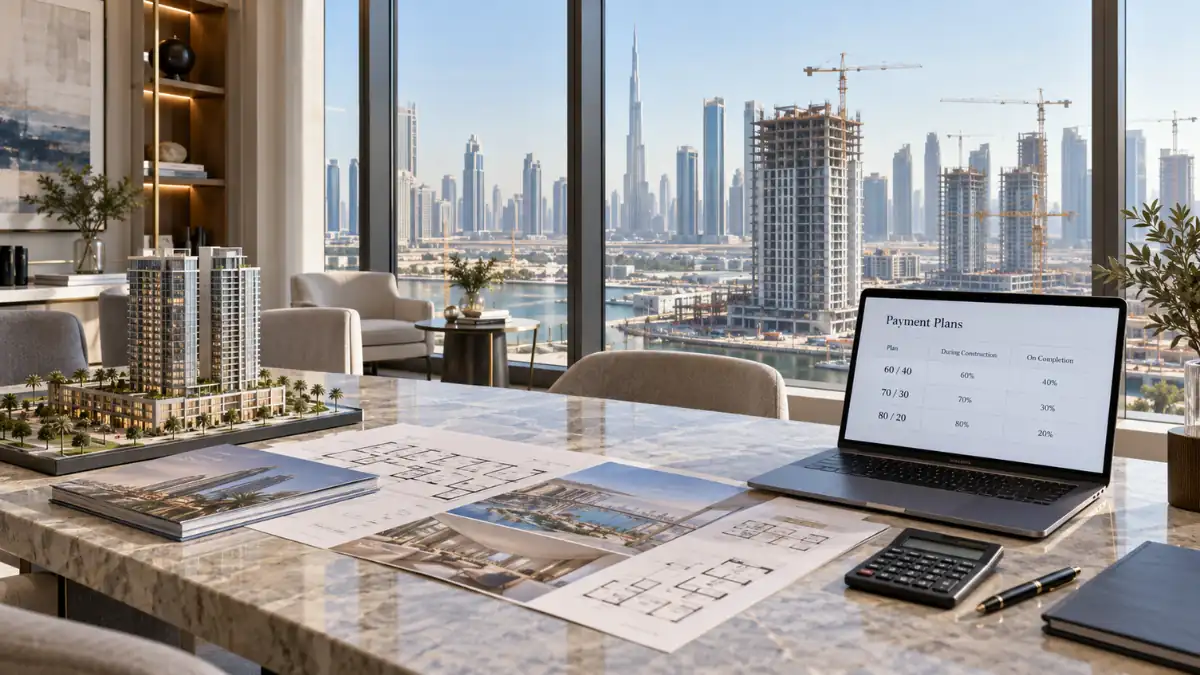
- Common payment structures: examples include 60/40, 70/30, 80/20 and selected post-handover arrangements.
- Registration costs: Dubai's property registration fee is generally 4% of the purchase price in total, with contractual responsibility for payment needing confirmation.
- Escrow protection: eligible off-plan project payments should go through the project's designated regulated escrow account.
- Mortgage funding: financing availability depends on the lender, the development and the stage of construction. Never assume that finance will automatically be available at handover.
Our advice at Dubai Light Haven: judge a payment plan by the total purchase cost, the timing of each instalment and your ability to complete the purchase. A smaller upfront payment may improve short-term affordability, but it does not automatically mean a better investment.
Looking at an off-plan payment schedule in Dubai?
Our team can help you understand the instalments, additional fees and financial commitments before you decide whether a development suits your budget.
How Do Dubai Off-Plan Property Payments Work?
Buying an off-plan property means agreeing to purchase a home while it is still being developed. You may be buying an apartment, townhouse or villa based on approved plans, specifications and the developer's construction schedule.
Rather than paying the entire purchase price at once, you agree to a series of instalments. These are normally recorded in the Sale and Purchase Agreement (SPA), which sets out the price, payment deadlines and the contractual obligations of both parties.
For many overseas buyers, this staged approach is one of the attractions of the Dubai market. However, the financial commitment begins well before you receive the keys.
What happens after you reserve an off-plan property?
A typical purchase moves through several stages:
- Reservation: you select a property and pay an agreed booking amount.
- Contract: you review and sign the SPA, confirming the complete instalment schedule.
- Registration: the developer arranges the required provisional registration of the off-plan sale.
- Construction: you make payments according to the agreed schedule.
- Handover: you settle the amount due, complete the required formalities and take possession when the property is ready.
- Post-handover: where applicable, you continue paying any remaining developer instalments.
Dubai's provisional registration system is commonly associated with Oqood. It records eligible off-plan sales before the normal title deed process is completed.
If you are unfamiliar with the wider buying process, our beginner's guide to investing in Dubai real estate explains the ownership rules, purchasing stages and essential checks.
Dubai Off-Plan Payment Plans: 60/40, 70/30 and 80/20 Explained
Developers use different arrangements to spread the purchase price. The numbers normally describe the proportion payable before or by handover compared with the balance payable at handover.
Nevertheless, the meaning must be checked carefully. In particular, some plans include post-handover payments, while others require the full outstanding balance when the property is completed.
60/40 payment plan
Under a typical 60/40 arrangement, 60% of the purchase price is paid through the construction period, with 40% due at handover.
This structure can reduce the amount of capital committed during construction. However, the larger final payment needs advance planning, particularly if you are considering mortgage finance.
70/30 payment plan
A 70/30 schedule generally means that 70% is paid before or during construction and the remaining 30% at handover.
Although this requires greater funding during development, the final balance is lower than under a 60/40 structure.
80/20 payment plan
An 80/20 plan places more of the financial commitment into the construction period, leaving 20% due at handover.
Consequently, it may appeal to buyers who already have funds available and prefer a smaller final settlement. It does not necessarily produce a lower purchase price or better return.
Post-handover payment plans
Some developers offer arrangements where part of the purchase price remains payable after the property has been handed over.
For example, a developer might require 60% by handover and spread the remaining 40% across an agreed period afterwards.
Such arrangements can help with cash flow. Nevertheless, you must establish whether the instalments carry extra costs, whether title transfer is affected and what happens if you sell before the balance is cleared.
Quick comparison: Dubai payment plan structures
| Payment plan | Before/by handover | At handover | Main consideration |
|---|---|---|---|
| 60/40 | 60% | 40% | Larger final payment |
| 70/30 | 70% | 30% | Higher construction-stage commitment |
| 80/20 | 80% | 20% | More capital committed earlier |
| Post-handover | Varies | Varies | Payments continue after completion |
These are illustrative structures, not guaranteed developer offers. Actual schedules may contain deposits, milestone payments or dates that differ from the simplified examples.
Dubai Off-Plan Property Payment Plan: A Worked Example
To understand the real financial commitment, consider an apartment with a purchase price of AED 1,500,000.
Assume the developer offers a 70/30 arrangement with a 10% initial deposit, five additional construction instalments and 30% payable at handover.
Example: AED 1.5 million apartment
| Payment stage | Percentage | Amount (AED) |
|---|---|---|
| Initial deposit | 10% | 150,000 |
| Construction instalment 1 | 10% | 150,000 |
| Construction instalment 2 | 10% | 150,000 |
| Construction instalment 3 | 10% | 150,000 |
| Construction instalment 4 | 15% | 225,000 |
| Construction instalment 5 | 15% | 225,000 |
| Handover payment | 30% | 450,000 |
| Total purchase price | 100% | 1,500,000 |
In this example, you would have committed AED 1,050,000 before handover, including the deposit, and would still need AED 450,000 to complete the purchase.
Crucially, that calculation excludes registration charges and other purchasing expenses.
What Additional Costs Come With Dubai Off-Plan Property Payments?
The advertised purchase price is only one part of your budget. Buyers should also understand the charges that sit outside the developer's instalment schedule.
1. Dubai Land Department registration fees
Dubai's standard property sale registration fee is 4% of the purchase price in total. The Dubai Land Department's provisional sale registration service identifies a 2% seller allocation and a 2% purchaser allocation.
In practice, buyers are often asked to bear the full 4% under their purchase agreement. Therefore, always confirm the agreed allocation in writing rather than assuming the legal fee split determines what you personally pay.
On an AED 1,500,000 purchase, a 4% registration fee would equal AED 60,000.
You can check the official requirements through the Dubai Land Department's initial sale registration service.
2. Administrative and processing charges
Depending on the transaction, additional expenses may include registration administration, document processing, bank transfer charges and other authorised service fees.
These vary according to the development and the services required. Ask for a written schedule distinguishing government charges from developer-imposed administration fees.
3. Mortgage and banking costs
If you use mortgage finance, you may face valuation charges, arrangement fees, insurance expenses and mortgage registration charges.
Overseas buyers should also consider currency conversion costs. Exchange-rate movements can affect the amount required in pounds sterling or another home currency, even if the Dubai purchase price stays unchanged.
4. Handover and ownership expenses
Once the property is ready, you may need to budget for utility connections, relevant community charges, service charge adjustments and furnishing.
If the property is intended for investment, allow for letting costs, possible vacant periods and ongoing maintenance.
Quick costs snapshot: AED 1,500,000 purchase
- Property purchase price: AED 1,500,000
- 10% initial deposit: AED 150,000
- Illustrative 4% registration fee: AED 60,000
- Initial deposit plus full registration fee: AED 210,000
- Other administration and transaction costs: additional, depending on the development
- Handover and ongoing ownership costs: budget separately
This example assumes the buyer is contractually responsible for the full 4% registration fee. The deposit is part of the property price, not an additional purchase charge. Actual fee responsibilities and due dates must be checked against the SPA.
For a broader explanation of deposits, instalments and ownership costs, our guide to developer payment arrangements and hidden charges provides further context.
Off-Plan vs Ready Property in Dubai: How Do Payments Differ?
An important decision is whether to purchase a property under construction or a completed home.
With an off-plan purchase, payments are generally spread over a longer period. With a ready property, the purchase balance is usually required on completion of the transaction, often supported by a mortgage where eligible.
| Factor | Off-plan property | Ready property |
|---|---|---|
| Payment timing | Scheduled instalments | Generally paid on completion |
| Initial cash requirement | Deposit plus relevant fees | Equity contribution plus fees |
| Rental income | Normally only after handover | Potentially available sooner |
| Construction risk | Present until completion | Construction normally finished |
| Mortgage availability | More dependent on project and stage | Often easier to assess for eligible completed homes |
Neither option is automatically superior. A ready property may offer earlier rental income, while a staged off-plan arrangement may be more suitable for someone building their capital allocation over time.
Equally, an off-plan property may be delivered into a different market from the one that existed when the purchase was agreed. That uncertainty deserves as much attention as the payment schedule.
Can You Get a Mortgage for Dubai Off-Plan Property?
Mortgage finance may be available for certain off-plan purchases. However, approval is not automatic, and individual banks set their own rules on eligible developers, projects, construction stages and borrower circumstances.
Mortgage eligibility during construction
Some lenders may consider financing an eligible development before completion, subject to their lending policies.
Other lenders may only offer practical financing options at a later construction stage or when the property is ready for handover.
As a result, you should confirm:
- whether the lender accepts the particular development,
- how much deposit or equity you must provide,
- when mortgage funds could become available,
- whether the property must reach a specified completion stage,
- what affordability and income documents are required, and
- what happens if the valuation is below your contracted purchase price.
Can a mortgage cover the handover payment?
Potentially, yes. However, your eligibility will depend on circumstances at the time of application or final approval.
Income changes, lending policy amendments, interest rates and property valuations can all affect the amount offered.
Is developer financing the same as a mortgage?
No. A developer instalment agreement is generally a contractual arrangement to pay the purchase price over time. A conventional mortgage is lending provided by a bank or other authorised finance provider.
This distinction matters when assessing interest costs, repayment terms, default conditions and ownership restrictions.
Not sure whether the final payment fits your budget?
Dubai Light Haven can help you compare instalment schedules and identify the questions to ask developers and finance providers before committing.
How Are Off-Plan Property Payments Protected in Dubai?
Dubai operates a regulatory framework for off-plan developments that includes project registration and dedicated escrow accounts.
An escrow account is a designated bank account associated with a particular development. It is intended to separate eligible project funds from the developer's ordinary operating money, subject to the applicable legal and regulatory controls.
Why the project escrow account matters
Before transferring purchase funds, you should verify that the development is properly registered and establish the correct payment beneficiary.
Dubai Land Department provides a project registration and escrow account framework for eligible off-plan developments.
However, escrow regulation does not mean that every investment risk disappears. Construction delays, contract disputes, market movements and developer performance remain relevant.
How to check a development
As part of our buyer due diligence approach, we recommend checking the following before substantial funds are transferred:
- the developer's legal identity and registration,
- the project's registration details,
- the designated escrow account information,
- the unit number and agreed property specifications,
- the SPA and its payment conditions, and
- the latest available construction progress information.
The Dubai Land Department provides an official project-status enquiry service, including access through Dubai REST. It can be used to review recorded project information and completion progress.
You can also read our Dubai property due diligence checklist for additional checks before paying a deposit.
How to Manage Your Dubai Off-Plan Payments Step by Step
A little preparation can make a significant difference to the overall buying experience.
Rather than concentrating only on securing a desirable unit, build a practical financial plan covering the complete period from reservation to handover.
Step-by-step buyer payment checklist
- Set your total purchasing budget. Include the purchase price, registration charges, transfer costs, currency exposure and expected ownership expenses.
- Confirm your funding sources. Identify the funds already available and distinguish these from savings, investments or mortgage proceeds that may not be accessible immediately.
- Compare payment schedules. Request a full dated breakdown showing each instalment, amount and triggering condition.
- Verify the project and escrow details. Check the developer and development through appropriate Dubai Land Department channels.
- Review the reservation documents and SPA. Understand cancellation clauses, late-payment provisions, handover conditions and any resale restrictions.
- Establish a payment calendar. Record the instalment deadlines and allow extra time for international bank transfers.
- Plan for the handover balance. Check any intended mortgage arrangements early and avoid depending entirely on uncertain future funding.
- Retain evidence of payments. Keep official receipts, transfer confirmations, statements and registration documents securely organised.
- Monitor development progress. Follow official project updates and the developer's communications while maintaining your contractual payment obligations.
- Prepare for ownership. Budget for final inspection, snagging, utility setup, insurance where needed and future service charges.
What should you request before the first major payment?
We recommend obtaining copies of the reservation terms, draft SPA, developer payment instructions, project details, unit specification and fee schedule.
Where any document is unclear, seek clarification or qualified independent legal advice before transferring significant funds.
Common Mistakes When Paying for Off-Plan Property in Dubai
1. Focusing only on the deposit
A relatively small initial deposit can make a purchase appear affordable. Yet the subsequent payments may be substantial, especially where instalments fall close together.
Calculate the full amount required during each year, not just the reservation payment.
2. Overlooking the final handover balance
Some buyers expect to arrange financing or sell another asset before handover. While that may be possible, the timing and proceeds cannot be guaranteed.
A funding shortfall at completion can create serious contractual difficulties.
3. Assuming construction will finish on the advertised date
Project schedules can change. Therefore, review the contract's completion provisions and any notice requirements relating to delays.
It is also important to understand whether payments depend on calendar dates or independently assessed construction progress.
4. Ignoring resale conditions
Some buyers intend to sell before handover. However, developers may impose minimum payment thresholds, consent requirements or other conditions before permitting assignment.
Remember that a profitable resale depends on an available buyer, the market price and transaction costs.
5. Treating the payment plan as an investment return
A long instalment period may be convenient, but it does not establish that a property is attractively priced.
Compare the property's total acquisition cost with suitable alternatives, likely rental demand, expected service charges and realistic resale prospects.
What happens if you miss an off-plan payment?
Missing a contractual instalment may lead to notices, penalties or other consequences under the SPA and applicable Dubai property regulations.
The outcome depends on factors including the contract, project circumstances and relevant legal procedures. Buyers should not assume a fixed refund amount or automatic right to cancel.
If you anticipate a problem, contact the developer promptly, retain written correspondence and obtain independent legal advice where appropriate.
Are Dubai Off-Plan Payment Plans a Good Investment Strategy?
A well-matched payment plan can make a property purchase easier to manage. Nevertheless, its suitability depends on your wider financial position and your reason for buying.
Consider your investment objective
If you are purchasing a future home, your priorities may include location, layout, schools, access to transport and the anticipated handover date.
By contrast, an investment buyer may concentrate on rental demand, purchase valuation, annual expenses and future resale liquidity.
Our analysis of off-plan investment advantages and risks explores these considerations further.
Compare the underlying property, not just the financing offer
Two developments might offer identical deposit requirements but very different long-term prospects.
Factors worth comparing include:
- the developer's delivery record and financial standing,
- the location and surrounding infrastructure,
- the purchase price per square foot compared with suitable alternatives,
- the quality and functionality of the planned property,
- expected service charges and ongoing costs,
- future competing supply in the area, and
- the flexibility of the payment and resale terms.
You can use the Dubai Land Department's official real estate transaction data when researching recorded market activity and comparable transactions.
Could Dubai off-plan property prices fall?
Yes. Property markets move in cycles, and prices can fall as well as rise.
Even if the developer delivers the property as agreed, its market value at handover may be lower than the original purchase price.
This is particularly important if you intend to refinance or resell shortly after completion. A longer payment period does not remove valuation risk.
Final Thoughts: Choosing a Dubai Off-Plan Payment Plan
Buying a property before completion can offer flexibility that is not always available with a finished home. By spreading instalments over construction, buyers can organise their capital around an agreed schedule rather than making one large payment immediately.
However, the headline split tells only part of the story. The real decision involves the full purchase price, payment timing, regulatory checks, contractual conditions and your financial readiness for handover.
At Dubai Light Haven, we encourage buyers to compare developments carefully, seek independent advice where appropriate and avoid making decisions based solely on promotional payment terms.
A suitable plan should support your purchasing objectives without leaving you dependent on uncertain future funding or unrealistic expectations of property growth.
FAQs: Dubai Off-Plan Property Payments
These are some of the most common questions buyers ask when researching instalment arrangements, mortgages and purchase costs.
How do Dubai off-plan property payments work?
You pay for an under-construction property through instalments agreed with the developer. Typically, these include an initial deposit, scheduled construction payments and an outstanding balance at handover. Some developments also offer payments after handover. The exact dates and obligations should be recorded in the SPA.
What is a typical Dubai off-plan property payment plan?
Developers advertise several structures, including 60/40, 70/30 and 80/20. These usually indicate the percentage payable during construction compared with the amount due at handover. However, there is no universal schedule, so buyers must check the full payment breakdown for their chosen property.
How much deposit do I need for off-plan property in Dubai?
Initial deposits of around 10%–20% are commonly advertised, although requirements vary by developer and project. You may also need funds for registration charges and other costs shortly after reservation. Confirm whether the booking amount forms part of the total deposit.
Can I buy Dubai off-plan property with a mortgage?
Mortgage finance may be possible for eligible developments and qualifying borrowers. Availability depends on the bank, construction progress, the developer and your financial circumstances. Financing should be investigated before signing rather than assumed to be available at handover.
What is the difference between a payment plan and a mortgage in Dubai?
A developer payment plan allows you to pay the purchase price in agreed instalments. A mortgage is lending from a bank or authorised finance provider, generally subject to credit checks, valuation, financing costs and repayment terms. They are different financial arrangements.
Can I pay off my Dubai off-plan property early?
Early settlement may be possible, depending on the developer and contractual terms. Before making a lump-sum payment, ask whether any discount is available, whether administrative conditions apply and how early settlement affects future obligations.
Are off-plan property payments protected in Dubai?
Dubai has a regulatory framework for eligible off-plan developments, including project registration and escrow requirements. Buyers should verify the relevant project and designated escrow account before transferring funds. These safeguards do not eliminate construction, contractual or market risks.
What happens if I cannot pay an off-plan instalment?
Missing an instalment can lead to contractual and legal consequences. The result depends on the SPA and applicable regulations, including any required notice or termination procedures. If difficulty is foreseeable, contact the developer promptly and seek qualified legal advice.
Can I sell my off-plan Dubai property before handover?
Resale or assignment may be permitted, but developer consent, minimum paid amounts, registration requirements and transfer charges may apply. Review these conditions before purchase, particularly if your investment strategy depends on an early resale.
Is there property tax on Dubai off-plan payments?
Dubai does not generally impose an annual personal residential property tax equivalent to council tax in the UK. However, purchases can incur registration fees, while ownership may involve service charges and other expenses. Your tax position in another country, including the UK, may also affect the investment's overall financial outcome.
Can Dubai off-plan property prices drop before handover?
Yes. Market values may change during construction. An off-plan property can be worth more or less at completion than its original purchase price. Buyers should account for this when planning a resale, refinancing or long-term investment strategy.
Is a 60/40 payment plan better than a 70/30 plan?
Neither is universally better. A 60/40 arrangement normally leaves a larger balance for handover, while a 70/30 plan requires more money during construction. Your available funds, income stability, financing options and total property cost should determine which is more appropriate.
Next Steps & Useful Dubai Property Guides
Understanding the payment schedule is an important first step. However, the wider buying decision also involves project selection, ownership checks, financing and investment risk.
These Dubai Light Haven guides explain the related topics in more detail:
- Can You Invest in Dubai Real Estate? A Step-by-Step Guide for Beginners — our main beginner's guide and the Pillar article supporting this topic.
- Dubai Payment Plan: The Real Costs, Hidden Fees & What Developers Don't Tell You — a closer look at instalment structures and additional charges.
- Dubai Off Plan Projects: Payment Plans, Handover & Real Costs — how developer projects, construction schedules and handover costs fit together.
- How to Buy Off Plan Property in Dubai — a practical guide to purchasing directly from a developer.
- How Much Deposit Is Required to Buy Property in Dubai? — understanding upfront capital requirements.
- Dubai Off Plan Property Investment: Pros, Cons & Risks Explained — evaluating longer-term investment suitability.
Key Facts Snapshot: Dubai Off-Plan Property Payments
- What you are buying A property under construction, purchased under an agreed developer contract.
- Typical initial deposit Often around 10%–20%, although individual offers vary.
- Common payment structures 60/40, 70/30, 80/20 and selected post-handover arrangements.
- Property registration fee Generally 4% of the purchase price in total; confirm who pays it under the agreement.
- Off-plan registration Provisional registration through the applicable Dubai Land Department system, commonly Oqood.
- Escrow protection Eligible development funds are subject to project escrow requirements.
- Mortgage availability Depends on lender requirements, buyer eligibility and the specific development.
- Main financial risk Being unable to meet instalments or the final handover balance.
- Main due diligence priority Verify the developer, project, escrow details, contract terms and full payment schedule.
- Investment consideration Payment flexibility does not guarantee appreciation, rental income or resale profit.
Buyer takeaway: Choose a payment arrangement that fits your complete purchasing budget, rather than selecting a property based solely on its advertised deposit.
Official Resources for Dubai Property Buyers
For regulatory requirements and market information, we recommend checking the relevant official resources directly. Requirements, services and charges can change over time.
- Dubai Land Department — Initial Sale Registration — official guidance on registering off-plan sales and associated charges.
- Dubai Land Department — Project Registration — information about project registration and escrow account requirements.
- Dubai Land Department — Real Estate Data — access to official property transaction and project data.
- Dubai Land Department — Project Status Enquiry — guidance on checking recorded development status and construction progress.
Ready to explore Dubai property with a clearer financial plan?
Dubai Light Haven can help you understand off-plan payment options, compare developments and identify important questions before making a property investment decision.

Performance Verified ✅
This page meets PME Optimisation Standards — achieving 95+ Desktop and 85+ Mobile PageSpeed benchmarks. Verified on
